

Third-party liability
- Required by law
- As long as the registration is in your name
- Suspend the registration when not in use
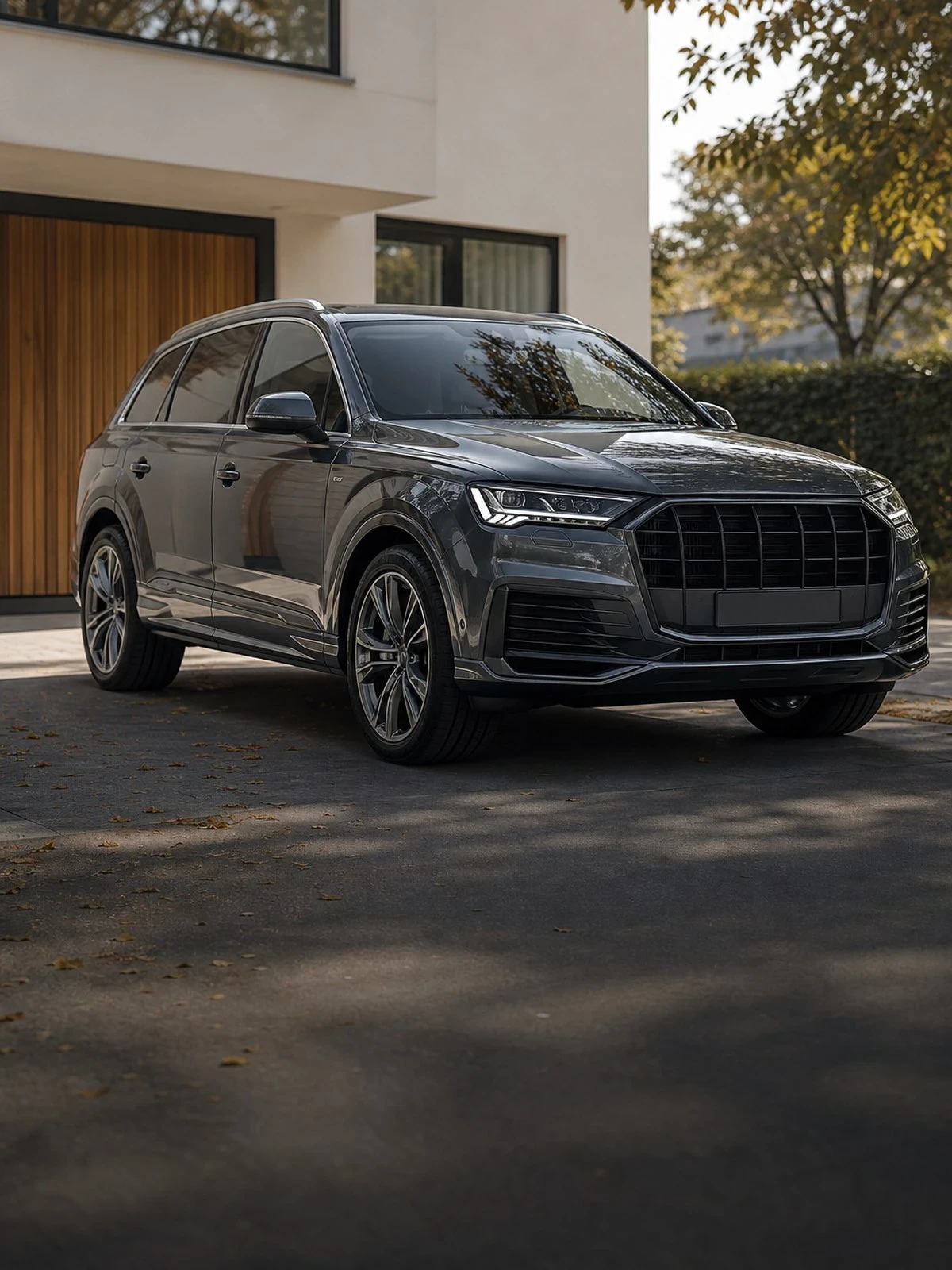
There are usually more people in a Q7 than in any other model in the range, and that shifts the conversation from bodywork to injury to the occupants.
This page in another language: Nederlands
Work out for yourself what it would cost.
Enter your details; you will receive a proposal within one working day.
A premium indication, not personal advice. Prefer to talk it through? Call 072 - 509 24 56.
The Q7 is the large family and people-carrying car of the line: seven seats, often fully occupied on holiday journeys and on the run to sport or school. Where the smaller models are about dents and bumpers, here it is about who was in the car and who pays for their loss. That is precisely the point where standard third-party cover leaves a gap.
The compulsory third-party liability cover under Article 2 of the Dutch Motor Insurance Liability Act (WAM) pays for the damage you cause to others. Passengers in your own car count as third parties in this: their injuries are covered where you are liable under Article 6:162 DCC. The the driver is not. If you cause a single-vehicle accident and are injured, your own third-party insurance pays nothing for your injury, your loss of income or your rehabilitation.
You fill that gap with occupants' indemnity insurance or occupants' personal accident insurance. The first pays the loss actually suffered by all occupants including the driver, regardless of fault. The second pays a fixed sum on death or permanent disability. On a car with this number of seats, the choice between those two matters more than the choice between the types of own-damage cover.
We compare your car insurance across dozens of insurers, explain where the real differences lie, and arrange the switch from start to finish — without you having to chase it yourself.
 Car insurance
 Compare
 Get covered
The structure of the cover in three parts, with an overview per situation below.
Damage you cause to others.
Causes beyond your control.
Including damage you cause yourself.
What is covered
| Situation | Third-party liability | Third-party, fire and theft | Comprehensive |
|---|---|---|---|
| Damage to the other party | Yes | Yes | Yes |
| Theft | No | Yes | Yes |
| Fire and storm | No | Yes | Yes |
| Damage you cause yourself | No | No | Yes |
| Wear and mechanical defects | No | No | No |
| Driving without a valid licence | No | No | No |
This overview is general in nature and is not personal advice. What is actually covered, including exclusions, limits and the excess, is set out in the policy conditions and the insurance card (verzekeringskaart) of the insurer; you receive both before you take out cover. Taking out cover without advice? Then read what execution only means for you.
Insurers weigh these details differently. That is where your saving is.
We look at the terms as well as the premium, and stay your point of contact when there is a claim.
We are not tied to one insurer and compare on the basis of an objective analysis of several companies.
You call or email someone who knows your file. No menu options, no changing call centres.
We cancel your old policy and align the start date, so you are never a day without cover.
We report the claim and monitor how it is handled. In urgent cases you can reach us on the emergency line.
Customers rate our service on four aspects: personal service, service delivery, availability and the outcome. The reviews are collected and published by NH1816 and come from customers who have actually taken out a policy with Finass Advies B.V. or reported a claim.
Four points that make the difference between a policy that pays out and one that does not.
Your third-party insurance pays for other people's losses, not your own. In a single-vehicle accident, for example against a tree or a crash barrier, you are left with your own injury losses unless you have additional cover. An occupants' accident insurance then pays on the basis of the loss actually suffered, even where the accident was your own fault. Check that this cover extends to the full number of seats and not just some of them.
Occupants' cover is taken out for the number of seats permitted under the registration document. If you carry more people than there are belts, you are acting unlawfully and the insurer can refuse to pay for that extra occupant. The same applies to the third row of seats: use only the belts provided for it and place children in an approved seat in a position where that is allowed.
An injury file runs for years and starts with the notification. Article 7:941 DCC requires you to report the event as soon as possible; do not wait until the medical position is clear. Record the circumstances straight away with a fully completed accident statement, photographs and witnesses' details. Also record who was sitting where: in a file with several injured people, the seating position is decisive in assessing the injuries.
Not covered are occupants carried without a belt or outside a seat, injury during paid passenger transport or taxi services, and injury while taking part in speed events or track use. Passengers' luggage is not covered by the car's own-damage cover either. Intent and wilful recklessness on the part of the insured fall under Article 7:952 DCC, and driving under the influence leads to the amounts paid being recovered from the driver.
This is what people ask us most.
Yes, passengers count as third parties. If you are liable for the accident under Article 6:162 of the Dutch Civil Code, your third-party insurance pays for their injury and property damage. The driver is the exception: that loss falls outside their own third-party cover. For that you need occupants' indemnity or personal accident insurance, which you have added to the policy separately.
Occupants' indemnity insurance pays the loss actually suffered by all occupants including the driver: injury, loss of income, the cost of care. Occupants' personal accident insurance pays a sum agreed in advance, only on death or permanent disability, without looking at the actual loss. The first suits a car in which several people regularly travel.
Only to the number of seats shown on the registration document and for which belts are fitted. If there are more people in the car than permitted, the insurer can refuse to pay for those occupants. When applying, check that the cover is taken out for the full number of seats and does not stay at five by default.
Yes. Article 7:941 of the Dutch Civil Code requires notification as soon as possible, and symptoms after a collision sometimes only appear days later. An early notification with a fully completed accident statement, photographs and witnesses' details keeps the file open. If you only report it months later, the insurer can argue that its ability to investigate has been harmed.
Every situation is different. For these situations we have a separate page.
Request a quote without obligation. We will look at which insurer best matches your activities and your risk.
Prefer to call? 072 - 509 24 56, weekdays 09:00–17:00.
Claim on the road? Emergency line 06 - 55 20 40 72.
Finass Verzekert is a trading name of Finass Advies B.V. We advise on and arrange non-life insurance on the basis of an objective analysis of several insurers, and receive commission for this from the insurer, which is included in the premium. You pay no separate advice fee. Before you take out cover, we establish your wishes and needs.
You will find our licence, KvK and Kifid details and our complaints procedure at the foot of every page.
This page was compiled by Finass Verzekert (LinkedIn). Last updated on .
The information on this page is general in nature and is not personal advice.
Maandag- Vrijdag: 09:00- 17:00
We use cookies and similar technologies to improve your experience on our website.