

Liability
- Cables and pipes
- Damage to buildings
- Injury to bystanders
A tracked excavator does not drive itself to the job and often stands on ground that has just been disturbed. The transport there and the ground beneath it are therefore the two risks that count.
This page in another language: Nederlands
The calculator and the quote form below are in Dutch. Prefer to do this in English? Email info@finassverzekert.nl or call 072 - 509 24 56 and we will take it from there.
Work out for yourself what it would cost.
Enter your details; you will receive a proposal within one working day.
A premium indication, not personal advice. Prefer to talk it through? Call 072 - 509 24 56.
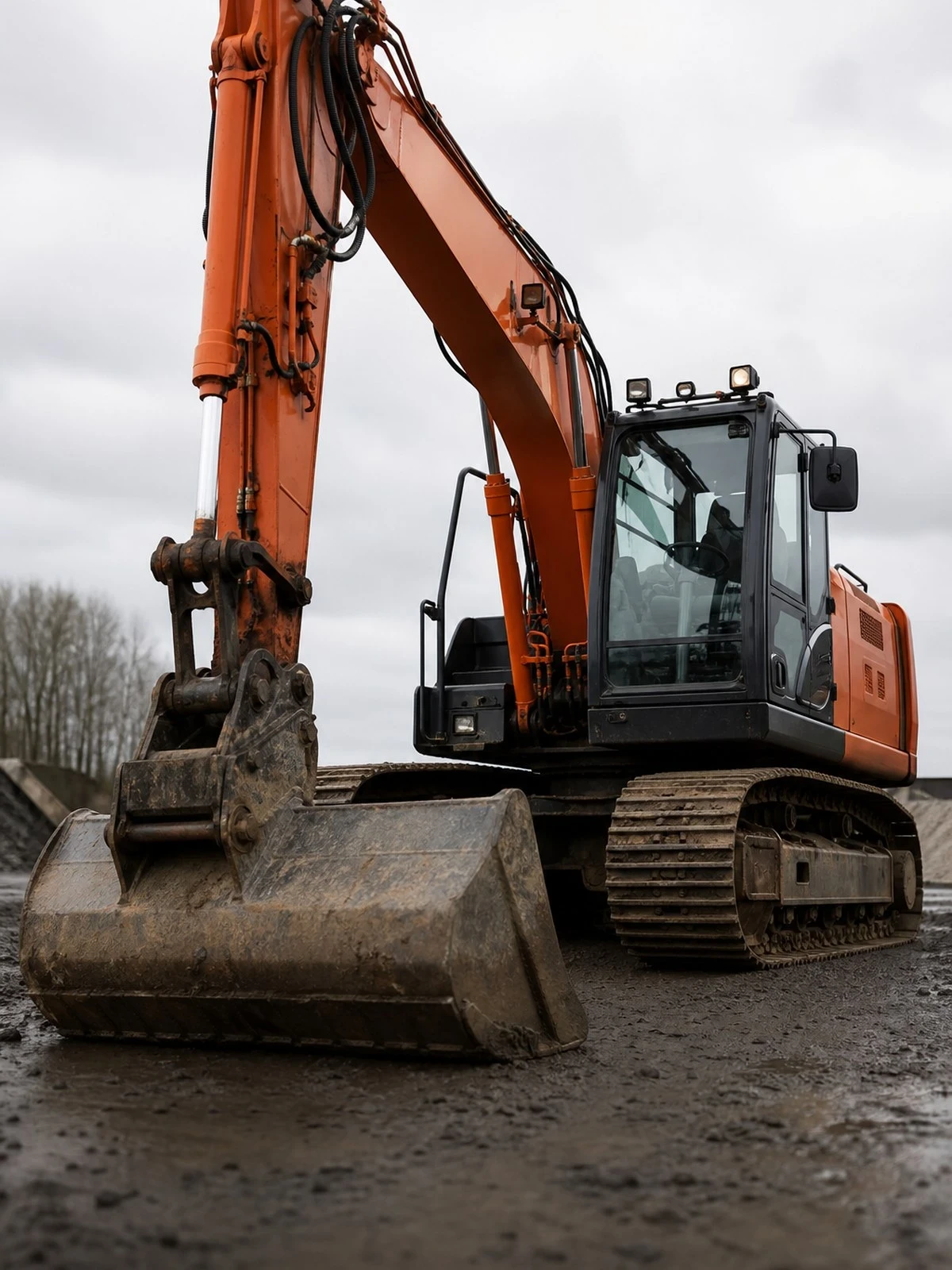
Hitachi mainly builds tracked excavators in the medium and heavy segment. Machines like these do not travel on the road but go on a low-loader. Every move is a loading, transport and unloading operation, and that is a cause of loss in its own right: driving off the trailer, a viaduct with too little headroom, shifting during transport. Check whether your policy includes damage during loading, unloading and transport, and whether that also applies when a haulier drives it.
The second point lies under the tracks. These machines work on embankments, alongside bank revetments, on freshly backfilled ground and next to excavations. Sinking, tipping over or sliding into the water are real scenarios, and with a heavy machine the recovery costs can run to an amount of the same order as the repair. Check whether recovery and clearance are insured separately or come out of the sum insured.
And the undercarriage itself: track pads, chains, idlers and rollers are wearing parts. No own-damage cover pays for these when they are worn out through normal use.
We compare your plant and machinery insurance across dozens of insurers, explain where the real differences lie, and arrange the switch from start to finish — without you having to chase it yourself.
 Plant and machinery insurance
 Compare
 Get covered
The structure of the cover in three parts, with an overview per situation below.
Damage you cause to others with the machine.
Damage to and theft of the machine, including inherent defect.
What comes into play with breakdown and transport.
What is covered
| Situation | Covered |
|---|---|
| Theft from the building site | Sometimes |
| Fire and storm damage | Yes |
| Inherent defect in the hydraulics | Sometimes |
| Damage to cables and pipes | Sometimes |
| Normal wear and tracks | No |
| Damage due to deferred maintenance | No |
This overview is general in nature and is not personal advice. What is actually covered, including exclusions, limits and the excess, is set out in the policy conditions and the insurance card (verzekeringskaart) of the insurer; you receive both before you take out cover. Taking out cover without advice? Then read what execution only means for you.
Insurers weigh these details differently. That is where your saving is.
We look at the terms as well as the premium, and stay your point of contact when there is a claim.
We are not tied to one insurer and compare on the basis of an objective analysis of several companies.
You call or email someone who knows your file. No menu options, no changing call centres.
We cancel your old policy and align the start date, so you are never a day without cover.
We report the claim and monitor how it is handled. In urgent cases you can reach us on the emergency line.
Customers rate our service on four aspects: personal service, service delivery, availability and the outcome. The reviews are collected and published by NH1816 and come from customers who have actually taken out a policy with Finass Advies B.V. or reported a claim.
Four points that make the difference between a policy that pays out and one that does not.
With tracked plant, a considerable share of the damage happens away from the job: driving onto the trailer, insufficient lashing, or unloading on a slope. Policies apply different regimes here. Some cover transport only when it is carried out by or on behalf of you with your own equipment, others also when a haulier is engaged. Have it recorded which applies. Damage caused by incorrect loading or inadequate securing is separately excluded in many sets of conditions.
If you subcontract the transport and something goes wrong, alongside your own-damage claim there is the question of who bears it. The haulier usually has its own conditions with limited liability. If you engage that haulier for the purposes of your own business, you can be held liable yourself under Article 6:171 DCC for damage it causes to third parties on the way. Agree in advance who bears which part, rather than working it out afterwards.
A machine that slides down an embankment or tips into an excavation has to be recovered with heavy equipment. Those recovery costs are not automatically insured, or they come out of the sum insured you need for the repair. Ask about a separate provision for recovery, clearance and environmental damage. Oil or hydraulic fluid leaking into the ground or into surface water brings a clean-up obligation that is separate from the damage to the machine.
Track pads, chains, rollers and sprockets are wearing parts and fall outside any own-damage cover when they wear out through use. If they break as a result of an insured event the position is different, but the burden of proof lies with you. If the machine works with a non-standard boom or special equipment, such as a long boom, a demolition boom or a magnet installation, declare it explicitly. Undeclared equipment is not an insured object and it also changes the stability profile.
Hydraulics are the most common source of damage; check whether inherent defect is included.
Not every company applies the same policy for this make. With unusual versions, the question is not what it costs but who will accept it.
This is what people ask us most.
Only if the policy includes transport. Some conditions cover transport with your own equipment but not transport by a haulier you engage, or the other way round. Have it recorded explicitly which regime applies to you. Damage arising because the machine was insufficiently secured or incorrectly loaded is also separately excluded in many policies.
The haulier usually works with conditions that limit its liability, so recovery is rarely complete. Also, you can be held liable yourself for damage it causes to third parties while working for your business, under Article 6:171 DCC. Make written arrangements in advance about who bears which part of this risk.
Not automatically. In some policies recovery and clearance come out of the sum insured for the machine, leaving less for the repair itself. Ask about a separate provision, certainly with heavy plant. Bear in mind that leaked oil brings a clean-up obligation that is separate from the damage to the machine.
Not when they wear out through normal use. Track pads, chains, rollers and sprockets are wearing parts and therefore fall outside the own-damage cover, just like tyres on wheeled plant. If the undercarriage is damaged by an insured event, for example in a tip-over or a fire, the position is different, but you do have to be able to substantiate that cause.
Every situation is different. For these situations we have a separate page.
Request a quote without obligation. We will look at which insurer best matches your activities and your risk.
Prefer to call? 072 - 509 24 56, weekdays 09:00–17:00.
Claim on the road? Emergency line 06 - 55 20 40 72.
Finass Verzekert is a trading name of Finass Advies B.V. We advise on and arrange non-life insurance on the basis of an objective analysis of several insurers, and receive commission for this from the insurer, which is included in the premium. You pay no separate advice fee. Before you take out cover, we establish your wishes and needs.
You will find our licence, KvK and Kifid details and our complaints procedure at the foot of every page.
This page was compiled by Finass Verzekert. Last updated on .
The information on this page is general in nature and is not personal advice.
Maandag- Vrijdag: 09:00- 17:00
We use cookies and similar technologies to improve your experience on our website.