

Extended Cover
- Fire, smoke and lightning strike
- Storm from force 7 upwards
- Water damage and leakage
- Burglary damage
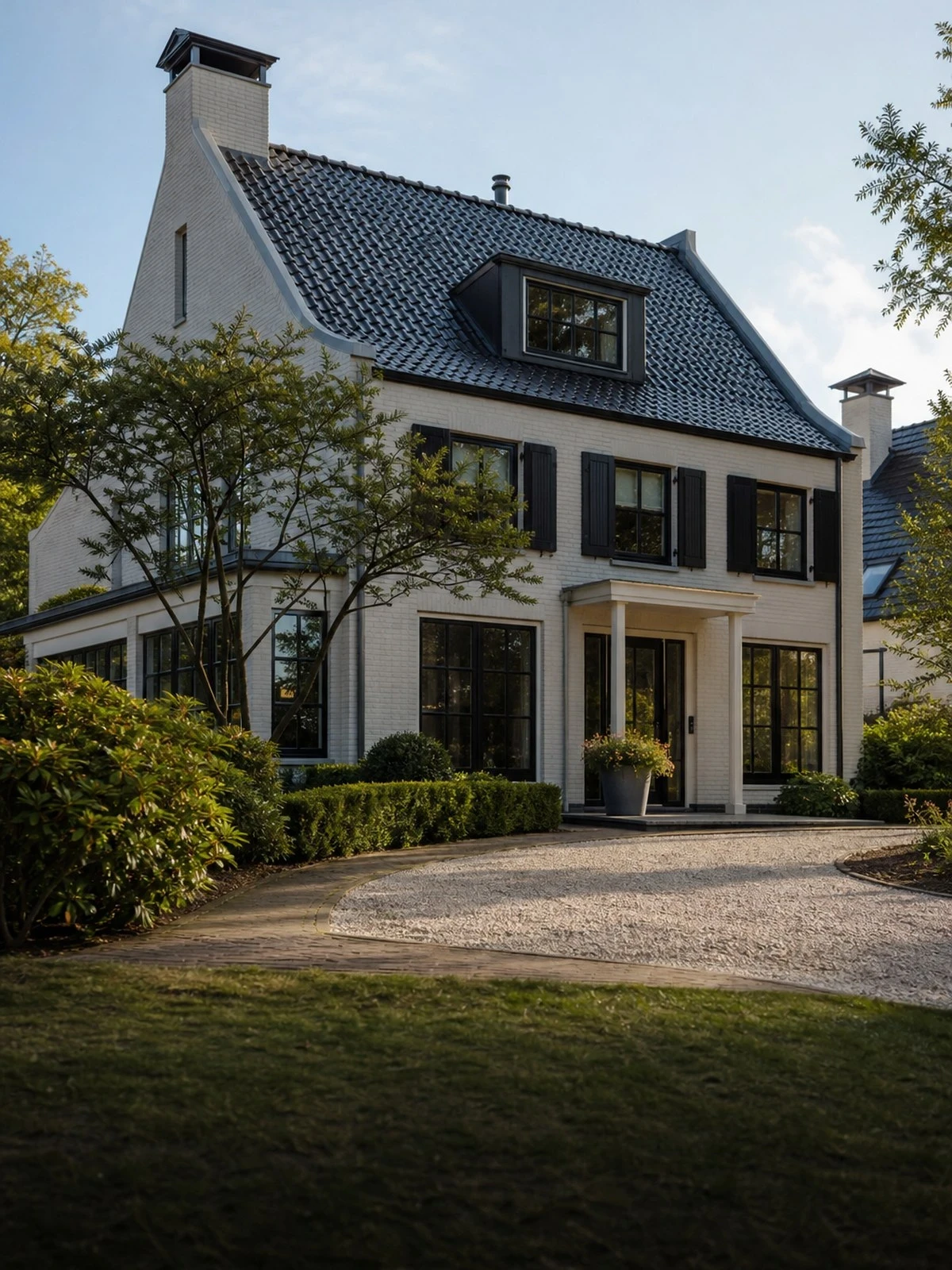
With a villa the problem is not the size but the level of finish: a calculation model based on cubic meters does not know your materials.
This page in another language: Dutch
Work out for yourself what it would cost.
Enter your details; you will receive a proposal within one working day.
A premium indication, not Personal advice. Prefer to talk it through? Call 072 - 509 24 56.
A villa is hard to capture in a rebuild value tool. Such a tool works with an average price per cubic meter for a house with standard brickwork, standard window frames and a standard installation. With a villa the value lies precisely in what departs from that: natural stone, exposed plasterwork, made-to-measure window frames, built-in building services and home automation. Rebuilding means having those elements made again, and that is exactly the cost the model does not see.
For this type of property you therefore work with a an agreed value valuation by an expert under Article 7:960 of the Dutch Civil Code. The value established is then fixed between you and the insurer and the proportionality rule for underinsurance No longer applies, as long as the report is valid. Without a valuation you depend on the guarantee against underinsurance, and that lapses as soon as it turns out that you completed the tool incompletely or incorrectly.
What a valuation does not solve is the rest of the plot: the swimming pool, pool house, landscaping, fencing and paving fall under their own sub-limits or outside the Cover altogether. If your main concern is the form of construction and the plot, read Buildings insurance for a detached house. If the property has protected status, different rules on repairs apply; see Buildings insurance for a listed building.
We compare your Buildings insurance across dozens of insurers, explain where the real differences lie, and arrange the switch from start to finish — without you having to chase it yourself.
 buildings insurance
 Compare
 Get covered
The structure of the cover in three parts, with an overview per Situation below.
The named perils: fire, storm, water, burglary and collision.
All sudden and unexpected damage from outside, unless excluded.
Rebuild value with a guarantee against underinsurance, or a valuation.
What is covered
| Situation | Extended | Comprehensive |
|---|---|---|
| Fire, smoke and lightning damage | Yes | Yes |
| Storm damage from force 7 upwards | Yes | Yes |
| Water damage from a burst pipe | Yes | Yes |
| Burglary damage to doors and frames | Yes | Yes |
| Drilling through a pipe while doing DIY | No | Yes |
| Subsidence, pile rot and deferred maintenance | No | No |
This overview is general in nature and is not personal advice. What is actually covered, including exclusions, limits and the excess, is set out in the policy conditions and the Insurance card (insurance card) of the insurer; you receive both before you take out Cover. Taking out Cover without advice? Then read what Execution only means for you.
Insurers weigh these details differently. That's where your saving is.
We look at the terms as well as the premium, and stay your point of Contact when there is a claim.
We are not tied to one insurer and Compare on the basis of an objective analysis of several companies.
You call or email someone who knows your file. No menu options, no changing call centers.
We cancel your old policy and align the start date, so you are never a day without Cover.
We report the claim and monitor how it is handled. In urgent cases you can reach us on the emergency line.
Customers rate our service on four aspects: personal service, service delivery, availability and the outcome. The reviews are collected and published by NH1816 and come from customers who have actually taken out a policy with Finass Advies BV or reported a claim.
Four points that make the difference between a policy that pays out and one that does not.
An agreed valuation under Article 7:960 of the Dutch Civil Code binds both parties to the assessed amount. Disputes about underinsurance therefore fall away, but the rest of the policy continues to apply in full: the report says nothing about whether the cause is covered. Settlement, pile rot, poor maintenance and slow-acting vapor remain excluded, however recent the valuation. Also watch the period of validity; it is stated on your policy schedule and it expires.
Two properties of the same volume differ widely in rebuilding costs as soon as one has a standard finish and the other has natural stone, resin floors and made-to-measure window frames. The repair time differs too: made-to-measure glass, curved frames or a particular type of brick have lead times, and that time runs on in the cost of alternative accommodation. Have the valuer name those elements separately rather than writing them off under a general heading for finishing.
Site features do not automatically belong to the insured building. A swimming pool with filtration and heating, a pool house, garden walls, fencing with access control and the paving of the drive fall under a sub-limit in many policies or outside the Cover. Planting and trees are almost always excluded, even where they are lost in a fire or storm. Declare each element with a value of its own and then check that it appears word for word on the policy schedule.
For high sums insured, insurers include a clause on certified locks and fittings and often on an alarm system monitored by an alarm receiving center. If that provision is missing or the alarm was switched off, damage from burglary will not be paid or only in part. Theft without signs of forced entry is excluded in any case. Answer the questions about security on the application in full: incorrect information falls under Articles 7:928 and 7:930 of the Dutch Civil Code.
For higher sums insured, insurers require certified locks and fittings and often an alarm connected to an alarm receiving center.
If you fill in the insurer's Rebuild value calculator correctly, you will usually receive a guarantee against underinsurance: in the event of a claim the actual amount is paid, even if the sum insured turns out to be too low. Your policy schedule states whether you have that guarantee. Without it, the proportionality rule applies, and that also affects small claims.
This is what people ask us most.
A tool works with average building costs per cubic meter for a house with a standard finish. Everything that is different about a villa, such as natural stone, made-to-measure frames and built-in building services, is not in that average. As a result you end up structurally too low and lose the difference when you claim, unless you have the value fixed with a valuation report.
The binding effect of the assessed value then lapses and, when you claim, the insurer assesses again whether the sum insured is adequate. If it turns out to be too low, payment is made proportionally and that affects small claims as well. Put the expiry date of the report in your diary and have a new valuation carried out in good time.
Not automatically. under most policies these elements fall under a separate maximum or outside the cover, and planting is usually excluded altogether. Declare the pool plant, outbuildings, fencing and paving with a value of their own on the application and then check on the policy schedule that they have actually been included.
As a rule, certified locks and fittings on all accessible openings in the facade and, above a certain sum assured, an alarm system monitored by an alarm receiving center. That appears as a clause on the policy. If you do not comply, the insurer can refuse or reduce a burglary claim; the exact requirement is set out in your policy conditions.
Every Situation is different. For these situations we have a separate page.
Request a Quote without obligation. We will look at which insurer best matches your activities and your risk.
Prefer to call? 072 - 509 24 56, weekdays 09:00–17:00.
Claim on the road? Emergency line 06 - 55 20 40 72.
Finass Verzekert is a trading name of Finass Advies BV We advise on and arrange non-life insurance on the basis of an objective analysis of several insurers, and receive commission for this from the insurer, which is included in the premium. You pay no separate advice fee. Before you take out cover, we establish your wishes and needs.
You will find our license, Chamber of Commerce and Kifid details and our complaints procedure at the foot of every page.
This page was compiled by Finass Insures (LinkedIn). Last updated on .
The information on this page is general in nature and is not Personal advice.
Monday-Friday: 09:00-17:00
We use cookies and similar technologies to improve your experience on our website.