

Insuring a lorry
Above 3,500 kilograms, ordinary motor insurance stops. From that weight you need a separate product with its own acceptance policy.
- Several insurers compared objectively
- 9.5 customer rating for a new policy
- AFM licence 12016589
- Personal 072 - 509 24 56, weekdays 9–17
This page in another language: Nederlands
The calculator and the quote form below are in Dutch. Prefer to do this in English? Email info@finassverzekert.nl or call 072 - 509 24 56 and we will take it from there.
Work out for yourself what it would cost.
Enter your details; you will receive a proposal within one working day.
- We compare the offerings of several insurers
- An adviser checks whether the cover suits your situation
- We arrange the switch, including cancellation
A premium indication, not personal advice. Prefer to talk it through? Call 072 - 509 24 56.
- Independent advice
- Several insurers
- Switching arranged
- Help with claims
In brief
Truck insurance is intended for vehicles with a maximum authorised mass above 3,500 kilograms: categories N2 up to 12 tonnes and N3 above that. Below that, your vehicle simply falls under the van insurance. That boundary is not a detail, because it determines not only the policy but also the licence: from 3,500 kilograms you need at least a C1 licence and above 7,500 kilograms a category C licence. If you drive without the correct category, own damage is not covered.
The obligation itself follows from Article 2 of the Dutch Motor Insurance Liability Act (WAM): every registered motor vehicle must be insured against liability, however little it is driven. That also applies to a trailer or semi-trailer with its own registration number. If you want to stop paying for a period, suspend the registration with the RDW is the only correct route. The vehicle may then not be parked on the public road.
Insurers then look at the use, and that weighs more heavily than the vehicle. Commercial carriage of goods for third parties, own-account transport for a business, a hobby truck taken to shows and a rigid lorry converted into a motorhome are four different risks with four different rates. For commercial use see business truck insurance; for private ownership, the options for private individuals and the overview of the types of truck insurance.
This page deals with one situation. The full overview is on Compare van insurance.
Independent, personal, sorted quickly
We compare your truck insurance across dozens of insurers, explain where the real differences lie, and arrange the switch from start to finish — without you having to chase it yourself.
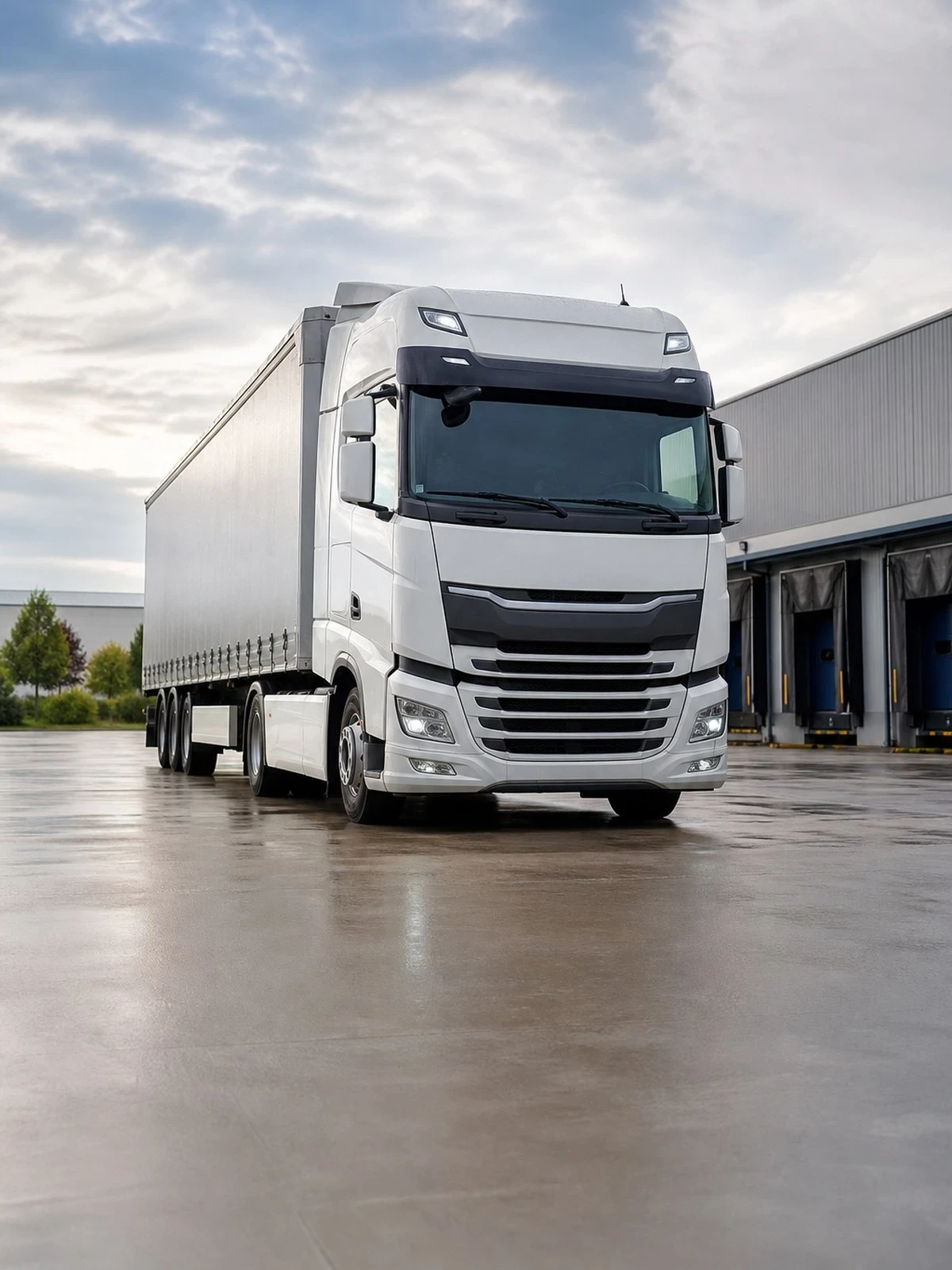 Truck insurance
 Compare
 Get covered
Why arrange it through Finass Verzekert?
We look at the terms as well as the premium, and stay your point of contact when there is a claim.
Independent
We are not tied to one insurer and compare on the basis of an objective analysis of several companies.
One fixed adviser
You call or email someone who knows your file. No menu options, no changing call centres.
Switching without hassle
We cancel your old policy and align the start date, so you are never a day without cover.
Help with claims
We report the claim and monitor how it is handled. In urgent cases you can reach us on the emergency line.
What to look out for
Four questions that determine which product and which company suit you.
Motor vehicle or machine
A vehicle that mainly works and barely drives — a concrete pump, a suction lorry, a mobile crane — is treated differently from a truck that carries goods. Damage arising while the vehicle is operating as a machine falls outside the WAM cover and belongs on the plant and machinery insurance. Establish that classification before you sign, not afterwards.
What you carry is not insured
The policy covers the vehicle, not the contents. You insure your own goods on the own goods in transit insurance, someone else's goods on the goods in transit insurance. If you carry for payment, you are also a carrier and the liability rules of CMR or the AVC conditions apply, with their own limits and time bars.
Age of the vehicle
Many companies no longer offer comprehensive cover above a certain age, or only on a market value basis. With a fifteen-year-old truck with a reconditioned engine, that is a real problem. A valuation report helps, but Article 7:960 of the Dutch Civil Code remains the upper limit: you never receive more than the loss actually suffered.
Wear and deferred maintenance
Engine damage, a defective gearbox, rust and worn brakes are maintenance items and are excluded on every policy. The same applies to damage arising because the vehicle had no valid roadworthiness certificate or was not technically sound. Keep maintenance invoices. After a large own-damage claim the loss adjuster will ask for them.
What does your premium depend on?
- Maximum permitted mass: the boundary between N2 and N3 changes the rate
- Purpose of use: carriage for hire and reward, own-account transport, hobby use or a living vehicle
- Year of manufacture and list price: determine whether own-damage cover is still offered
- Driver's licence and experience: the number of years holding C1 or C
- Number of kilometres per year: with limited use, separate rates are possible
- Trailer or semi-trailer: its own registration number and therefore its own cover
Insurers weigh these details differently. That is where your saving is.
What is covered
| Situation | Third-party liability | Comprehensive |
|---|---|---|
| Your rigid lorry hits a low viaduct and the body is torn open | No | Yes |
| Damage to your own cab after a collision, while the driver only held a category B licence | No | No |
| Theft of the catalytic converter and the batteries from the parked truck | No | Yes |
| The truck burns down in the shed while the registration is suspended at the RDW | No | Provided that |
| Your unregistered trailer rolls away uncoupled into a van | Provided that | No |
| While tipping you break up a customer's brick paving | Yes | Yes |
When suspending the registration, expressly ask for storage cover. Without that agreement nothing continues during the suspension.
Reviewed by the advisory team of Finass Verzekert · LinkedIn
Finass Advies B.V. · AFM licence 12016589 · Chamber of Commerce 37131781
AFM licence for: Adviseren en bemiddelen in schadeverzekeringen particulier, Adviseren en bemiddelen in schadeverzekeringen zakelijk
Last reviewed on
This page was written and reviewed by advisers of a firm licensed by the AFM (Wft). Advice and policies are always handled by an adviser, never automatically.
Frequently asked questions
This is what people ask us most.
From what weight do I need truck insurance?
From a maximum authorised mass of more than 3,500 kilograms. Below that, the vehicle is a van as far as the insurer is concerned, even if it looks like a small lorry. What is decisive is what appears on the registration certificate, not the appearance or the unladen weight. If in doubt, look at the vehicle classification on part I of the registration certificate.
Must a semi-trailer be insured separately?
Yes, a semi-trailer or trailer with its own registration number falls independently under the insurance requirement of Article 2 of the WAM. As long as the combination is coupled, liability is carried by the towing vehicle, but an uncoupled semi-trailer that causes damage falls outside it. Own-damage cover for the semi-trailer is always a separate consideration.
Can I insure a lorry in my own name?
You can, but the number of companies that accept a lorry in the name of a private individual is limited. They usually require that no carriage for payment takes place at all, that the mileage stays low and that the vehicle is stored securely. We know which companies still write this category.
What if I do not use the vehicle for part of the year?
Suspend the registration at the RDW (the Dutch vehicle authority). The insurance requirement then lapses for that period, and so does road tax. During the suspension the vehicle may not be parked or driven on the public road. Many companies allow limited own-damage cover against fire and theft to continue while it is in storage; ask about this explicitly.
Every situation is different. For these situations we have a separate page.
- What does lorry insurance for private individuals cover?Forms of cover, recovery, exclusions
- Private lorry insurance: what are your options?Private use, forms of cover, suspend or keep insured
- Insuring a lorry privatelyHobby use, category C licence, limited mileage
- How do you insure a hobby lorry?Hobby use, valuation, category C licence
- Insuring a hobby lorryHobby use, valued amount, limited mileage
- Insuring a lorry for private useRegistered privately, the line with business use, use clause
- Insuring a lorry in driving licence category CC1 and C licences, above 3,500 kg, cover and recovery
- Insuring a lorry in your own nameAcceptance, no carriage for payment, mileage limit
- Lorry insurance through De GoudseTractor unit and semi-trailer, load, body