

Third-party liability
- Required by law
- As long as the registration is in your name
- Suspend the registration when not in use
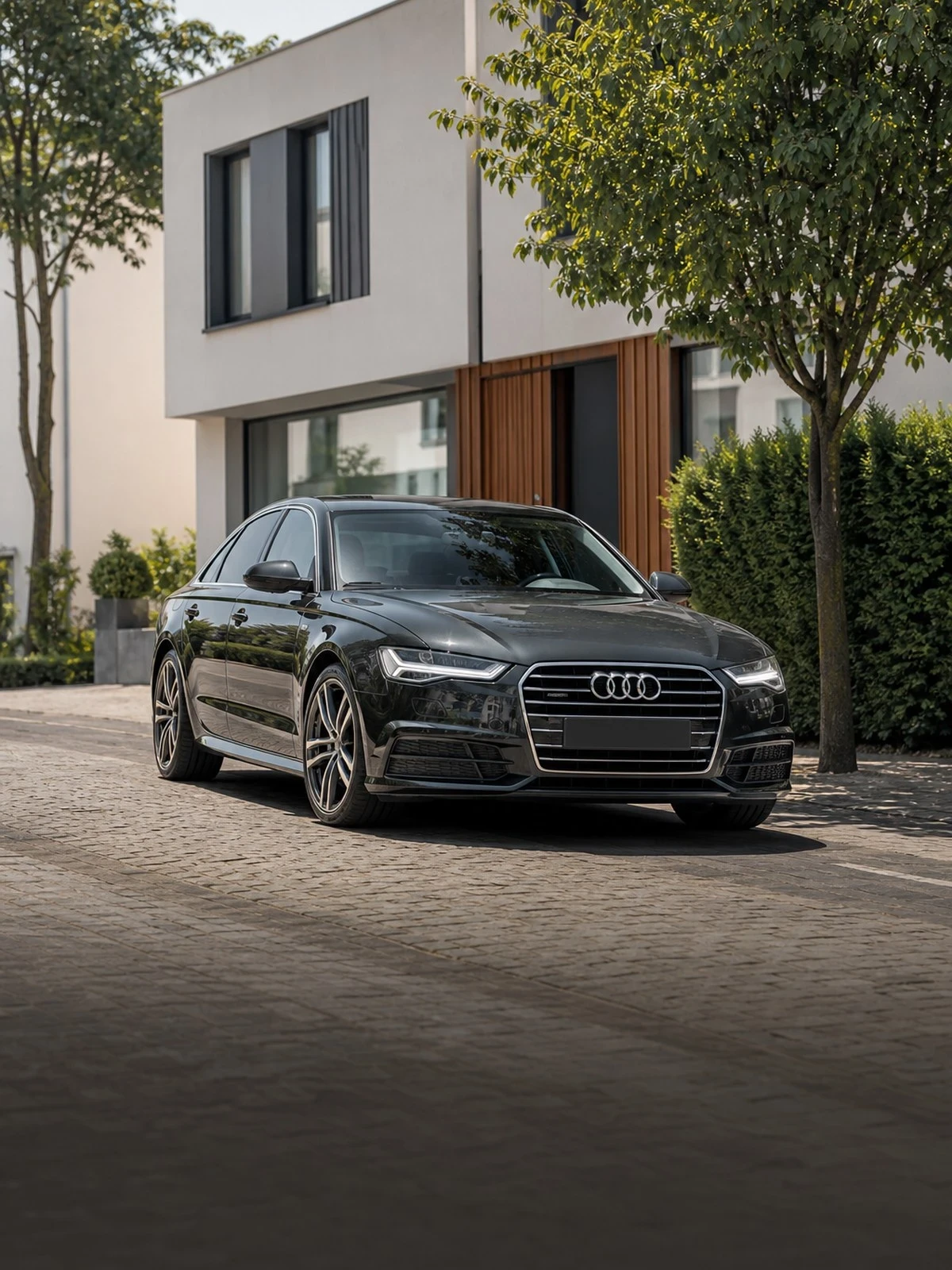
The A6 is the executive class of the range: many examples spend their first years as lease cars and then come onto the private used market, with all the questions about value that brings.
This page in another language: Nederlands
Work out for yourself what it would cost.
Enter your details; you will receive a proposal within one working day.
A premium indication, not personal advice. Prefer to talk it through? Call 072 - 509 24 56.
Two things determine how you insure this car. The first is repair costs in relation to value. An A6 is full of comfort and chassis technology: adaptive damping or air suspension, extensive lighting modules and sensors in the bumpers and mirrors. A collision that looks limited therefore quickly affects several expensive components, so the car becomes an economic total loss sooner than the panel damage would suggest.
The second is the loss of value. In this class the value falls sharply in the first years, after which the car is resold as an ex-lease used car. If you buy such an example, the question is how the insurer settles a total loss: at market value, or on the basis of a purchase price rule that holds your purchase price for a set period. That rule differs widely from insurer to insurer and is the most important point of comparison on this car.
We set those two matters side by side and only then assess the type of cover. See also our explanation of comprehensive cover.
We compare your car insurance across dozens of insurers, explain where the real differences lie, and arrange the switch from start to finish — without you having to chase it yourself.
 Car insurance
 Compare
 Get covered
The structure of the cover in three parts, with an overview per situation below.
Damage you cause to others.
Causes beyond your control.
Including damage you cause yourself.
What is covered
| Situation | Third-party liability | Third-party, fire and theft | Comprehensive |
|---|---|---|---|
| Damage to the other party | Yes | Yes | Yes |
| Theft | No | Yes | Yes |
| Fire and storm | No | Yes | Yes |
| Damage you cause yourself | No | No | Yes |
| Wear and mechanical defects | No | No | No |
| Driving without a valid licence | No | No | No |
This overview is general in nature and is not personal advice. What is actually covered, including exclusions, limits and the excess, is set out in the policy conditions and the insurance card (verzekeringskaart) of the insurer; you receive both before you take out cover. Taking out cover without advice? Then read what execution only means for you.
Insurers weigh these details differently. That is where your saving is.
We look at the terms as well as the premium, and stay your point of contact when there is a claim.
We are not tied to one insurer and compare on the basis of an objective analysis of several companies.
You call or email someone who knows your file. No menu options, no changing call centres.
We cancel your old policy and align the start date, so you are never a day without cover.
We report the claim and monitor how it is handled. In urgent cases you can reach us on the emergency line.
Customers rate our service on four aspects: personal service, service delivery, availability and the outcome. The reviews are collected and published by NH1816 and come from customers who have actually taken out a policy with Finass Advies B.V. or reported a claim.
Four points that make the difference between a policy that pays out and one that does not.
In a low-speed collision it is rarely only about bodywork. The bumper contains distance sensors and radar, the mirrors hold cameras, and components of the chassis system hang from the front axle. Replacing those modules mounts up quickly, so the repairer goes above the economic threshold and the insurer declares a total loss. So ask in advance how your insurer determines the value and whether you may put forward a counter-proposal.
On a total loss an insurer pays the market value in principle, and in this class that is often lower than what you paid shortly before. A purchase price rule applies the price you paid for an agreed period. That period and the conditions differ from policy to policy: sometimes it applies only where the car was bought from an approved dealer, sometimes only to the first owner. Have this recorded before you sign.
As the car gets older, the balance shifts. The premium for comprehensive cover stays relatively high because repair costs stay high, while the value drops away. At some point you are paying a considerable share of the residual value each year. Third-party, fire and theft then keeps fire, theft, storm and glass damage in place at a lower premium, while you bear damage you cause yourself. We work out that tipping point for you.
Mechanical and electronic defects are never covered: an air spring that fails, a faulty module or a software error come under maintenance and warranty, not under the policy. Loss of value after a proper repair is not paid for either. Beyond that the standard exclusions apply: driving without a valid licence, driving under the influence, and use as a taxi, driving school car or car-sharing vehicle where that is not shown on the policy.
This is what people ask us most.
Because repair costs rise faster than the residual value falls. Sensors, lighting modules and chassis parts that go in a collision are expensive, while the market value of a car in this class has dropped considerably after a few years. As soon as repair goes above the economic threshold, a total loss is declared and the insurer pays the market value, less the proceeds of the wreck.
That rule provides that on a total loss, for an agreed period, the insurer works from the price you paid for the car rather than the market value at the time of the loss. On a used car in this class that makes a considerable difference. The period and the conditions vary from insurer to insurer; check whether the purchase invoice and the firm you bought from meet the requirements.
No. A split air spring, a compressor that fails or a leaking valve block are mechanical defects, and those are excluded on every car policy. The insurance covers damage from an external event, not the ageing of components. If the air suspension is damaged in a collision or by an obstacle in the road, that repair is covered by own-damage cover.
Not on your own own-damage cover: that pays the repair costs, not the difference in resale value between an undamaged and a repaired car. If someone else is liable, you can claim loss of value as a head of damage from their third-party insurer, provided you support it with a valuation or report. On a car in this class that can be a considerable amount and is worth pursuing.
Every situation is different. For these situations we have a separate page.
Request a quote without obligation. We will look at which insurer best matches your activities and your risk.
Prefer to call? 072 - 509 24 56, weekdays 09:00–17:00.
Claim on the road? Emergency line 06 - 55 20 40 72.
Finass Verzekert is a trading name of Finass Advies B.V. We advise on and arrange non-life insurance on the basis of an objective analysis of several insurers, and receive commission for this from the insurer, which is included in the premium. You pay no separate advice fee. Before you take out cover, we establish your wishes and needs.
You will find our licence, KvK and Kifid details and our complaints procedure at the foot of every page.
This page was compiled by Finass Verzekert (LinkedIn). Last updated on .
The information on this page is general in nature and is not personal advice.
Maandag- Vrijdag: 09:00- 17:00
We use cookies and similar technologies to improve your experience on our website.