

Third-party liability
- Required by law
- As long as the registration is in your name
- Suspend the registration when not in use
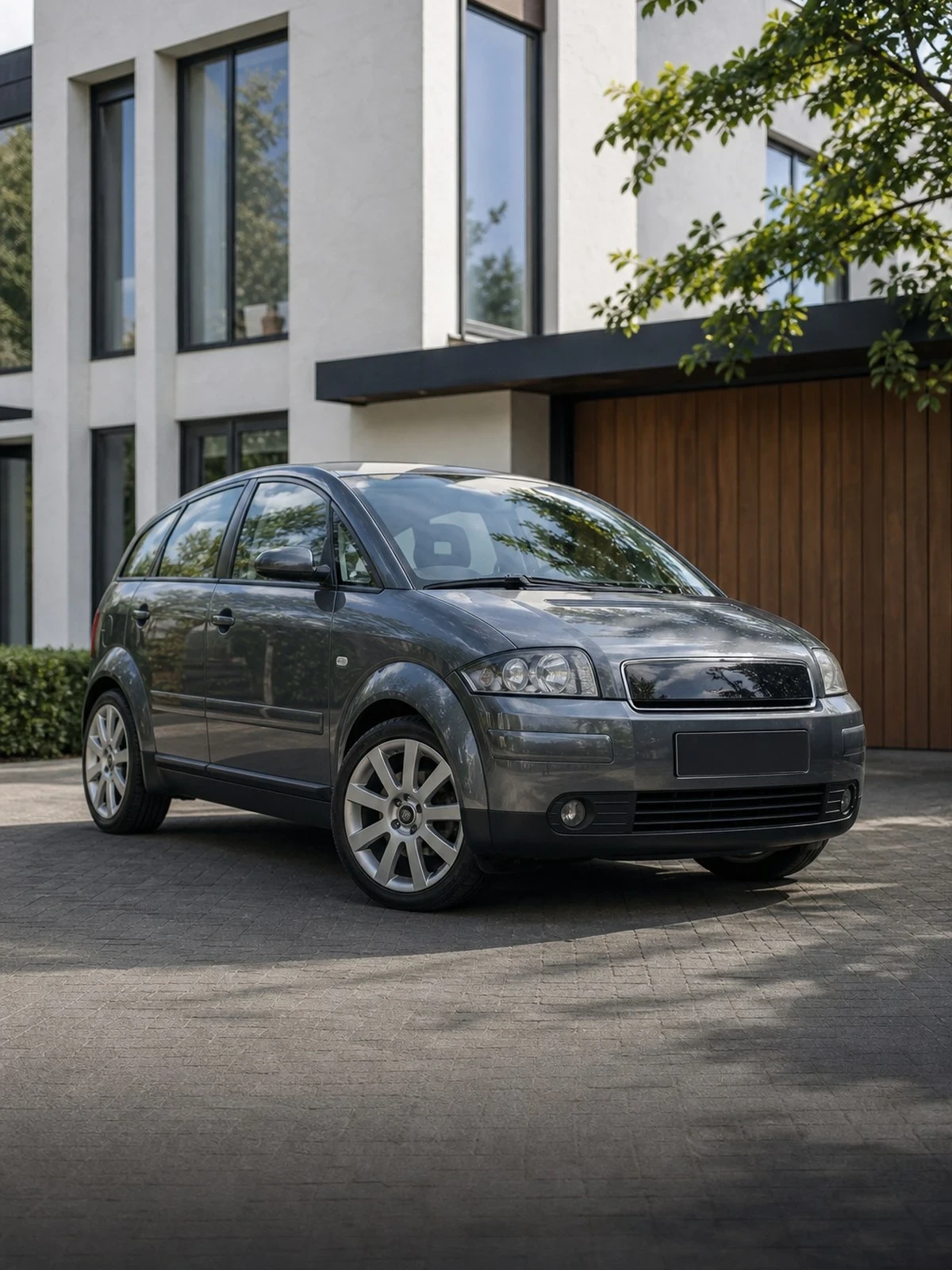
The A2 has an aluminium body and is now a youngtimer: repair costs are high while the market value is low, and that makes total loss the decisive scenario.
This page in another language: Nederlands
Work out for yourself what it would cost.
Enter your details; you will receive a proposal within one working day.
A premium indication, not personal advice. Prefer to talk it through? Call 072 - 509 24 56.
The Audi A2 was built between 1999 and 2005 on an aluminium spaceframe. That is remarkable in engineering terms and awkward in insurance terms: aluminium panels cannot be beaten out as steel can, repair calls for a bodyshop with the right equipment and separate tools, and panels are replaced more often than repaired. The repair bill for a collision that looks minor therefore comes out higher than on a steel car of the same age.
Set against that is a low market value. The combination means an insurer quickly decides on a total loss: as soon as repair exceeds a proportion of the market value stated in the conditions, the car is written off and a well-maintained example is lost. Anyone who wants to keep their A2 has to arrange that in advance, not once the loss adjuster is already there.
We therefore look at whether a a fixed agreed value makes sense, whether a youngtimer or third-party, fire and theft arrangement fits better, and which insurer accepts aluminium repairs. See also the Audi overview page and the classic car insurance for the older examples.
We compare your car insurance across dozens of insurers, explain where the real differences lie, and arrange the switch from start to finish — without you having to chase it yourself.
 Car insurance
 Compare
 Get covered
The structure of the cover in three parts, with an overview per situation below.
Damage you cause to others.
Causes beyond your control.
Including damage you cause yourself.
What is covered
| Situation | Third-party liability | Third-party, fire and theft | Comprehensive |
|---|---|---|---|
| Damage to the other party | Yes | Yes | Yes |
| Theft | No | Yes | Yes |
| Fire and storm | No | Yes | Yes |
| Damage you cause yourself | No | No | Yes |
| Wear and mechanical defects | No | No | No |
| Driving without a valid licence | No | No | No |
This overview is general in nature and is not personal advice. What is actually covered, including exclusions, limits and the excess, is set out in the policy conditions and the insurance card (verzekeringskaart) of the insurer; you receive both before you take out cover. Taking out cover without advice? Then read what execution only means for you.
Insurers weigh these details differently. That is where your saving is.
We look at the terms as well as the premium, and stay your point of contact when there is a claim.
We are not tied to one insurer and compare on the basis of an objective analysis of several companies.
You call or email someone who knows your file. No menu options, no changing call centres.
We cancel your old policy and align the start date, so you are never a day without cover.
We report the claim and monitor how it is handled. In urgent cases you can reach us on the emergency line.
Customers rate our service on four aspects: personal service, service delivery, availability and the outcome. The reviews are collected and published by NH1816 and come from customers who have actually taken out a policy with Finass Advies B.V. or reported a claim.
Four points that make the difference between a policy that pays out and one that does not.
An aluminium body may not be worked on in the same space as steel, because filings cause galvanic corrosion. Repairers need separate equipment and certification. Not every bodyshop in an insurer's network can do this. So ask in advance whether free choice of repairer is allowed, because a policy with compulsory network repair may send you to a firm that cannot carry out the work in-house.
If the repair costs exceed a proportion of the market value stated in the conditions, the insurer may decide on a total loss. On a car with high repair costs and a low market value, that threshold is soon reached. If you want to keep the car, say so as soon as you report the claim, ask for the wreck and have it recorded what salvage value is being deducted. Going back on that choice afterwards rarely works.
On a well-maintained or restored example with a complete history, an agreed valuation by a recognised valuer is the way to fix the value in advance. Article 7:960 of the Dutch Civil Code allows that as long as the valuation is valid; insurers apply a period for this. Once it expires, the market value the loss adjuster establishes applies again. Keep maintenance invoices and photographs, because they support the report.
Wear, corrosion and mechanical defects are not a sudden event and fall outside own-damage cover. A seized engine or a worn clutch is therefore not a claim. Costs that arise because a part is no longer available are not paid for on top. Loss of value after a repair is rarely paid. Undeclared modifications are not insured, and intent and recklessness fall away under Article 7:952 of the Dutch Civil Code.
This is what people ask us most.
Often not, unless the value has been fixed by a valuation. Set your annual premium plus excess against the market value. If that value falls below roughly three to four times that outlay, comprehensive cover delivers little. Third-party, fire and theft keeps the important causes in place, such as fire, storm, theft and glass damage, at a lower premium.
The body is aluminium. That material cannot be beaten out as steel can, calls for separate welding equipment and may not be worked on in the same space as steel because of galvanic corrosion. Panels are therefore replaced rather than repaired, and the number of firms able to do this work is limited. That pushes up both the hourly rate and the time it takes.
Usually yes, but you have to say so when you report the claim. The insurer then pays the agreed value less the salvage value of the wreck and your excess. Have it recorded in writing what salvage value is being applied. If the vehicle is registered as beyond repair, further requirements apply before it can go back on the road with a registration.
That depends on the build date and on the conditions the insurer sets. Such schemes usually require a limited annual mileage, storage in a locked space, a second car for everyday use and sometimes a minimum age for the driver. In return you can often work with an agreed valuation rather than the market value.
Every situation is different. For these situations we have a separate page.
Request a quote without obligation. We will look at which insurer best matches your activities and your risk.
Prefer to call? 072 - 509 24 56, weekdays 09:00–17:00.
Claim on the road? Emergency line 06 - 55 20 40 72.
Finass Verzekert is a trading name of Finass Advies B.V. We advise on and arrange non-life insurance on the basis of an objective analysis of several insurers, and receive commission for this from the insurer, which is included in the premium. You pay no separate advice fee. Before you take out cover, we establish your wishes and needs.
You will find our licence, KvK and Kifid details and our complaints procedure at the foot of every page.
This page was compiled by Finass Verzekert (LinkedIn). Last updated on .
The information on this page is general in nature and is not personal advice.
Maandag- Vrijdag: 09:00- 17:00
We use cookies and similar technologies to improve your experience on our website.