

Third-party liability
- Required by law
- As long as the registration is in your name
- Suspend the registration when not in use
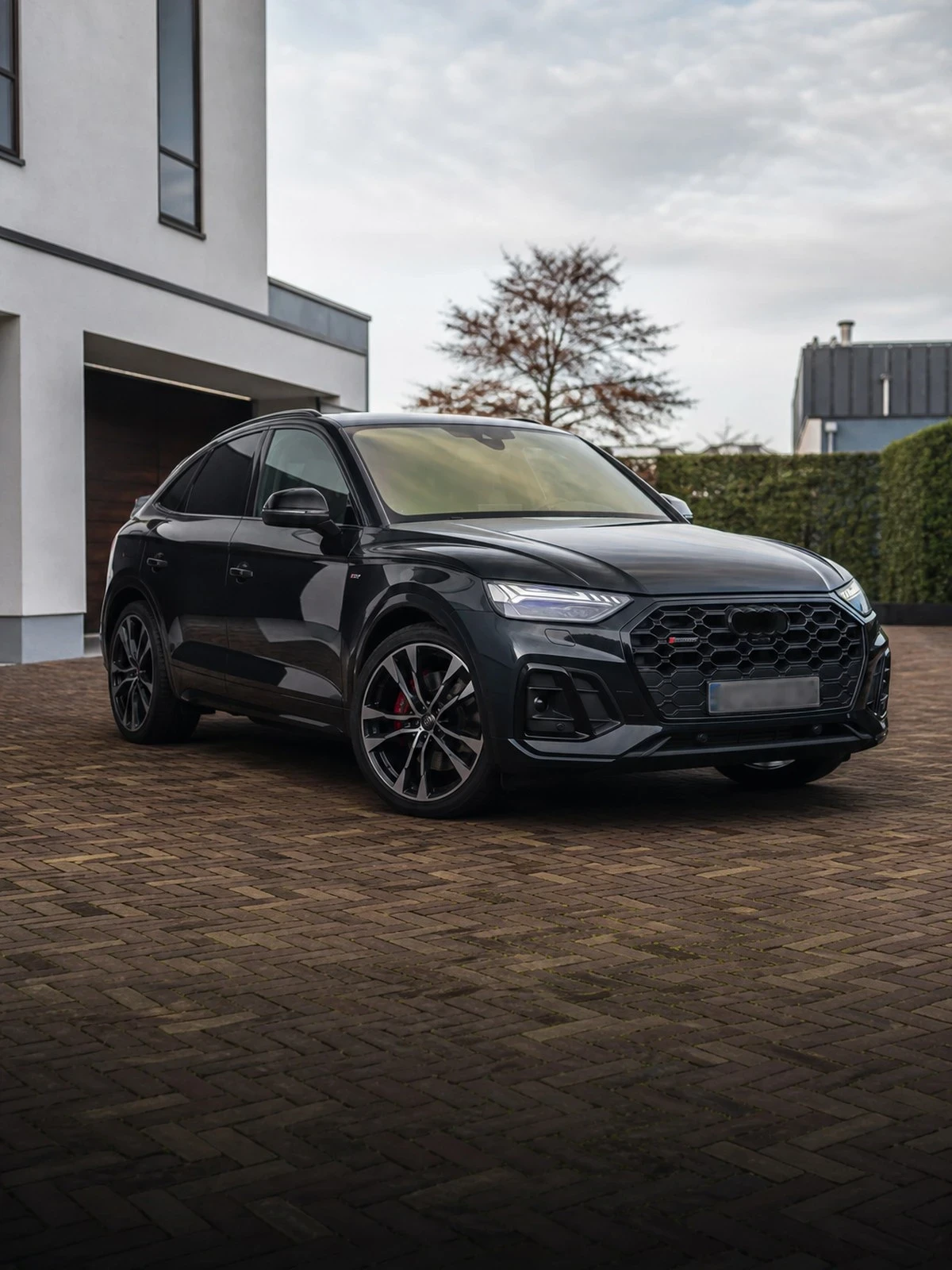
The SQ5 is the car people actually take across the border, and then what matters most is what is still arranged for you abroad.
This page in another language: Nederlands
Work out for yourself what it would cost.
Enter your details; you will receive a proposal within one working day.
A premium indication, not personal advice. Prefer to talk it through? Call 072 - 509 24 56.
The SQ5 is bought as a comfortable long-distance car: plenty of motorway mileage, holidays with a full car and business journeys through Germany, Belgium and France. For the insurance that means a different point of attention from a car that mostly stays in its own region. The heart of the matter here is not the form of cover but the question of where the cover applies and who helps you when you come to a stop far from home.
The compulsory third-party liability cover under Article 2 of the Dutch Motor Insurance Liability Act (WAM) applies in the Netherlands and, under the European arrangements, in the other countries of the European Economic Area. For countries beyond those, the green card determines where you are insured: the card lists the country codes, and a crossed-out code means no cover. Check that card before you leave, and not at the border.
Own-damage cover and assistance follow a route of their own. Comprehensive cover usually applies in the same area as the green card, but repatriation of the car and its occupants, a replacement vehicle and the advancing of repair costs sit in separate breakdown assistance cover. Without that module the insurer does not arrange the tow. For the basic structure, see comprehensive or third-party, fire and theft.
We compare your car insurance across dozens of insurers, explain where the real differences lie, and arrange the switch from start to finish — without you having to chase it yourself.
 Car insurance
 Compare
 Get covered
The structure of the cover in three parts, with an overview per situation below.
Damage you cause to others.
Causes beyond your control.
Including damage you cause yourself.
What is covered
| Situation | Third-party liability | Third-party, fire and theft | Comprehensive |
|---|---|---|---|
| Damage to the other party | Yes | Yes | Yes |
| Theft | No | Yes | Yes |
| Fire and storm | No | Yes | Yes |
| Damage you cause yourself | No | No | Yes |
| Wear and mechanical defects | No | No | No |
| Driving without a valid licence | No | No | No |
This overview is general in nature and is not personal advice. What is actually covered, including exclusions, limits and the excess, is set out in the policy conditions and the insurance card (verzekeringskaart) of the insurer; you receive both before you take out cover. Taking out cover without advice? Then read what execution only means for you.
Insurers weigh these details differently. That is where your saving is.
We look at the terms as well as the premium, and stay your point of contact when there is a claim.
We are not tied to one insurer and compare on the basis of an objective analysis of several companies.
You call or email someone who knows your file. No menu options, no changing call centres.
We cancel your old policy and align the start date, so you are never a day without cover.
We report the claim and monitor how it is handled. In urgent cases you can reach us on the emergency line.
Customers rate our service on four aspects: personal service, service delivery, availability and the outcome. The reviews are collected and published by NH1816 and come from customers who have actually taken out a policy with Finass Advies B.V. or reported a claim.
Four points that make the difference between a policy that pays out and one that does not.
The green card is the proof of your third-party cover abroad and states for each country whether the cover applies. A crossed-out country code means you are not insured there. You then have to take out temporary insurance at the border. If you drive there without it, you are uninsured and risk having the vehicle impounded. Ask for an amended card as soon as your route falls outside the standard area.
Towing, recovery, repatriation of the car, transport of the occupants home and a replacement car on the spot fall under assistance, not under own-damage cover. Choose deliberately between assistance abroad only and assistance including the Netherlands, and note the age limit that many insurers apply to breakdown assistance. Always call the emergency centre first. If you arrange a recovery firm yourself, that bill is often not paid.
Together with the other party, fill in the European Accident Statement; that form has the same structure in every country, so you can understand the boxes even if the language is not yours. Note the registration number, insurer and policy number of the other party, and take photographs of the final position of both vehicles. Article 7:941 DCC requires notification as soon as possible; call the emergency centre while you are still at the scene of the accident.
Not covered are journeys in countries whose code is crossed out on the green card, the cost of a recovery firm you engage yourself without going through the emergency centre, and maintenance, repairs or parts that are not needed to continue the journey. Losses from delay, missed bookings and accommodation costs without assistance cover also fall outside it, as does the occupants' luggage.
This is what people ask us most.
Within the European Economic Area a Dutch registration is enough as proof of insurance, but the green card remains the most practical document after a collision and is required outside that area. Check the country codes before you leave: a crossed-out code means no cover. If your route differs, ask your insurer for an amended card in good time.
That is the assistance cover, not the own-damage cover. Always call the emergency centre shown on your policy or green card first; they will engage a recovery firm and keep the costs within the agreed arrangements. If you arrange a recovery firm yourself, the bill is often not paid, or only in part. Without assistance cover all the costs are at your expense.
Only if a replacement vehicle is included in your assistance cover. The conditions determine the class of the replacement car, the maximum period and whether the arrangement also applies to a breakdown as well as to a collision. If your policy says nothing about a replacement vehicle, the emergency centre will at most arrange transport home for the occupants.
Complete the European accident statement together, note the registration number, insurer and policy number of the other party and take photographs of the final position of both cars. Then report it to your own insurer as soon as possible, as Article 7:941 of the Dutch Civil Code requires. Recovery from a foreign insurer runs through a claims representative in the Netherlands and takes more time than a domestic file.
Every situation is different. For these situations we have a separate page.
Request a quote without obligation. We will look at which insurer best matches your activities and your risk.
Prefer to call? 072 - 509 24 56, weekdays 09:00–17:00.
Claim on the road? Emergency line 06 - 55 20 40 72.
Finass Verzekert is a trading name of Finass Advies B.V. We advise on and arrange non-life insurance on the basis of an objective analysis of several insurers, and receive commission for this from the insurer, which is included in the premium. You pay no separate advice fee. Before you take out cover, we establish your wishes and needs.
You will find our licence, KvK and Kifid details and our complaints procedure at the foot of every page.
This page was compiled by Finass Verzekert (LinkedIn). Last updated on .
The information on this page is general in nature and is not personal advice.
Maandag- Vrijdag: 09:00- 17:00
We use cookies and similar technologies to improve your experience on our website.