

Liability
- Cables and pipes
- Damage to buildings
- Injury to bystanders
A skid-steer loader is small, changes attachments constantly and travels to the next job on a trailer. Those three characteristics determine where the policy leaks.
This page in another language: Nederlands
The calculator and the quote form below are in Dutch. Prefer to do this in English? Email info@finassverzekert.nl or call 072 - 509 24 56 and we will take it from there.
Work out for yourself what it would cost.
Enter your details; you will receive a proposal within one working day.
A premium indication, not personal advice. Prefer to talk it through? Call 072 - 509 24 56.
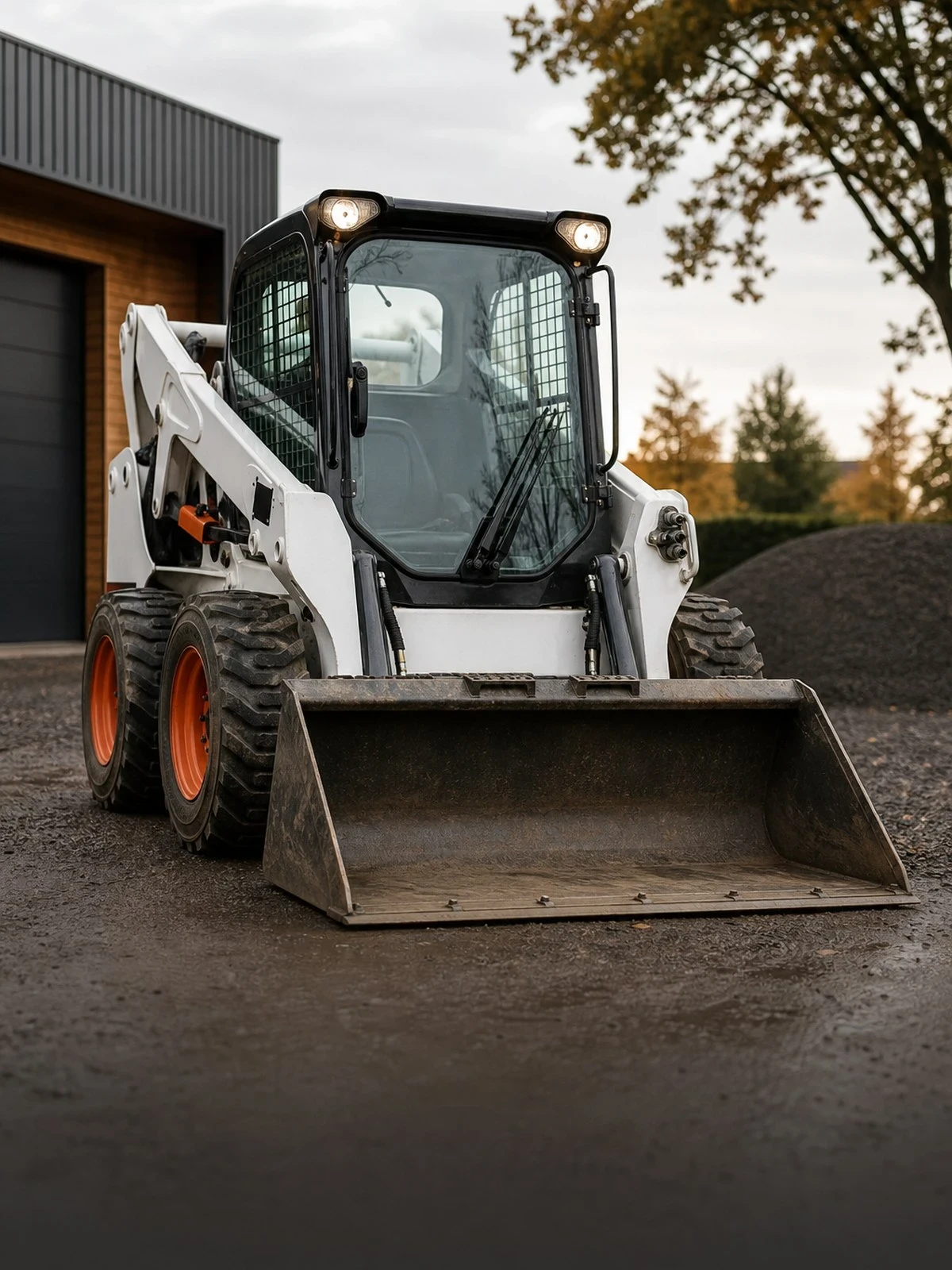
Bobcat made the skid-steer loader standard equipment in construction, landscaping and agriculture. The machine turns by letting the wheels slip and works with a range of interchangeable attachments. In insurance terms that is no detail: the attachments are separate objects. A bucket, grab, sweeper unit, cutter bar or snow plough is not insured because it is fitted to the machine, but because it appears on the policy by name and value.
The second point is mobility. A skid-steer loader fits on a trailer, can be loaded by two people and often stands on site overnight rather than in a shed. Insurers therefore attach conditions to the cover: an immobiliser, a tracker, and agreements about where the machine stands outside working hours. If you do not meet them, it is not the premium but the theft cover that lapses.
The third point is the surface. A machine that steers by slipping leaves marks on block paving, asphalt, grass and floors. That damage rarely falls under own-damage cover and often under the liability or care, custody and control cover, provided that cover is there.
We compare your plant and machinery insurance across dozens of insurers, explain where the real differences lie, and arrange the switch from start to finish — without you having to chase it yourself.
 Plant and machinery insurance
 Compare
 Get covered
The structure of the cover in three parts, with an overview per situation below.
Damage you cause to others with the machine.
Damage to and theft of the machine, including inherent defect.
What comes into play with breakdown and transport.
What is covered
| Situation | Covered |
|---|---|
| Theft from the building site | Sometimes |
| Fire and storm damage | Yes |
| Inherent defect in the hydraulics | Sometimes |
| Damage to cables and pipes | Sometimes |
| Normal wear and tracks | No |
| Damage due to deferred maintenance | No |
This overview is general in nature and is not personal advice. What is actually covered, including exclusions, limits and the excess, is set out in the policy conditions and the insurance card (verzekeringskaart) of the insurer; you receive both before you take out cover. Taking out cover without advice? Then read what execution only means for you.
Insurers weigh these details differently. That is where your saving is.
We look at the terms as well as the premium, and stay your point of contact when there is a claim.
We are not tied to one insurer and compare on the basis of an objective analysis of several companies.
You call or email someone who knows your file. No menu options, no changing call centres.
We cancel your old policy and align the start date, so you are never a day without cover.
We report the claim and monitor how it is handled. In urgent cases you can reach us on the emergency line.
Customers rate our service on four aspects: personal service, service delivery, availability and the outcome. The reviews are collected and published by NH1816 and come from customers who have actually taken out a policy with Finass Advies B.V. or reported a claim.
Four points that make the difference between a policy that pays out and one that does not.
The appeal of this plant lies in the attachments, and that is exactly where the cover goes wrong. Buckets, grabs, pallet forks, snow ploughs, hydraulic breakers and cutter bars are insured individually. If the machine is stolen with a grab fitted, the insurer only pays for what appears on the policy. Keep an up-to-date list with type and serial number, and report any purchase immediately. Wearing parts such as teeth, cutting edges, blades and tyres are always excluded.
Compact plant disappears from building sites because it can be put on a trailer quickly. Insurers therefore set prevention requirements: a coded key or PIN, a tracker and an agreement about storage. If the machine is left unattended overnight on an open site while the policy prescribes locked storage, that is a breach of condition. Likewise, theft where the key was left in the machine is excluded in virtually every policy.
After a theft, handling runs through the police report, the registration of the serial number and the tracker data. Article 7:941 of the Dutch Civil Code obliges you to notify the loss as soon as reasonably possible; policies set a concrete time limit around that. If you notify late and the insurer's interests are harmed as a result, for example because the trail has gone cold, it may reduce the payout. Always record when the machine was last seen.
Steering by slipping means the tyres skid across the surface. On a block-paved path, a newly poured floor, a sports pitch or a client's lawn, that produces a claim. Such damage is not own-damage; where the working surface is concerned it often falls under the care, custody and control exclusion, because you are working on that object at the time. Ask specifically about cover for damage to grounds and floors before you take on indoor work.
Attachments such as buckets and grabs are not automatically insured and must be declared separately.
Not every company applies the same policy for this make. With unusual versions, the question is not what it costs but who will accept it.
This is what people ask us most.
No. Attachments count as separate objects and must appear on the policy with type, serial number and value. If a grab that has not been declared is fitted to the machine when it is stolen, the insurer will not pay for it. If you buy an extra attachment, report it straight away; adding it later has no retrospective effect.
That depends on the prevention requirements in your policy. Some insurers accept a fenced-off building site, others require locked storage or an active tracker. If you depart from what was agreed, the theft cover may lapse. Record the agreement in writing, so that there is no argument afterwards about what was allowed.
Report it to the police, pass on the serial number and secure the tracker data. Then notify the insurer of the theft as soon as possible; Article 7:941 DCC requires this. Note when the machine was last seen and by whom. Late notification can prejudice the insurer's chances of recovering it, and it may set that off against the payout.
That is liability damage, not own-damage. If you are working on or at the damaged surface, it also quickly falls under the care, custody and control exclusion and is only covered if a separate provision has been made for it. Discuss this in advance when you work on finished grounds, floors or sports pitches.
Every situation is different. For these situations we have a separate page.
Request a quote without obligation. We will look at which insurer best matches your activities and your risk.
Prefer to call? 072 - 509 24 56, weekdays 09:00–17:00.
Claim on the road? Emergency line 06 - 55 20 40 72.
Finass Verzekert is a trading name of Finass Advies B.V. We advise on and arrange non-life insurance on the basis of an objective analysis of several insurers, and receive commission for this from the insurer, which is included in the premium. You pay no separate advice fee. Before you take out cover, we establish your wishes and needs.
You will find our licence, KvK and Kifid details and our complaints procedure at the foot of every page.
This page was compiled by Finass Verzekert. Last updated on .
The information on this page is general in nature and is not personal advice.
Maandag- Vrijdag: 09:00- 17:00
We use cookies and similar technologies to improve your experience on our website.