

Liability
- Cables and pipes
- Damage to buildings
- Injury to bystanders
With Liebherr it is often a tower crane or a heavy machine standing on a building site for months, and then the focus of the policy shifts to erection, wind and the time the item stays there.
This page in another language: Nederlands
The calculator and the quote form below are in Dutch. Prefer to do this in English? Email info@finassverzekert.nl or call 072 - 509 24 56 and we will take it from there.
Work out for yourself what it would cost.
Enter your details; you will receive a proposal within one working day.
A premium indication, not personal advice. Prefer to talk it through? Call 072 - 509 24 56.
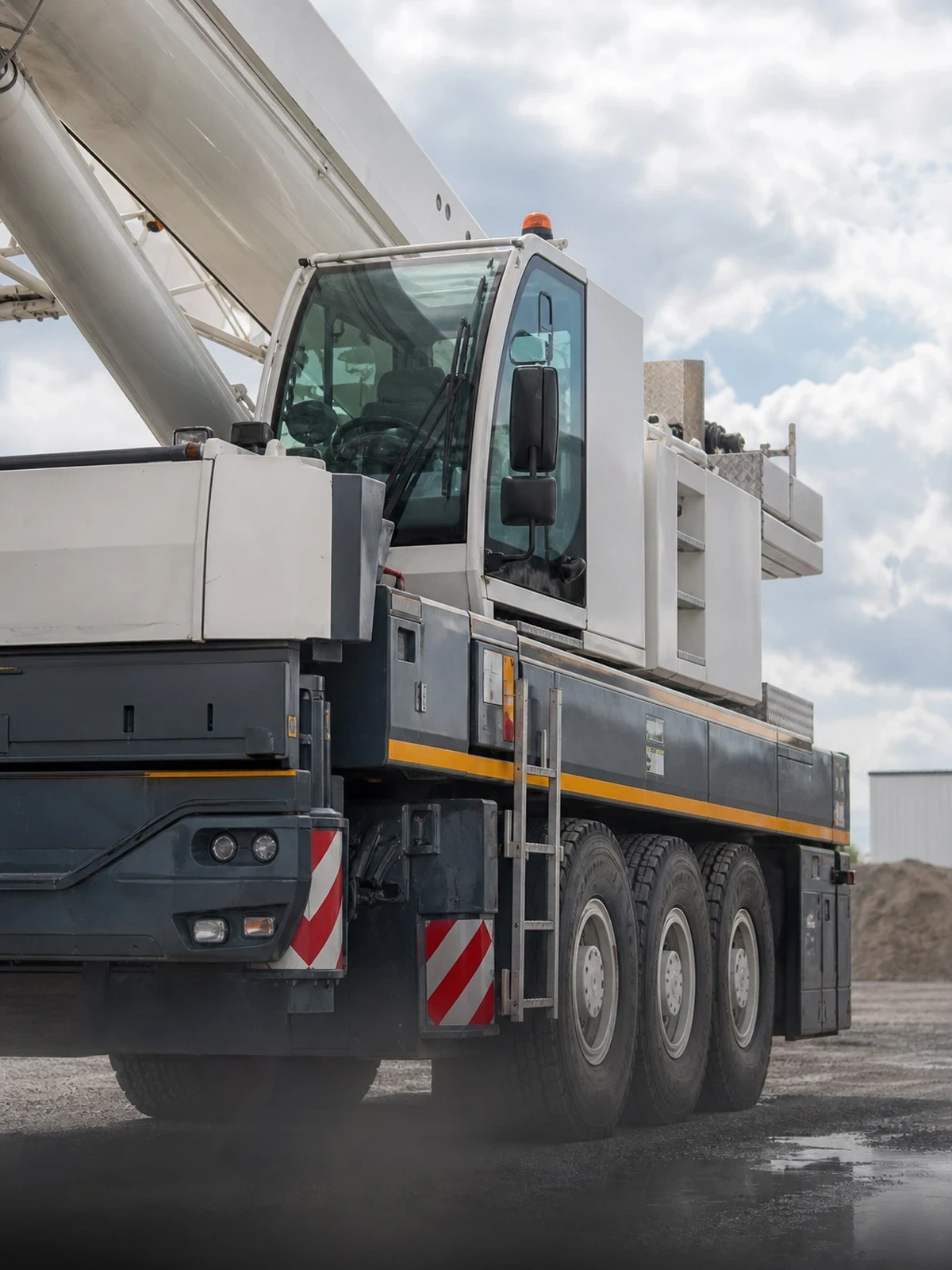
Liebherr supplies two worlds under one name: tracked excavators and wheel loaders for earthmoving, and tower cranes erected on the building site. For insurance that distinction is decisive. An excavator drives to the job and away again. A tower crane is delivered in sections, assembled on site and then stands in the same place for months. Erection and dismantling are the hours in which things go wrong with this kind of plant.
A crane standing in one place for a long time becomes part of the building site. Wind, the ground beneath the ballast and the surroundings then determine the risk. Insurers therefore record how the crane is left outside working hours and who follows the weather forecast. Those arrangements appear in the policy, not in the manufacturer's manual.
Heavy lifting plant is also rarely used alone. Cranes are hired in, lent out or made available with an operator. Who is then liable for damage to third parties depends on the contract and on Articles 6:170 and 6:171 of the Dutch Civil Code.
We compare your plant and machinery insurance across dozens of insurers, explain where the real differences lie, and arrange the switch from start to finish — without you having to chase it yourself.
 Plant and machinery insurance
 Compare
 Get covered
The structure of the cover in three parts, with an overview per situation below.
Damage you cause to others with the machine.
Damage to and theft of the machine, including inherent defect.
What comes into play with breakdown and transport.
What is covered
| Situation | Covered |
|---|---|
| Theft from the building site | Sometimes |
| Fire and storm damage | Yes |
| Inherent defect in the hydraulics | Sometimes |
| Damage to cables and pipes | Sometimes |
| Normal wear and tracks | No |
| Damage due to deferred maintenance | No |
This overview is general in nature and is not personal advice. What is actually covered, including exclusions, limits and the excess, is set out in the policy conditions and the insurance card (verzekeringskaart) of the insurer; you receive both before you take out cover. Taking out cover without advice? Then read what execution only means for you.
Insurers weigh these details differently. That is where your saving is.
We look at the terms as well as the premium, and stay your point of contact when there is a claim.
We are not tied to one insurer and compare on the basis of an objective analysis of several companies.
You call or email someone who knows your file. No menu options, no changing call centres.
We cancel your old policy and align the start date, so you are never a day without cover.
We report the claim and monitor how it is handled. In urgent cases you can reach us on the emergency line.
Customers rate our service on four aspects: personal service, service delivery, availability and the outcome. The reviews are collected and published by NH1816 and come from customers who have actually taken out a policy with Finass Advies B.V. or reported a claim.
Four points that make the difference between a policy that pays out and one that does not.
A tower crane is delivered in sections and assembled on site. It is precisely in those hours that things go wrong: a section set down incorrectly, a connection not torqued to specification, or damage caused by the assist crane. Many plant policies cover the crane in operation but exclude damage during erection and dismantling unless that phase has been declared separately. Ask how your policy treats that period and who carries out the erection.
After work a tower crane should be left in free slew, so that the jib can turn with the wind. If that is not done and the crane blows over, Article 7:952 of the Dutch Civil Code comes into play: damage caused by reckless conduct remains at your expense. Insurers also record at what wind force work stops and who takes that decision. Without that agreement, storm damage is followed by an argument you will not win.
Once a crane stands on a foundation and forms part of the building site for months, it may be classed as a structure. Article 6:174 DCC places liability for a defective structure with the possessor, even where you are not at fault. That covers the ballast, the crane track and the fencing around it. Check whether your liability cover includes this form of strict liability and not only fault-based liability.
If you make a crane available with an operator, your employee works under someone else's direction. Both you and the client can be held responsible for damage to third parties, under Articles 6:170 and 6:171 of the Dutch Civil Code. Hire terms sometimes push that risk entirely onto the owner. Record who draws up the lifting plan, who gives instructions and whether your insurer accepts the operating clause used.
Parts for the heavy segment have longer delivery times; cover for downtime matters more here than with smaller plant.
Not every company applies the same policy for this make. With unusual versions, the question is not what it costs but who will accept it.
This is what people ask us most.
Not automatically. Many plant policies cover the crane in operation and leave the erection and dismantling phase outside the cover. If you want those hours included, that must appear on the policy, stating who carries out the erection and dismantling. Have it recorded as well whether the assist crane placing the sections falls under the same cover.
That work is stopped in good time, the load comes off the hook and the crane is set in free slew so that the jib turns with the wind. If that is not done, the insurer may treat the damage as reckless by relying on Article 7:952 of the Dutch Civil Code. Record for each project who takes that decision.
That depends on the contract and on who actually gives the instructions. Articles 6:170 and 6:171 of the Dutch Civil Code make both the employer and the client answerable for the mistakes of subordinates and of third parties engaged. In reality the hire agreement places the risk with one of the two. Check whether your own policy accepts that contractual transfer.
Damage from a sudden event falls under own-damage cover, but the gradual deterioration of ropes, sheaves and bearings is wear and tear and stays outside the policy. Damage arising because a condemned component remained in use is also refused. Keep inspection and replacement reports, because they determine on which side of that line your claim falls.
Every situation is different. For these situations we have a separate page.
Request a quote without obligation. We will look at which insurer best matches your activities and your risk.
Prefer to call? 072 - 509 24 56, weekdays 09:00–17:00.
Claim on the road? Emergency line 06 - 55 20 40 72.
Finass Verzekert is a trading name of Finass Advies B.V. We advise on and arrange non-life insurance on the basis of an objective analysis of several insurers, and receive commission for this from the insurer, which is included in the premium. You pay no separate advice fee. Before you take out cover, we establish your wishes and needs.
You will find our licence, KvK and Kifid details and our complaints procedure at the foot of every page.
This page was compiled by Finass Verzekert. Last updated on .
The information on this page is general in nature and is not personal advice.
Maandag- Vrijdag: 09:00- 17:00
We use cookies and similar technologies to improve your experience on our website.