

Liability
- Cables and pipes
- Damage to buildings
- Injury to bystanders
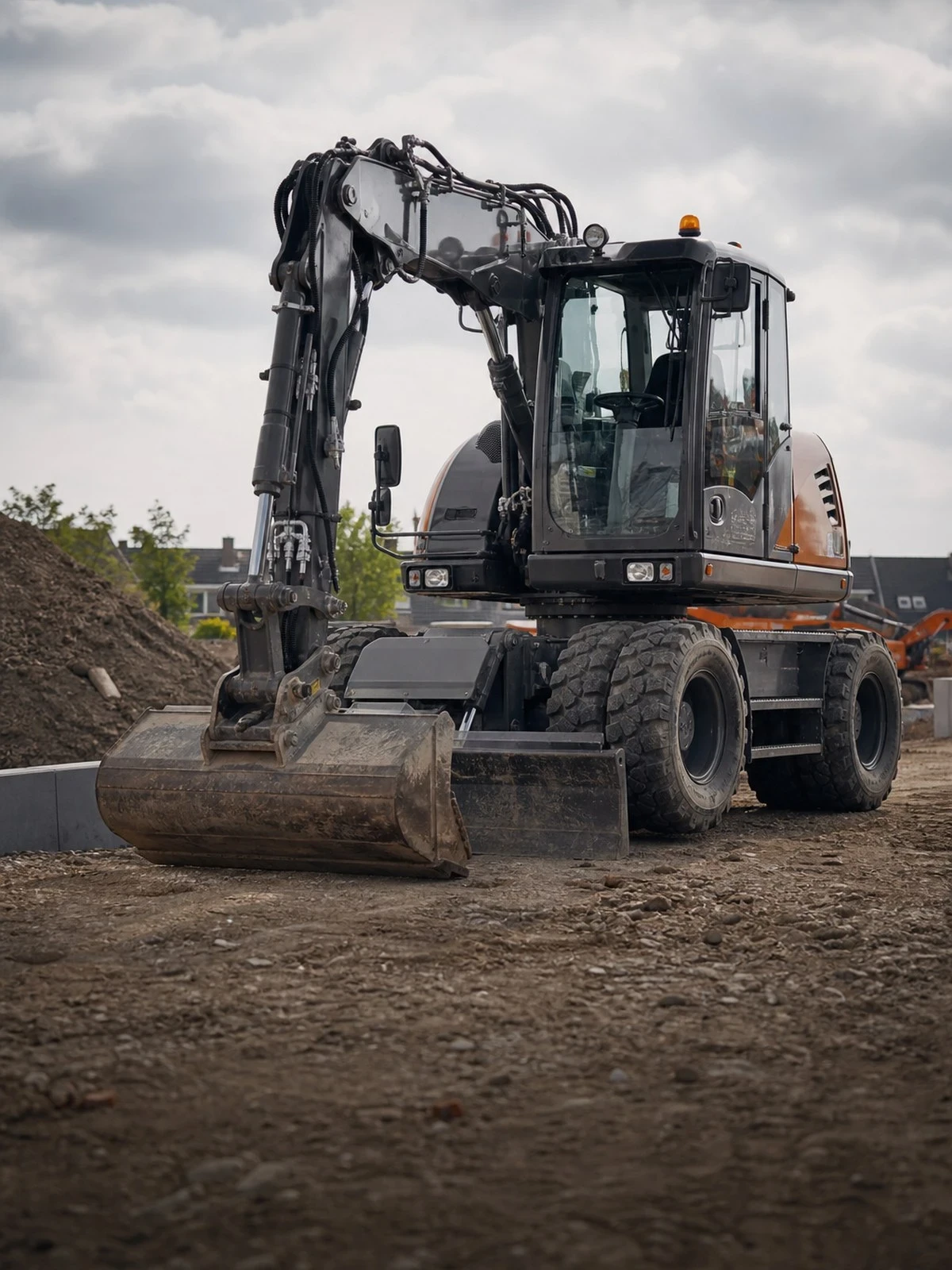
A Mecalac is bought so that you can work where there is no room, and it is precisely those cramped urban sites that determine what damage you cause and how your machine should appear on the policy.
This page in another language: Nederlands
Work out for yourself what it would cost.
Enter your details; you will receive a proposal within one working day.
A premium indication, not personal advice. Prefer to talk it through? Call 072 - 509 24 56.
Mecalac builds machines that are hard to pigeonhole: a swing loader, an excavator with a rotating cab, a machine that digs, loads and moves itself. For the user that is the strength of the make. For an insurer it is a question of classification, because the description of the item on the policy determines which exclusions and which limits apply.
The second characteristic is the workplace. This plant stands on a pavement, in a residential street, between parked cars and right against a facade. The damage you cause there is rarely large, but it is almost always to someone else's property and it happens often. That makes the claims frequency more important here than the size of any single event.
And people walk past. Working in the public space means you are responsible not only for your machine, but also for the barriers around it and for the conditions the local authority has attached to your permit.
We compare your plant and machinery insurance across dozens of insurers, explain where the real differences lie, and arrange the switch from start to finish — without you having to chase it yourself.
 Plant and machinery insurance
 Compare
 Get covered
The structure of the cover in three parts, with an overview per situation below.
Damage you cause to others with the machine.
Damage to and theft of the machine, including inherent defect.
What comes into play with breakdown and transport.
What is covered
| Situation | Covered |
|---|---|
| Theft from the building site | Sometimes |
| Fire and storm damage | Yes |
| Inherent defect in the hydraulics | Sometimes |
| Damage to cables and pipes | Sometimes |
| Normal wear and tracks | No |
| Damage due to deferred maintenance | No |
This overview is general in nature and is not personal advice. What is actually covered, including exclusions, limits and the excess, is set out in the policy conditions and the insurance card (verzekeringskaart) of the insurer; you receive both before you take out cover. Taking out cover without advice? Then read what execution only means for you.
Insurers weigh these details differently. That is where your saving is.
We look at the terms as well as the premium, and stay your point of contact when there is a claim.
We are not tied to one insurer and compare on the basis of an objective analysis of several companies.
You call or email someone who knows your file. No menu options, no changing call centres.
We cancel your old policy and align the start date, so you are never a day without cover.
We report the claim and monitor how it is handled. In urgent cases you can reach us on the emergency line.
Customers rate our service on four aspects: personal service, service delivery, availability and the outcome. The reviews are collected and published by NH1816 and come from customers who have actually taken out a policy with Finass Advies B.V. or reported a claim.
Four points that make the difference between a policy that pays out and one that does not.
As soon as you are in the public space, the job involves barriers, a diversion and sometimes a traffic controller. If a pedestrian trips over a badly placed barrier or someone is injured by a swinging arm, that is personal injury under Article 6:162 of the Dutch Civil Code. Your liability insurance covers that damage, but not the local authority's fine and not the cost of belatedly complying with the permit conditions.
A lamp post, a road sign, a tree or a stretch of block paving: in built-up areas you are more likely to hit municipal property than your own. Local authorities claim the repair costs and, for trees, work with a valuation far higher than expected. This is damage to property under your liability cover. Damage to the works you are constructing yourself, or to the object you are working on, usually falls outside it.
Compact plant in cramped surroundings produces a different claims pattern from heavy plant on an open site: no single large event, but a series of small ones. A mirror, a parked car, a kerb, a garden wall. Every notification counts towards your claims record, even where the amount stays below the excess. Consider carefully which losses you report and what excess suits the way you work.
Insurers work with fixed item categories: excavator, wheel loader, dumper. A machine combining several functions does not fit those, and is therefore sometimes described too widely or too narrowly. Make sure the make, type, serial number and specification appear exactly on the schedule of plant. If the description differs from what is actually there, a claim first produces an argument about which cover applied before money is discussed.
Specialist parts have long delivery times; cover for downtime is particularly relevant here.
Not every company applies the same policy for this make. With unusual versions, the question is not what it costs but who will accept it.
This is what people ask us most.
That is property damage to a third party and runs through your liability insurance, not through the machine's own-damage cover. The local authority sends the repair costs. Watch out for trees: they are assessed at a valuation that can mount up considerably. Report this kind of damage immediately, even where the amount seems low, because the final account often comes later.
Yes, personal injury to third parties falls under the liability cover, with Article 6:162 of the Dutch Civil Code as its basis. What is not covered is an administrative fine or a penalty payment because the barriers did not meet the permit conditions. Make sure, therefore, that the barriers are right, and record with photographs what the situation looked like when the work started.
Yes. At renewal, insurers look at the number of notifications and not only at the amount paid out. A series of small claims can lead to a premium increase or to cancellation. Choose an excess that suits your work, therefore, and consider case by case whether reporting is necessary, without ignoring the duty to notify under Article 7:941 of the Dutch Civil Code.
With the make, type, year of manufacture, serial number and actual specification. For machines combining several functions, a general description such as excavator is too narrow. If the description does not match what is on site, the first argument after a loss is about which cover applied.
Every situation is different. For these situations we have a separate page.
Request a quote without obligation. We will look at which insurer best matches your activities and your risk.
Prefer to call? 072 - 509 24 56, weekdays 09:00–17:00.
Claim on the road? Emergency line 06 - 55 20 40 72.
Finass Verzekert is a trading name of Finass Advies B.V. We advise on and arrange non-life insurance on the basis of an objective analysis of several insurers, and receive commission for this from the insurer, which is included in the premium. You pay no separate advice fee. Before you take out cover, we establish your wishes and needs.
You will find our licence, KvK and Kifid details and our complaints procedure at the foot of every page.
This page was compiled by Finass Verzekert (LinkedIn). Last updated on .
The information on this page is general in nature and is not personal advice.
Maandag- Vrijdag: 09:00- 17:00
We use cookies and similar technologies to improve your experience on our website.