

Liability
- Covered while coupled
- Under the car's third-party liability cover
- Uncoupled: no longer covered
With containers and chassis the first question is not what cover you need, but who actually owns the equipment and what you have accepted in the interchange contract.
This page in another language: Nederlands
The calculator and the quote form below are in Dutch. Prefer to do this in English? Email info@finassverzekert.nl or call 072 - 509 24 56 and we will take it from there.
Work out for yourself what it would cost.
Enter your details; you will receive a proposal within one working day.
A premium indication, not personal advice. Prefer to talk it through? Call 072 - 509 24 56.
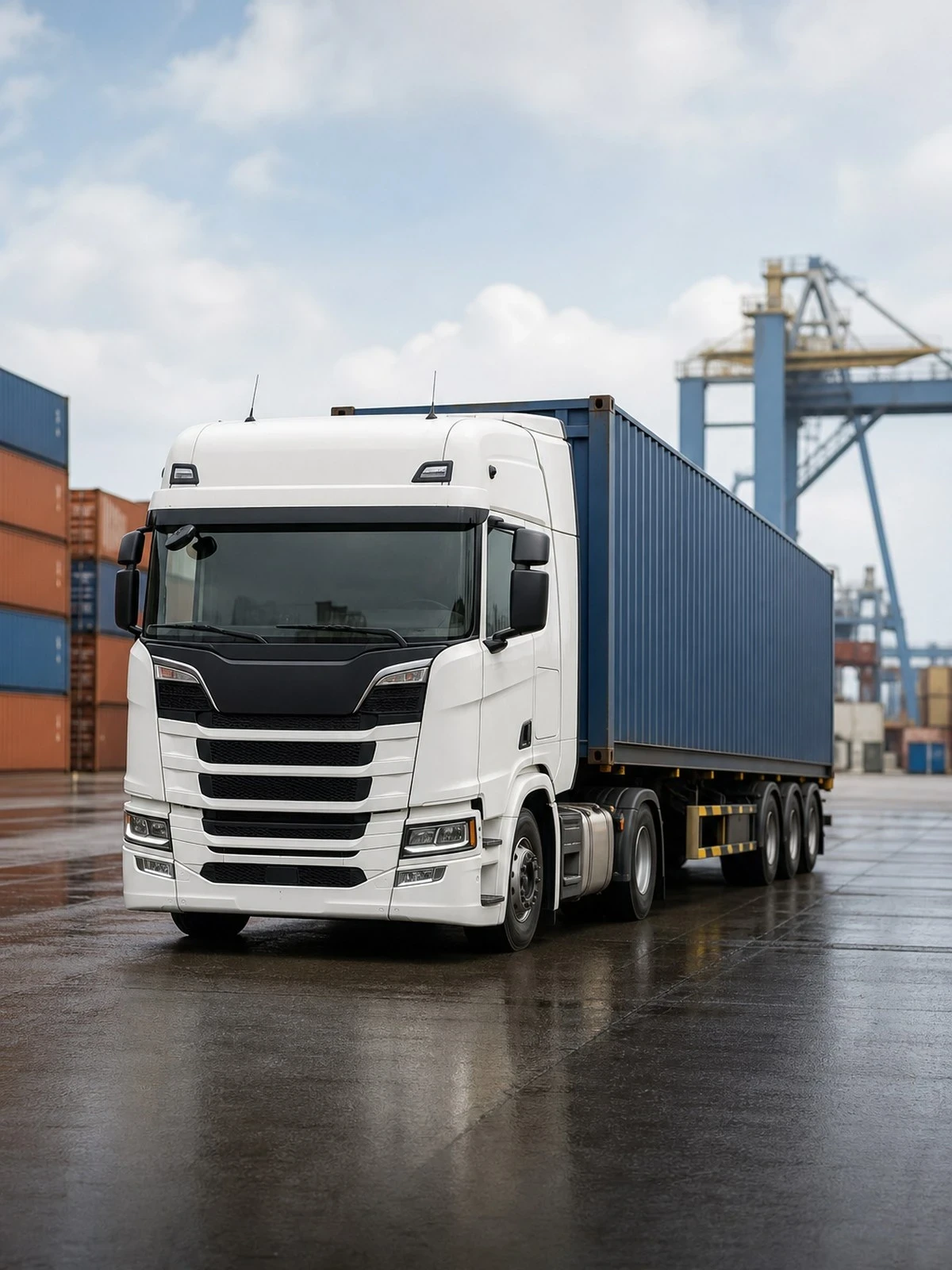
Containers and container chassis are rarely bought. They are hired from a shipping line, a leasing company or a depot, and handed over under an interchange or equipment agreement. That contract sets out who insures the equipment, who pays for damage and up to what point you are responsible. Anyone who fails to read that document only discovers, when a door panel is dented, that he is contractually liable for the full cost of repair.
In insurance terms that is awkward, because someone else's equipment in your care falls under the care, custody and control exclusion. An ordinary liability policy specifically excludes damage to goods you carry, work on or hold in safekeeping. So you need either own-damage cover on the hired equipment, or an extension that restores part of the care, custody and control risk. A liability claim against a third party under Article 6:162 of the Dutch Civil Code is no substitute for it.
Container transport also generates costs that are not damage at all: demurrage and detention when the equipment is returned late to the depot. Those charges appear as an exclusion in almost every policy and are purely contractual. If you carry the goods yourself, your carriers' liability remains a separate layer alongside this.
We compare your trailer insurance across dozens of insurers, explain where the real differences lie, and arrange the switch from start to finish — without you having to chase it yourself.
 Trailer insurance
 Compare
 Get covered
The structure of the cover in three parts, with an overview per situation below.
Damage you cause to others with the trailer.
External causes beyond your control.
Including damage you cause yourself.
What is covered
| Situation | Third-party, fire and theft | Comprehensive |
|---|---|---|
| Theft after forced entry, with the prescribed lock | Yes | Yes |
| Fire and storm damage on the pitch | Yes | Yes |
| Hail damage to roof and walls | Provided that | Yes |
| Collision damage while manoeuvring | No | Yes |
| Contents in the caravan or trailer | Provided that | Provided that |
| Damp, wear and deferred maintenance | No | No |
A trailer or caravan is not an independent motor vehicle and therefore has no insurance requirement of its own. Damage you cause to others with it falls under the third-party liability cover of the towing vehicle, as long as the combination is coupled (Article 2 WAM). Once the trailer is uncoupled and has come to a standstill, that cover no longer applies.
This overview is general in nature and is not personal advice. What is actually covered, including exclusions, limits and the excess, is set out in the policy conditions and the insurance card (verzekeringskaart) of the insurer; you receive both before you take out cover. Taking out cover without advice? Then read what execution only means for you.
Insurers weigh these details differently. That is where your saving is.
We look at the terms as well as the premium, and stay your point of contact when there is a claim.
We are not tied to one insurer and compare on the basis of an objective analysis of several companies.
You call or email someone who knows your file. No menu options, no changing call centres.
We cancel your old policy and align the start date, so you are never a day without cover.
We report the claim and monitor how it is handled. In urgent cases you can reach us on the emergency line.
Customers rate our service on four aspects: personal service, service delivery, availability and the outcome. The reviews are collected and published by NH1816 and come from customers who have actually taken out a policy with Finass Advies B.V. or reported a claim.
Four points that make the difference between a policy that pays out and one that does not.
When collecting from the depot, the driver signs for the condition of the container or the chassis. That form is the evidence used later to establish whether a dent, a crack in the floor or a faulty door bar is down to you. If it is signed without an inspection, existing damage suddenly becomes your damage. Record the condition with photographs of every side, including the CSC plate and the container number, and keep them with the consignment note.
As long as hired equipment is on your premises or behind your tractor unit, you have it in your care. Standard liability insurance exclude damage to such goods through the care, custody and control exclusion, precisely because it is not a liability risk but a bailee's risk. So arrange own-damage cover on the hired equipment or an express care, custody and control extension with a limit of its own. Without one of the two, you face a liability claim from the shipping line and a policy that does not match it.
A refrigerated container has a unit that can fail of its own accord. A tank container is subject to an inspection regime and a residue risk. Insurability and acceptance differ by type. For a reefer it is also the case that refrigeration failure and spoilage of the contents do not fall under equipment cover, but under cargo cover. When you take out the policy, state expressly what type of equipment you work with and whether you also store it loaded.
Three items are almost never eligible for payment. Demurrage, detention and standing charges, because those are contractual penalties and not damage. Corrosion, rust and normal wear to panels and floor sections, which go with the use. And the the load itself, regardless of who owns it. Damage caused by incorrect stowage or by an excess weight that does not match the VGM declaration is also left to your own account as standard.
A heavier trailer has its own registration number. Also check that the driving licence is adequate for the combination.
As long as the item is coupled, liability runs through the towing vehicle. Once uncoupled that no longer applies, and damage to the item itself was never covered in any case. Insurers therefore require an approved coupling lock and a declared storage location. For higher values, a tracker as well.
This is what people ask us most.
That is set out in the interchange or lease agreement, not in the law. The owner often keeps the equipment insured himself, but places the excess and the repair costs contractually on the carrier. You then insure your own contractual responsibility. Read which clause makes you liable and up to what amount before you decide what cover you need.
In principle, no. The care, custody and control exclusion rules out damage to goods you carry, work on or otherwise have in your care, and hired equipment falls squarely within it. There are extensions that partly restore this, usually with a limit and an excess of their own. Without such an extension or own-damage cover on the equipment, the loss remains at your expense.
No. Demurrage and detention are contractual charges for using equipment too long or returning it too late, and are therefore not damage in insurance terms. Almost every policy excludes them expressly. They can only be controlled through planning and through clear arrangements about free days in the transport contract with your client.
That is never covered by insurance on the equipment. If you carry goods for clients, your carrier's liability applies, with a limit per kilogram under the CMR or the AVC. If the cargo interest wants the actual value covered, it takes out goods in transit insurance for that. These are two separate policies with different insured parties and different bases of settlement.
Every situation is different. For these situations we have a separate page.
Request a quote without obligation. We will look at which insurer best matches your activities and your risk.
Prefer to call? 072 - 509 24 56, weekdays 09:00–17:00.
Claim on the road? Emergency line 06 - 55 20 40 72.
Finass Verzekert is a trading name of Finass Advies B.V. We advise on and arrange non-life insurance on the basis of an objective analysis of several insurers, and receive commission for this from the insurer, which is included in the premium. You pay no separate advice fee. Before you take out cover, we establish your wishes and needs.
You will find our licence, KvK and Kifid details and our complaints procedure at the foot of every page.
This page was compiled by Finass Verzekert. Last updated on .
The information on this page is general in nature and is not personal advice.
Maandag- Vrijdag: 09:00- 17:00
We use cookies and similar technologies to improve your experience on our website.