

Rebuild value
- Not the market value
- Not the WOZ value (the Dutch property valuation)
- Guarantee against underinsurance
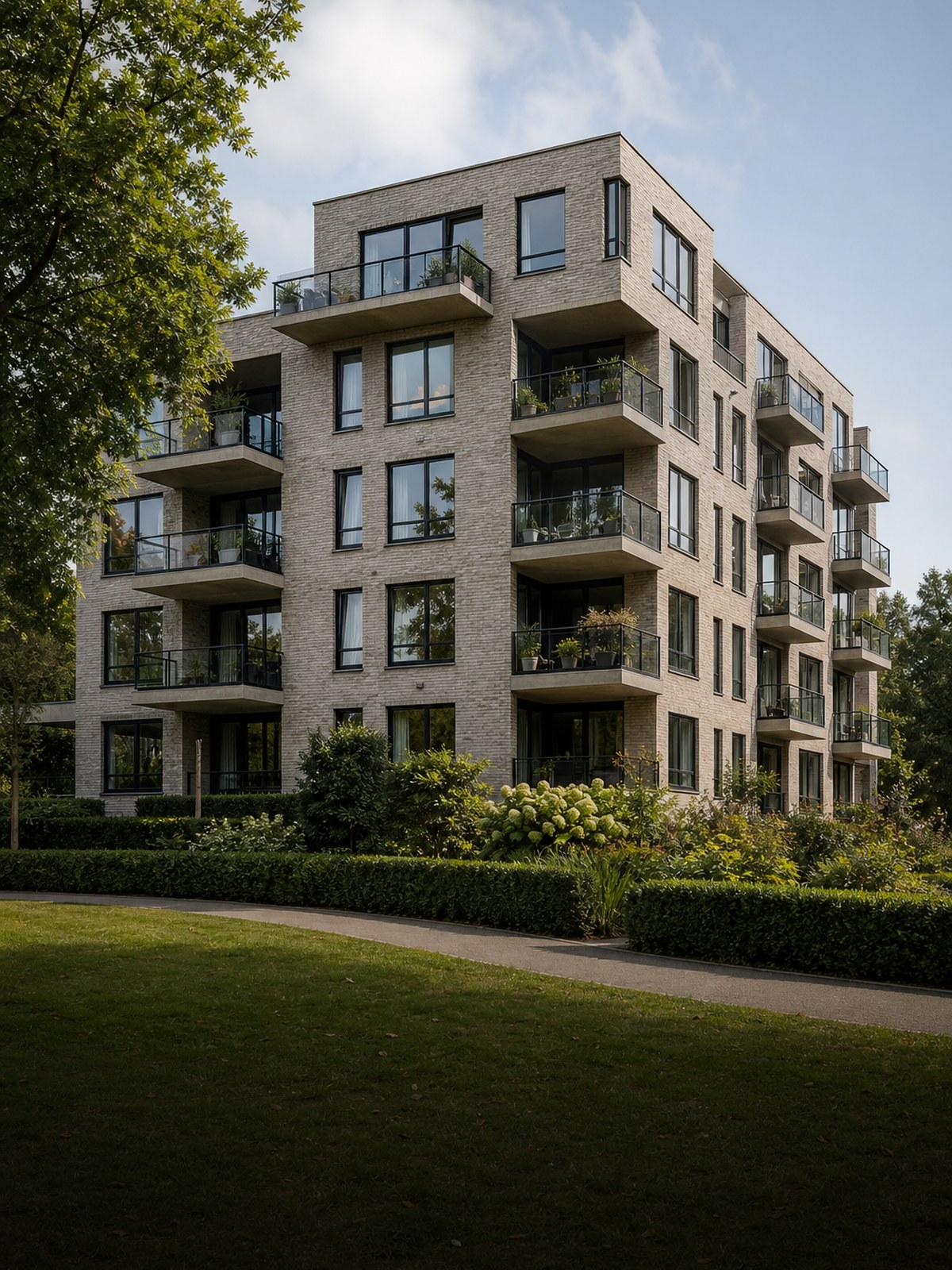
You insure a block of flats as a single structural whole, with the heaviest use in the building determining the risk profile of all the units.
This page in another language: Nederlands
The calculator and the quote form below are in Dutch. Prefer to do this in English? Email info@finassverzekert.nl or call 072 - 509 24 56 and we will take it from there.
Work out for yourself what it would cost.
Enter your details; you will receive a proposal within one working day.
A premium indication, not personal advice. Prefer to talk it through? Call 072 - 509 24 56.
With a whole block it is not about dozens of homes but about one object: a structure with shared installations, communal areas and shared access. The sum insured is the rebuild value of the whole, including lifts, storage units, access balconies, the parking deck and boundary fencing. After a claim, an individual owner's share is also paid out of that single sum.
The rate depends heavily on the use. If there is a supermarket, a restaurant or a garage business at street level, the whole block is assessed on that heaviest risk, because a kitchen fire at street level threatens the homes above. Insurers then ask about the fire separation between the business premises and the residential part and about the installation in that unit.
The number of floors also counts. Above a certain height the fire service can no longer fight a fire from outside and everything shifts to compartmentation, dry risers and escape routes. How the association's own duty to insure is arranged is explained under VvE building insurance.
We compare your buildings insurance across dozens of insurers, explain where the real differences lie, and arrange the switch from start to finish — without you having to chase it yourself.
 Buildings insurance
 Compare
 Get covered
The structure of the cover in three parts, with an overview per situation below.
What it costs to rebuild the premises.
Everything permanently attached to the building.
What is excluded as standard.
What is covered
| Situation | Standard | With extension |
|---|---|---|
| Fire, smoke and lightning strike | Yes | Yes |
| Storm from force 7 upwards | Yes | Yes |
| Water damage from a burst pipe | Yes | Yes |
| Glass breakage | Sometimes | Yes |
| Groundwater coming through the floor | No | No |
| Wear and deferred maintenance | No | No |
This overview is general in nature and is not personal advice. What is actually covered, including exclusions, limits and the excess, is set out in the policy conditions and the insurance card (verzekeringskaart) of the insurer; you receive both before you take out cover. Taking out cover without advice? Then read what execution only means for you.
Insurers weigh these details differently. That is where your saving is.
We look at the terms as well as the premium, and stay your point of contact when there is a claim.
We are not tied to one insurer and compare on the basis of an objective analysis of several companies.
You call or email someone who knows your file. No menu options, no changing call centres.
We cancel your old policy and align the start date, so you are never a day without cover.
We report the claim and monitor how it is handled. In urgent cases you can reach us on the emergency line.
Customers rate our service on four aspects: personal service, service delivery, availability and the outcome. The reviews are collected and published by NH1816 and come from customers who have actually taken out a policy with Finass Advies B.V. or reported a claim.
Four points that make the difference between a policy that pays out and one that does not.
Catering, retail or storage at street level helps determine the premium for the homes above. Insurers look at the fire-resisting separation between the business premises and the residential part, at the extraction above a kitchen and at the storage of goods in the store rooms. If a tenant at street level changes trade, report it: from a clothes shop to a takeaway is a different underwriting question, even though the building does not change.
Lifts, booster pump installations, communal boilers, heat pumps, entry phones and the mechanical ventilation are permanent fixtures and therefore part of the structure. They are regularly forgotten when the rebuild value is set, leaving the block underinsured. A breakdown or wear and tear of a lift is not, incidentally, an insured loss; that remains maintenance at the association's expense and belongs in the long-term maintenance plan.
With high-rise buildings the assessment shifts from firefighting water to structural separation. Insurers ask about fire resistance between homes and service ducts, about smoke-free escape routes and about access to the facades for equipment. An enclosed courtyard or a narrow access route counts in that. The facade cladding has also become an underwriting question, particularly where it contains combustible insulation or panelling.
Damage caused by wear and tear, corroded pipework, a worn roof covering or subsided foundations is excluded, however great the consequences. A leak that ran for months because nobody inspected the flat roof is therefore not an insurable event but a maintenance item. An up-to-date long-term maintenance plan with a well-filled reserve fund is therefore not bureaucracy but the basis of the cover.
This is what people ask us most.
Yes, the structure of your home is part of the block and is therefore included up to the original level of finish. Your contents and the improvements you made yourself fall outside it. You arrange those personally; how that division works is set out in insuring a flat with a VvE.
Because the block is structurally a single whole and a fire at street level develops upwards. Insurers therefore rate on the heaviest use in the building. Good fire separation between the business premises and the residential part reduces that effect; have that separation assessed and record the outcome, because that is the only argument that counts.
The owners' association, represented by the board or the managing agent. For a block that has not been divided, for example owned by an investor, it is the owner itself. Individual residents cannot report a claim or make changes independently; that always runs through the policyholder, even where the damage occurs in their home.
Only where it results from a covered peril, such as fire, lightning strike or water from a burst pipe. Wear and tear, a faulty control system or a breakdown through ageing is maintenance and comes out of the reserve fund. For that kind of failure there is a separate maintenance contract; that is not an insurance product.
Every situation is different. For these situations we have a separate page.
Request a quote without obligation. We will look at which insurer best matches your activities and your risk.
Prefer to call? 072 - 509 24 56, weekdays 09:00–17:00.
Claim on the road? Emergency line 06 - 55 20 40 72.
Finass Verzekert is a trading name of Finass Advies B.V. We advise on and arrange non-life insurance on the basis of an objective analysis of several insurers, and receive commission for this from the insurer, which is included in the premium. You pay no separate advice fee. Before you take out cover, we establish your wishes and needs.
You will find our licence, KvK and Kifid details and our complaints procedure at the foot of every page.
This page was compiled by Finass Verzekert (LinkedIn). Last updated on .
The information on this page is general in nature and is not personal advice.
Maandag- Vrijdag: 09:00- 17:00
We use cookies and similar technologies to improve your experience on our website.