

Third-party liability
- Required by law
- As long as the registration is in your name
- Suspend the registration when not in use
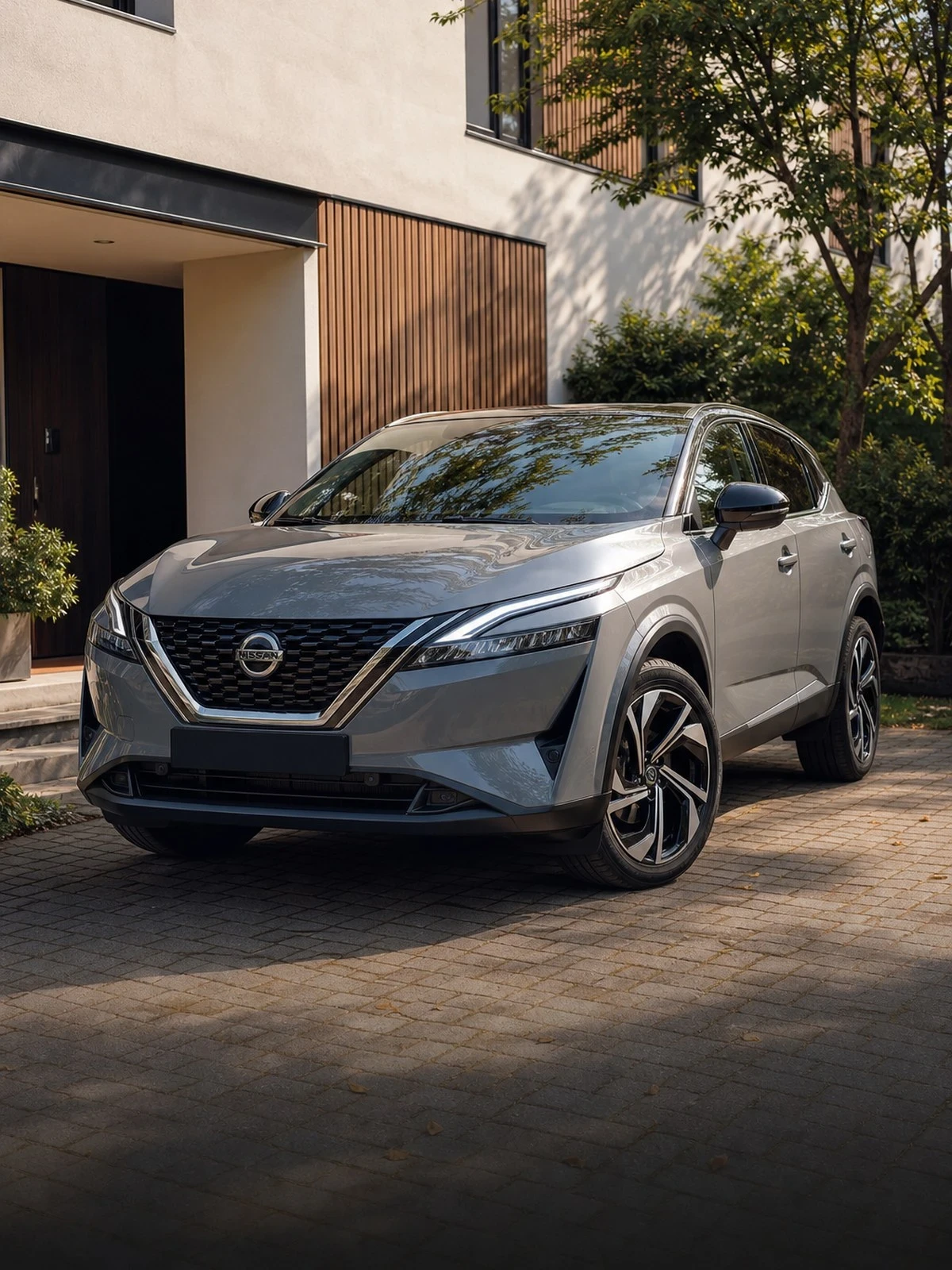
With Nissan, two very different questions come together: that of the family SUV with changing drivers, and that of the electric models where the battery pack determines how a claim is settled.
This page in another language: Nederlands
The calculator and the quote form below are in Dutch. Prefer to do this in English? Email info@finassverzekert.nl or call 072 - 509 24 56 and we will take it from there.
Work out for yourself what it would cost.
Enter your details; you will receive a proposal within one working day.
A premium indication, not personal advice. Prefer to talk it through? Call 072 - 509 24 56.
Nissan has been in the electric field for a long time and also supplies petrol models and versions in which a combustion engine only generates electricity. For insurance that distinction matters: weight, repair costs and the likelihood of a total loss differ per drivetrain, even within the same body.
The second strand is family use. Models such as the Qashqai and the X-Trail are driven by several people, with child seats in the back and belongings in the boot. There it turns on the question of who has been declared as the regular driver and what happens if someone other than the declared driver covers most of the kilometres.
If you are looking for a comparison within the same segment, the pages on Kia and Volvo are closest to this make.
We compare your car insurance across dozens of insurers, explain where the real differences lie, and arrange the switch from start to finish — without you having to chase it yourself.
 Car insurance
 Compare
 Get covered
The structure of the cover in three parts, with an overview per situation below.
Damage you cause to others.
Causes beyond your control.
Including damage you cause yourself.
What is covered
| Situation | Third-party liability | Third-party, fire and theft | Comprehensive |
|---|---|---|---|
| Damage to the other party | Yes | Yes | Yes |
| Theft | No | Yes | Yes |
| Fire and storm | No | Yes | Yes |
| Damage you cause yourself | No | No | Yes |
| Wear and mechanical defects | No | No | No |
| Driving without a valid licence | No | No | No |
This overview is general in nature and is not personal advice. What is actually covered, including exclusions, limits and the excess, is set out in the policy conditions and the insurance card (verzekeringskaart) of the insurer; you receive both before you take out cover. Taking out cover without advice? Then read what execution only means for you.
Insurers weigh these details differently. That is where your saving is.
We look at the terms as well as the premium, and stay your point of contact when there is a claim.
We are not tied to one insurer and compare on the basis of an objective analysis of several companies.
You call or email someone who knows your file. No menu options, no changing call centres.
We cancel your old policy and align the start date, so you are never a day without cover.
We report the claim and monitor how it is handled. In urgent cases you can reach us on the emergency line.
Customers rate our service on four aspects: personal service, service delivery, availability and the outcome. The reviews are collected and published by NH1816 and come from customers who have actually taken out a policy with Finass Advies B.V. or reported a claim.
Four points that make the difference between a policy that pays out and one that does not.
If the battery pack loses capacity after some years, that is wear and not insured damage; no own-damage policy pays for declining range. If the pack is damaged by a collision, fire, flooding or an impact from outside, that does fall under the own-damage cover. A fault in the charging electronics without an external cause is likewise a warranty or maintenance matter and not a claim.
If the charging cable is cut through and taken while the car is charging, most policies cover that only where the cable was connected to the car at the time. A spare cable in the boot falls under personal belongings and is covered only to a limited extent, or not at all. A charging point at your home belongs with buildings insurance (opstalverzekering); misuse of a stolen charge card is a payment matter, not damage to the car.
Declare who drives the car most and not just who pays for the policy. If a young driver in fact covers most of the kilometres while a parent is named as the regular driver, the insurer can, when there is a claim, rely on Article 7:930 of the Dutch Civil Code and pay proportionately. Loose belongings in the car, from a child seat to a bag, are rarely insured with it.
The battery pack represents a large part of the value. Damage to the floor or to the housing therefore leads sooner to a finding that repair no longer outweighs the value. Because of Article 7:960 of the Dutch Civil Code you never receive more than your actual loss, so with an electric car it is all the more important to know which valuation scheme your policy contains.
This is what people ask us most.
No. Loss of capacity through use and ageing is wear and falls outside every own-damage cover. The manufacturer's warranty is there for that, and often promises a minimum remaining capacity within a certain period. The insurance only steps in where the pack is damaged by something from outside, such as a collision, fire or flooding.
Most policies pay for that, on condition that the cable was connected to the car at the time and you report it to the police. If the cable is lying loose in the boot, it falls under personal belongings and a low limit often applies, or no cover at all. Check that provision before you buy a second cable.
Because the battery pack represents a large part of the replacement value. If the floor or the housing of the pack is damaged, the repair costs are soon higher than what the car is worth at that moment. The expert then declares the car a total loss and payment is made according to the valuation scheme in your policy.
Occasionally, usually yes, but whoever in fact covers most of the kilometres must be named on the policy as the regular driver. If that is not right and damage occurs, the insurer may adjust the payment to the premium that matched the actual risk. Some policies also apply a higher excess for young drivers.
Every situation is different. For these situations we have a separate page.
Request a quote without obligation. We will look at which insurer best matches your activities and your risk.
Prefer to call? 072 - 509 24 56, weekdays 09:00–17:00.
Claim on the road? Emergency line 06 - 55 20 40 72.
Finass Verzekert is a trading name of Finass Advies B.V. We advise on and arrange non-life insurance on the basis of an objective analysis of several insurers, and receive commission for this from the insurer, which is included in the premium. You pay no separate advice fee. Before you take out cover, we establish your wishes and needs.
You will find our licence, KvK and Kifid details and our complaints procedure at the foot of every page.
This page was compiled by Finass Verzekert (LinkedIn). Last updated on .
The information on this page is general in nature and is not personal advice.
Maandag- Vrijdag: 09:00- 17:00
We use cookies and similar technologies to improve your experience on our website.