

Third-party liability
- Required by law
- As long as the registration is in your name
- Suspend the registration when not in use
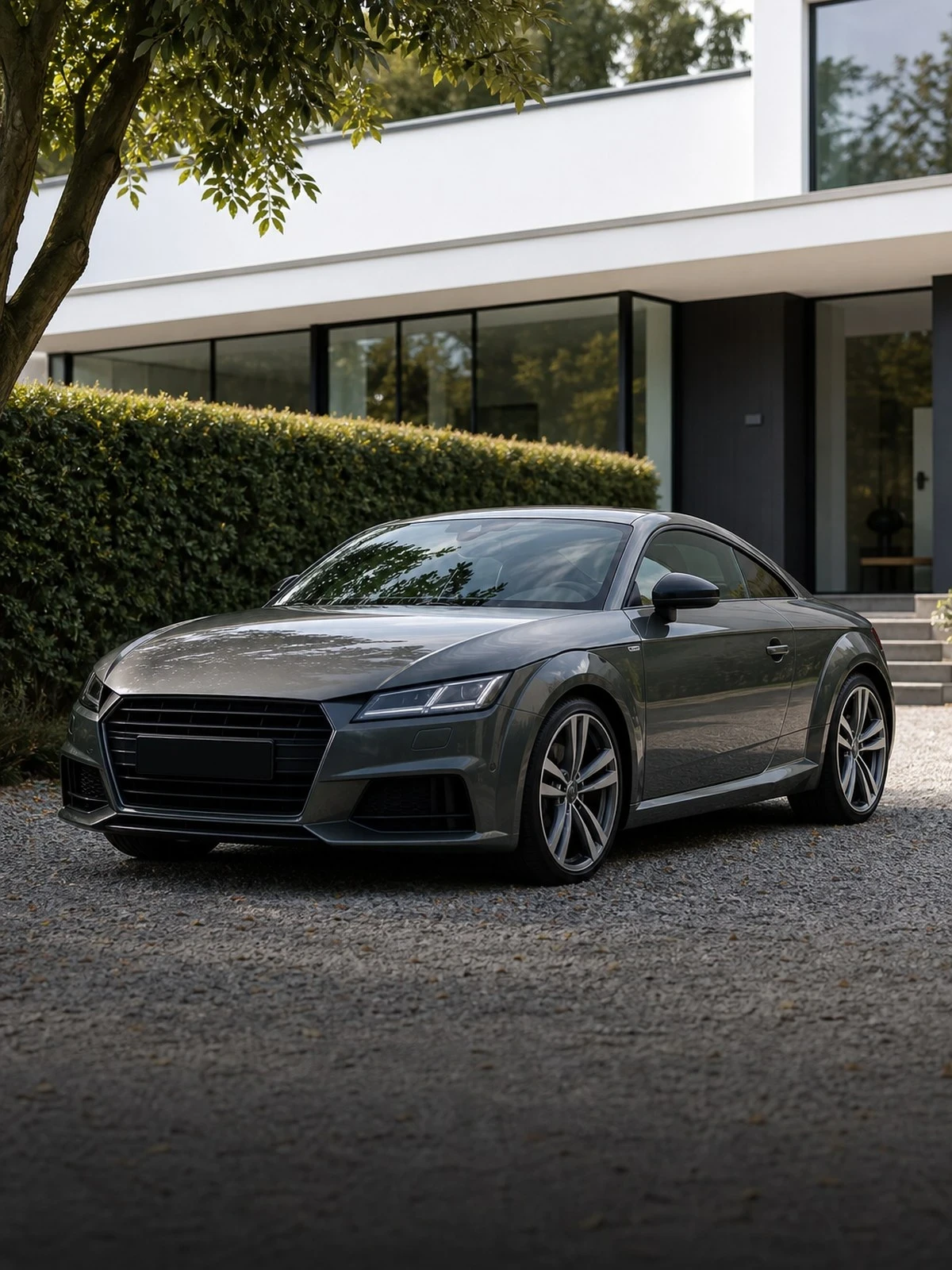
The TT is a two-seat coupé or roadster that is often kept as a second car. That opens up arrangements which do not exist for a family car.
This page in another language: Nederlands
Work out for yourself what it would cost.
Enter your details; you will receive a proposal within one working day.
A premium indication, not personal advice. Prefer to talk it through? Call 072 - 509 24 56.
Within the Audi range the TT is unusual in that it is rarely the only car in the household. Many examples cover a limited mileage, stand idle in winter and are used mainly at weekends. That calls for a different policy from an everyday car: a low mileage band, a discount for fixed storage and sometimes a second-car arrangement under which you take part of the no-claims years of your first car with you.
Technically, the body is the point to watch. The TT is built from a combination of aluminium and steel, with bonded and riveted joints. Not every repairer may or can work on that; aluminium calls for separate tools and a separate straightening bench. So have it recorded that you may nominate a marque specialist or a repairer with aluminium certification. If the car is sent to the standard network, the repair is not always matched to the structure.
If you drive an older TT, consider whether an enthusiast arrangement suits you. With limited mileage, fixed storage and no commuting use, insurers offer more favourable conditions, often with an agreed value under Article 7:960 of the Dutch Civil Code. On the first generation even a classic car or youngtimer insurance may come into view. Do bear in mind that such arrangements carry strict conditions of use.
We compare your car insurance across dozens of insurers, explain where the real differences lie, and arrange the switch from start to finish — without you having to chase it yourself.
 Car insurance
 Compare
 Get covered
The structure of the cover in three parts, with an overview per situation below.
Damage you cause to others.
Causes beyond your control.
Including damage you cause yourself.
What is covered
| Situation | Third-party liability | Third-party, fire and theft | Comprehensive |
|---|---|---|---|
| Damage to the other party | Yes | Yes | Yes |
| Theft | No | Yes | Yes |
| Fire and storm | No | Yes | Yes |
| Damage you cause yourself | No | No | Yes |
| Wear and mechanical defects | No | No | No |
| Driving without a valid licence | No | No | No |
This overview is general in nature and is not personal advice. What is actually covered, including exclusions, limits and the excess, is set out in the policy conditions and the insurance card (verzekeringskaart) of the insurer; you receive both before you take out cover. Taking out cover without advice? Then read what execution only means for you.
Insurers weigh these details differently. That is where your saving is.
We look at the terms as well as the premium, and stay your point of contact when there is a claim.
We are not tied to one insurer and compare on the basis of an objective analysis of several companies.
You call or email someone who knows your file. No menu options, no changing call centres.
We cancel your old policy and align the start date, so you are never a day without cover.
We report the claim and monitor how it is handled. In urgent cases you can reach us on the emergency line.
Customers rate our service on four aspects: personal service, service delivery, availability and the outcome. The reviews are collected and published by NH1816 and come from customers who have actually taken out a policy with Finass Advies B.V. or reported a claim.
Four points that make the difference between a policy that pays out and one that does not.
Where steel is straightened, aluminium is replaced or bonded. A body shop without aluminium certification simply cannot carry out part of the work, with the risk that a solution is chosen which weakens the structure. Have it recorded in the policy or when you report the claim that the car goes to a marque specialist. On average side damage that is worth more than most of the differences in excess you weigh up when taking out the policy.
On the open version the hood fabric is a risk of its own. Cuts made in an attempted break-in, damage to the hood mechanism and leaks after folding it away incorrectly all occur regularly. Vandalism to the fabric is covered under third-party, fire and theft, but wear to the seams, discolouration and a jamming mechanism are not. Also check whether the car may be parked with the hood open; some policies exclude theft if the car is left unlocked.
If the TT is kept indoors from November to March, you can use that. A low mileage band and fixed, locked storage produce better conditions. Suspending the registration is an alternative: the insurance requirement under Article 2 of the Dutch Motor Insurance Liability Act (WAM)then lapses, but so does cover for use on the road. Fire and theft cover during storage only continues if that is expressly stated in your policy.
The following remain outside the cover: driving on a circuit, during a track day or in a skill event; wear to the hood fabric and the hood mechanism, and mechanical defects such as clutch or transmission damage; damage during use that has not been declared, for example commuting under an enthusiast arrangement; and damage or theft while the car was kept somewhere other than the storage declared, where that storage is included as a condition in the policy.
This is what people ask us most.
Often you can. Insurers offer a second-car arrangement under which the discount on your first car partly counts, provided both cars are at the same address and in the same name. A low mileage band helps as well. The condition is that the declaration is correct: if you do drive it every day after all, the risk differs from the one accepted.
Vandalism, cuts and damage from an attempted break-in fall under third-party, fire and theft. Wear to the fabric, discolouration, leaking seams and a jamming mechanism are not a sudden event and remain outside the cover. Have the mechanism checked periodically and never fold the hood away wet; that prevents most of this damage.
When the registration is suspended the statutory insurance requirement lapses and you may no longer use the road. Own-damage cover for fire, theft and damage in storage can continue, but only if that has been expressly agreed. Report it to your insurer in advance and reactivate it before you take the first drive in the spring.
For the earliest examples a youngtimer or enthusiast arrangement can apply. It does come with conditions: a maximum number of kilometres a year, a second car for everyday use, locked storage and usually a valuation report. If you do not meet those, a standard policy with a low mileage band is usually the better choice.
Every situation is different. For these situations we have a separate page.
Request a quote without obligation. We will look at which insurer best matches your activities and your risk.
Prefer to call? 072 - 509 24 56, weekdays 09:00–17:00.
Claim on the road? Emergency line 06 - 55 20 40 72.
Finass Verzekert is a trading name of Finass Advies B.V. We advise on and arrange non-life insurance on the basis of an objective analysis of several insurers, and receive commission for this from the insurer, which is included in the premium. You pay no separate advice fee. Before you take out cover, we establish your wishes and needs.
You will find our licence, KvK and Kifid details and our complaints procedure at the foot of every page.
This page was compiled by Finass Verzekert (LinkedIn). Last updated on .
The information on this page is general in nature and is not personal advice.
Maandag- Vrijdag: 09:00- 17:00
We use cookies and similar technologies to improve your experience on our website.