

Third-party liability
- Damage to other cars and injury
- No cover for your own SQ3
- Compulsory under Article 2 of the Dutch Motor Insurance Liability Act (WAM)
- Rarely suitable for this model
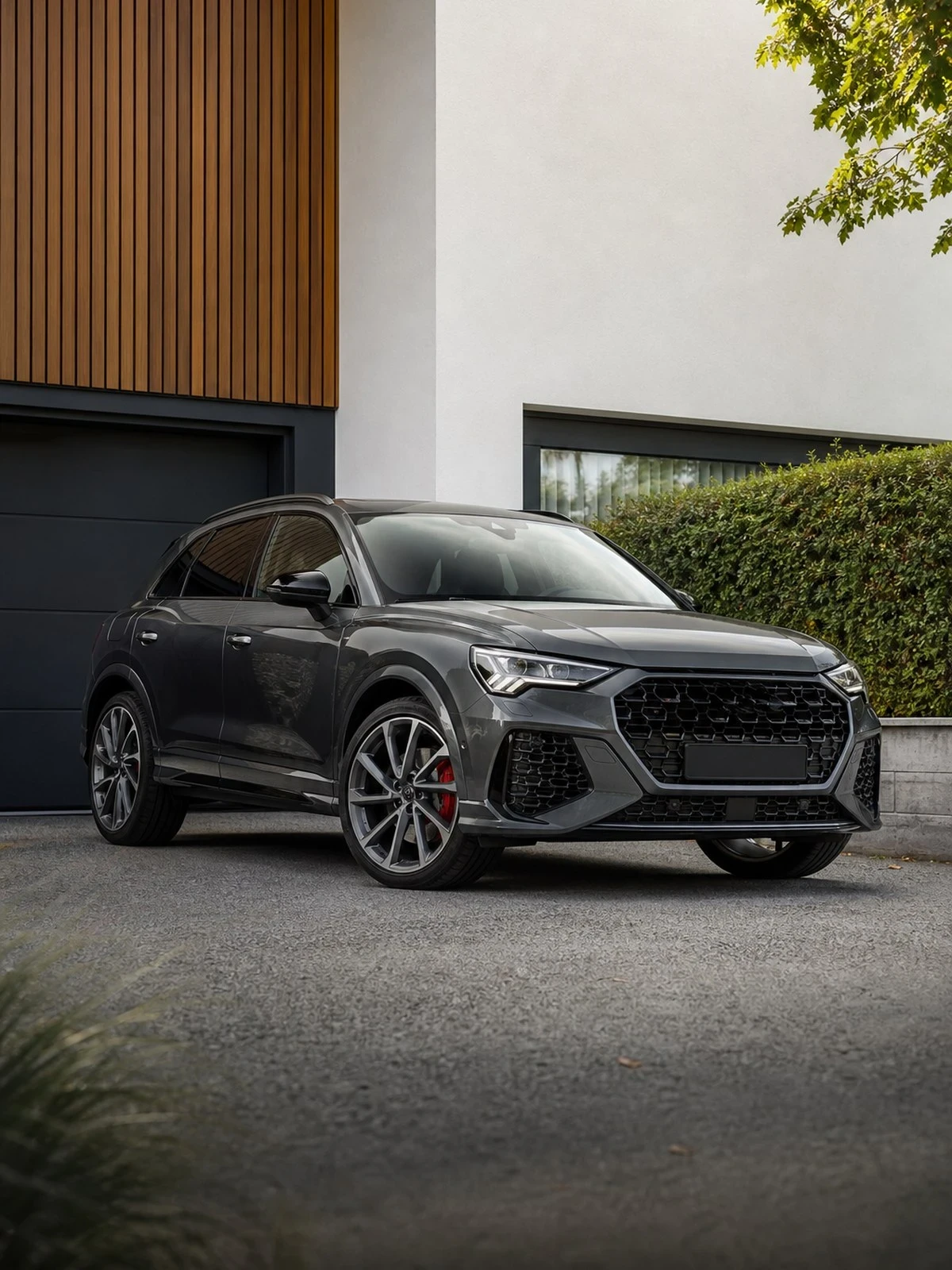
The SQ3 is a heavy family SUV with a sporting drivetrain: high mileage, changing drivers, often a towbar and usually finance or a lease contract behind it.
This page in another language: Nederlands
Work out for yourself what it would cost.
Enter your details; you will receive a proposal within one working day.
A premium indication, not personal advice. Prefer to talk it through? Call 072 - 509 24 56.
On this model it is less about the car itself and more about how it is used. An SUV of this size does the commuting, the holidays and the family journeys, with a roof box or a trailer behind it. That pattern of use determines the annual mileage, the group of drivers and the chance of a claim abroad, and those three points count for more on acceptance than the model designation alone.
Third-party liability insurance is compulsory under Article 2 of the Dutch Motor Insurance Liability Act (WAM). On a heavy vehicle that cover has added significance: in a collision, mass translates into higher damage and more serious injury to the other party, and that is precisely where the open limit of third-party liability cover applies. Damage to the car itself falls under own-damage cover.
Two points determine whether the cover really fits when you claim: the valuation arrangement in relation to your finance or lease contract, and the declaration of accessories such as a towbar, roof rack and trailer. Both only come into play at the moment of a claim, and by then it is too late to change them.
We compare your car insurance across dozens of insurers, explain where the real differences lie, and arrange the switch from start to finish — without you having to chase it yourself.
 Car insurance
 Compare
 Get covered
Three types of cover, with below them the situations that come up most often with this car.
The legally required cover for damage you cause to others.
As well as third-party liability, a fixed list of events: theft, glass, fire, storm and collision with animals.
Also damage to your own car caused by you or without a third party involved.
What is covered
| Situation | Third-party liability | Comprehensive |
|---|---|---|
| Damage you cause to someone else with the SQ3 | Yes | Yes |
| Theft of the car or of parts | No | Yes |
| Glass damage including calibration of the camera | No | Yes |
| Damage to your own car after a single-vehicle accident | No | Yes |
| Damage to a declared towbar or roof rack | No | Provided that |
| Damage during a track day or speed run | No | No |
What is actually covered, including exclusions, limits and the excess, is set out in the policy conditions and the insurance card (verzekeringskaart) that you receive before you take out cover.
Insurers weigh these details differently. That is where your saving is.
We look at the terms as well as the premium, and stay your point of contact when there is a claim.
We are not tied to one insurer and compare on the basis of an objective analysis of several companies.
You call or email someone who knows your file. No menu options, no changing call centres.
We cancel your old policy and align the start date, so you are never a day without cover.
We report the claim and monitor how it is handled. In urgent cases you can reach us on the emergency line.
Customers rate our service on four aspects: personal service, service delivery, availability and the outcome. The reviews are collected and published by NH1816 and come from customers who have actually taken out a policy with Finass Advies B.V. or reported a claim.
Four points that arise more often on this model than on a standard Q3.
If the car is financed or leased, the question is not only whether there will be a payout but how much. On a total loss the insurer pays according to the valuation arrangement on your policy: replacement value as new, purchase price or market value, each with its own term. If your finance runs on longer than that arrangement, a balance remains outstanding on a car you no longer have. Read the term of the arrangement before you compare on premium.
A towbar is an accessory that belongs on the policy. An important distinction: damage you cause to someone else with a coupled trailer usually falls under the third-party cover of the towing car while you are driving; damage to the trailer or caravan itself does not. Separate insurance is needed for that. The same applies to a roof box, a cycle carrier and their contents: those are rarely insured without a separate declaration.
In a family car it is not always the same person behind the wheel. The premium is calculated on the regular driver; if a young adult living at home drives it regularly, that is a different risk from the one on the policy. Declare the group of drivers realistically. Also consider occupants' indemnity or personal accident insurance, because third-party cover pays the other party but not the injuries of you and the family members travelling with you.
The following, among others, are outside the cover: damage to the trailer or caravan itself and to the load on it; hire and paid passenger transport, even occasionally; and mechanical or electronic defects without a collision, such as a failed transmission. Driving without a valid licence or under the influence is also excluded, as are intent and gross fault under Article 7:952 of the Dutch Civil Code. Accessories you did not declare fall under Articles 7:928 and 7:930 of the Dutch Civil Code. You report a claim as soon as reasonably possible (Article 7:941 DCC).
The following, among others, are outside the cover: taking part in speed or skill trials and driving on a track, even on a touring run; wear and tear and mechanical or electronic defects without a collision, such as a failed transmission or clutch; damage while driving without a valid driving licence or under the influence; and damage from hire or carrying passengers for payment. Damage to a coupled trailer or caravan does not fall under the car policy, damage to a wheel or tyre on its own only where it follows from a covered event, and intent and recklessness are excluded under Article 7:952 of the Dutch Civil Code.
If the car is financed, the payout on a total loss can be lower than your outstanding balance. What decides it is the depreciation scheme: replacement value as new, purchase price and market value arrangements differ considerably in duration and conditions. Read which arrangement applies and how long it runs before you compare on premium. Also declare accessories and modifications when you take out the policy (Article 7:928 of the Dutch Civil Code); withholding information can cause the payout to lapse (Article 7:930 of the Dutch Civil Code). You report a claim as soon as reasonably possible (Article 7:941 of the Dutch Civil Code).
This is what people ask us most.
The insurer pays according to the valuation arrangement stated on your policy. If that is the market value and your finance still has years to run, a balance may remain outstanding. So look at the length of the replacement value as new or purchase price arrangement and discuss whether additional cover for the difference makes sense given the term of your contract.
Only for liability, and only while the trailer or caravan is coupled. If you cause damage to someone else with it, that usually falls under the third-party cover of the towing car. Damage to the caravan itself, theft of it and damage while it stands uncoupled call for separate caravan or trailer insurance.
Yes, if that person drives the car regularly. The premium is based on the main driver. A younger driver who has not been declared is a departure from the declaration. When you claim, the insurer can adjust the payout or revise the policy. Travelling as a passenger occasionally, or driving once, is a different matter from weekly use.
Third-party cover pays for injury to occupants and other road users where you are liable, but not for your own injuries as the driver. If you run into a crash barrier in a single-vehicle accident, there is no liable other party. For that situation there is occupants' indemnity insurance or occupants' personal accident insurance, which pays regardless of fault.
Every situation is different. For these situations we have a separate page.
Ask for a no-obligation quote using the registration number. We compare both the premium and the conditions for this version.
Prefer to call? 072 - 509 24 56, weekdays 09:00–17:00.
Claim on the road? Emergency line 06 - 55 20 40 72.
Finass Verzekert is a trading name of Finass Advies B.V. We advise on and arrange non-life insurance on the basis of an objective analysis of several insurers, and receive commission for this from the insurer, which is included in the premium. You pay no separate advice fee. Before you take out cover, we establish your wishes and needs.
You will find our licence, KvK and Kifid details and our complaints procedure at the foot of every page.
This page was compiled by Finass Verzekert (LinkedIn). Last updated on .
The information on this page is general in nature and is not personal advice.
Maandag- Vrijdag: 09:00- 17:00
We use cookies and similar technologies to improve your experience on our website.