

Third-party liability
- Required by law
- As long as the registration is in your name
- Suspend the registration when not in use
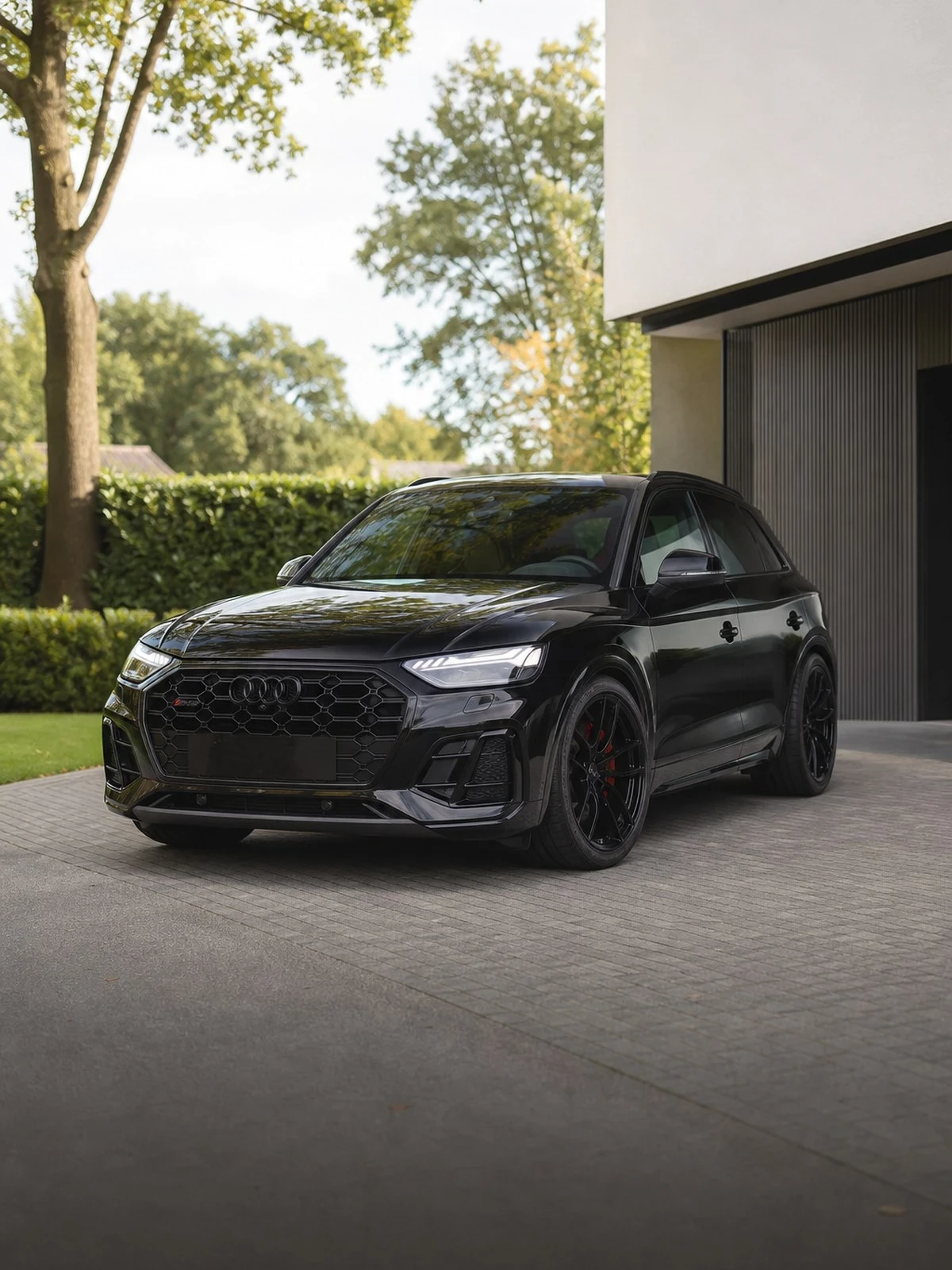
An RS Q5 does not appear in every rating table, and that is precisely why the insurance here starts with establishing the value rather than with the type of cover.
This page in another language: Nederlands
Work out for yourself what it would cost.
Enter your details; you will receive a proposal within one working day.
A premium indication, not personal advice. Prefer to talk it through? Call 072 - 509 24 56.
Not every version within this model range appears in the standard lists insurers work with. If it is an import, a version never officially supplied to the Dutch market or an example built to a different specification, the insurer cannot rate the car at the touch of a button. You only notice the consequence when you claim: there is no self-evident market value that the parties agree on.
The solution is a a valuation beforehand. Article 7:960 DCC provides that you do not receive more than the loss suffered, but it allows the value to be established in advance by experts. Such a valuation report binds both parties for the period of validity set out in the report and the policy. Without a valuation, on a total loss the insurer works from the market value that its own expert establishes, and on a rare version that can be a long way from what you paid.
On an import, watch the paperwork side too: a Dutch registration, an individual approval where one is needed, and watertight documentation of provenance. Without those you will get no further with underwriting. For how the cover is built up, see comprehensive or third-party, fire and theft and the overview Audi car insurance.
We compare your car insurance across dozens of insurers, explain where the real differences lie, and arrange the switch from start to finish — without you having to chase it yourself.
 Car insurance
 Compare
 Get covered
The structure of the cover in three parts, with an overview per situation below.
Damage you cause to others.
Causes beyond your control.
Including damage you cause yourself.
What is covered
| Situation | Third-party liability | Third-party, fire and theft | Comprehensive |
|---|---|---|---|
| Damage to the other party | Yes | Yes | Yes |
| Theft | No | Yes | Yes |
| Fire and storm | No | Yes | Yes |
| Damage you cause yourself | No | No | Yes |
| Wear and mechanical defects | No | No | No |
| Driving without a valid licence | No | No | No |
This overview is general in nature and is not personal advice. What is actually covered, including exclusions, limits and the excess, is set out in the policy conditions and the insurance card (verzekeringskaart) of the insurer; you receive both before you take out cover. Taking out cover without advice? Then read what execution only means for you.
Insurers weigh these details differently. That is where your saving is.
We look at the terms as well as the premium, and stay your point of contact when there is a claim.
We are not tied to one insurer and compare on the basis of an objective analysis of several companies.
You call or email someone who knows your file. No menu options, no changing call centres.
We cancel your old policy and align the start date, so you are never a day without cover.
We report the claim and monitor how it is handled. In urgent cases you can reach us on the emergency line.
Customers rate our service on four aspects: personal service, service delivery, availability and the outcome. The reviews are collected and published by NH1816 and come from customers who have actually taken out a policy with Finass Advies B.V. or reported a claim.
Four points that make the difference between a policy that pays out and one that does not.
A valuation report from a recognised valuer describes the vehicle, the specification, the condition and the value assessed. As long as the report is valid, that figure is the starting point on a total loss; Article 7:960 DCC gives that prior valuation binding force. Without a report the insurer's expert sets the market value after the claim, and you then have that argument at the worst possible moment. Renew the report before the period of validity expires.
When you apply, state exactly which version it is, whether it is an import, the year of manufacture and mileage and which options are fitted. This falls under the duty of disclosure in Article 7:928 DCC. If it turns out afterwards that the model designation declared does not match the vehicle, the insurer can reduce the payout under Article 7:930 DCC, even where the error was unintentional.
On a version never supplied here through official channels, body panels and specific parts are harder to obtain. So when taking out the policy, have it recorded whether the insurer pays for repair with original factory parts or with equivalent alternatives, and whether delivery times from abroad are allowed. Without an agreement in advance, a car is written off as a total loss sooner than it is repaired.
Not covered are any increase in value over time above the valued amount, the cost of parts obtainable only from abroad in so far as your policy excludes that, and damage while taking part in speed events or track use. Wear and mechanical defects fall outside it too. An expired valuation report no longer counts: the market value rule in the conditions then applies again.
This is what people ask us most.
Not as a matter of law, but on a version that does not appear in the standard lists it is the only way to fix the value in advance. Article 7:960 of the Dutch Civil Code gives a prior valuation by experts binding force, as long as the report is valid. Without a report the insurer works on a total loss from the market value its own expert establishes after the event.
That is set out in the report itself and in your policy conditions; insurers apply a fixed period after which the valuation lapses. If the validity expires without a revaluation, you fall back on the market value rule. Put the end date in your diary and have the report renewed before it expires, not afterwards.
Do not simply pick the nearest option, but give the actual specification in writing with the vehicle identification number and the type approval. This falls under the duty of disclosure in Article 7:928 of the Dutch Civil Code. An incorrect model designation can mean the insurer reduces the payout under Article 7:930 DCC when you claim.
No. The number of providers is smaller for unusual or imported versions, and some insurers will only accept with a valuation, with a security requirement or with an increased excess. So supply the registration document, the valuation report and the purchase documentation with your application straight away; that avoids refusals and speeds up underwriting considerably.
Every situation is different. For these situations we have a separate page.
Request a quote without obligation. We will look at which insurer best matches your activities and your risk.
Prefer to call? 072 - 509 24 56, weekdays 09:00–17:00.
Claim on the road? Emergency line 06 - 55 20 40 72.
Finass Verzekert is a trading name of Finass Advies B.V. We advise on and arrange non-life insurance on the basis of an objective analysis of several insurers, and receive commission for this from the insurer, which is included in the premium. You pay no separate advice fee. Before you take out cover, we establish your wishes and needs.
You will find our licence, KvK and Kifid details and our complaints procedure at the foot of every page.
This page was compiled by Finass Verzekert (LinkedIn). Last updated on .
The information on this page is general in nature and is not personal advice.
Maandag- Vrijdag: 09:00- 17:00
We use cookies and similar technologies to improve your experience on our website.