

Third-party liability
- Required by law
- As long as the registration is in your name
- Suspend the registration when not in use
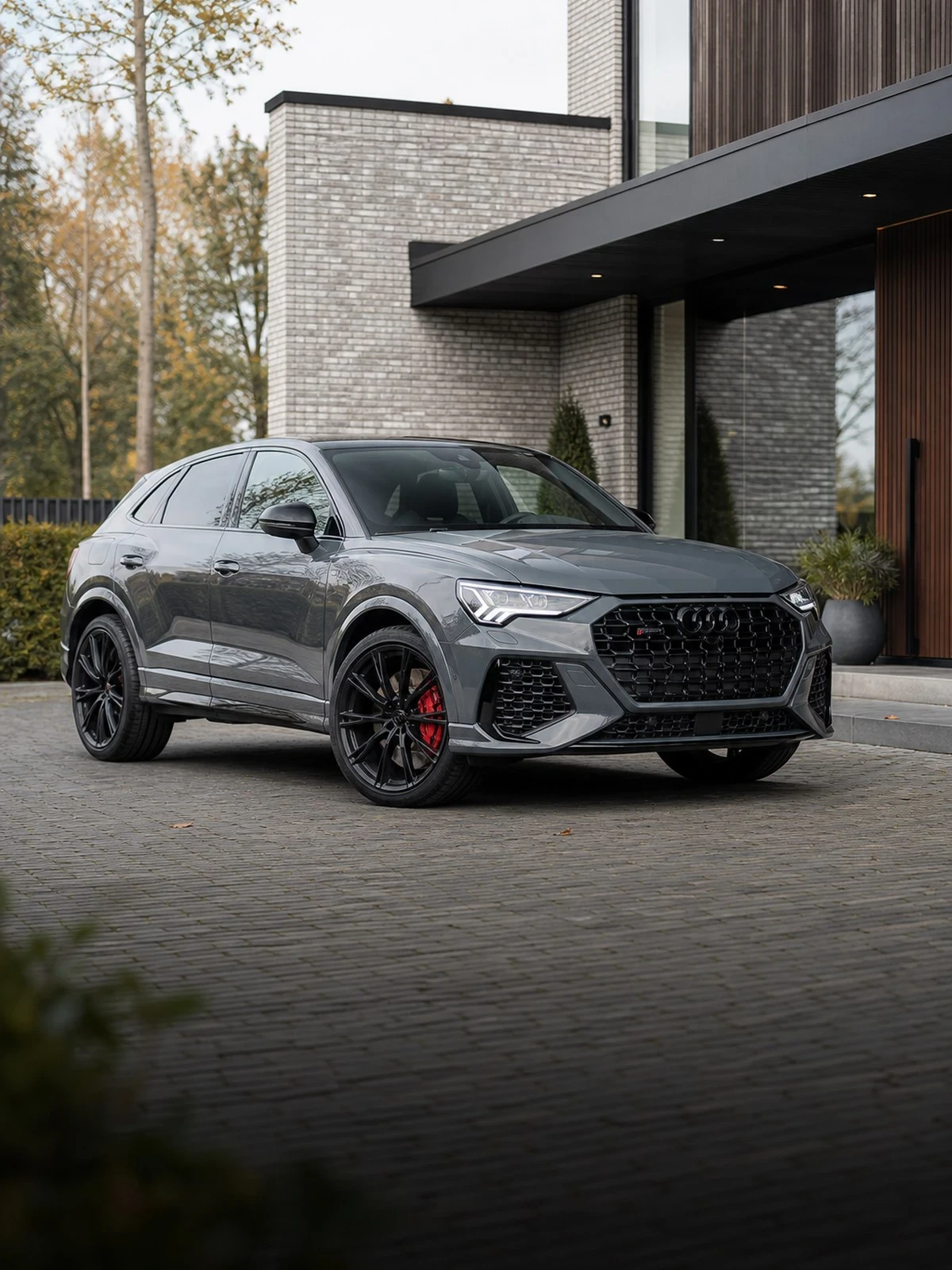
The RS Q3 is a compact car with power that does not belong to that size, and insurers therefore assess it on what happens to it after purchase.
This page in another language: Nederlands
Work out for yourself what it would cost.
Enter your details; you will receive a proposal within one working day.
A premium indication, not personal advice. Prefer to talk it through? Call 072 - 509 24 56.
The RS Q3 is the smallest body in the range with the most powerful drivetrain beneath it. That attracts its own kind of owner and produces its own kind of file: of all the models in this group, this is the car on which something has most often been changed in the engine management, the exhaust or the suspension. For the insurance that is the decisive point, not the height or the weight.
A modification that changes the power, the top speed or the handling is an increase in risk. You must declare it. Article 7:928 DCC governs the duty of disclosure when the insurance is taken out; changes during the term must, under virtually all conditions, be reported within a fixed period. If you conceal a power increase and damage occurs, the insurer can reduce or refuse the payout under Article 7:930 DCC.
Watch too what happens with the car on a circuit. Virtually every policy excludes taking part in speed events, timed runs and driving skill or track days. That also applies where the day is offered as a 'touring run' or 'tuition day'. Ask your insurer in writing in advance what is permitted. For the types of cover see comprehensive or third-party, fire and theft.
We compare your car insurance across dozens of insurers, explain where the real differences lie, and arrange the switch from start to finish — without you having to chase it yourself.
 Car insurance
 Compare
 Get covered
The structure of the cover in three parts, with an overview per situation below.
Damage you cause to others.
Causes beyond your control.
Including damage you cause yourself.
What is covered
| Situation | Third-party liability | Third-party, fire and theft | Comprehensive |
|---|---|---|---|
| Damage to the other party | Yes | Yes | Yes |
| Theft | No | Yes | Yes |
| Fire and storm | No | Yes | Yes |
| Damage you cause yourself | No | No | Yes |
| Wear and mechanical defects | No | No | No |
| Driving without a valid licence | No | No | No |
This overview is general in nature and is not personal advice. What is actually covered, including exclusions, limits and the excess, is set out in the policy conditions and the insurance card (verzekeringskaart) of the insurer; you receive both before you take out cover. Taking out cover without advice? Then read what execution only means for you.
Insurers weigh these details differently. That is where your saving is.
We look at the terms as well as the premium, and stay your point of contact when there is a claim.
We are not tied to one insurer and compare on the basis of an objective analysis of several companies.
You call or email someone who knows your file. No menu options, no changing call centres.
We cancel your old policy and align the start date, so you are never a day without cover.
We report the claim and monitor how it is handled. In urgent cases you can reach us on the emergency line.
Customers rate our service on four aspects: personal service, service delivery, availability and the outcome. The reviews are collected and published by NH1816 and come from customers who have actually taken out a policy with Finass Advies B.V. or reported a claim.
Four points that make the difference between a policy that pays out and one that does not.
Chip tuning, a modified ECU, a different turbo or a sports exhaust that changes the power must be reported. The insurer then reassesses whether it accepts the risk and on what terms. If you do not report it, the question when you claim is whether it would have written the policy on the same terms. Article 7:930 DCC then allows it to reduce or entirely refuse the payout, including on damage unconnected with the modification.
Lowering springs, different wheel sizes, coilovers and modified brake systems change the handling and the braking distance. They also have to meet road traffic law requirements and fit within the type approval. A modification without approval means the vehicle is not permitted on public roads. If you drive it anyway, that affects both the roadworthiness test and the cover. Keep test reports and fitting invoices with your policy papers.
Taking part in competitions, speed trials, timed runs and driving on a closed circuit is excluded on a private policy, including practice and tuition laps. A skid course in your own car also falls under this with many insurers. If you do want to do it, separate day cover is needed. That usually covers liability but not your own car. Assume that in advance and not afterwards.
Also excluded are wear to the clutch, brakes and tyres from hard driving, engine damage from overloading or overheating, and damage resulting from a faulty or badly fitted modification. Intent and wilful recklessness fall under Article 7:952 DCC. On serious speeding offences the insurer pays the other party under Article 2 of the Dutch Motor Insurance Liability Act (WAM), but may refuse the own-damage claim.
This is what people ask us most.
Yes. An increase in power changes the risk the insurer has accepted and must, under virtually all conditions, be reported within a fixed period. If you do not, it can rely on Article 7:930 of the Dutch Civil Code when you claim and reduce or refuse the payout. Report it in writing and keep the confirmation with your policy.
In principle, no. Speed events, timed runs and driving on a closed circuit are excluded as standard, including on a day offered as tuition or a touring run. Separate day cover exists, but it usually only pays for liability towards third parties and not for damage to your own car. Ask for the conditions in advance.
The other party is paid in any event; Article 2 WAM does not allow the insurer to escape that obligation. For your own own-damage claim it is different: in cases of wilful recklessness the insurer can refuse under Article 7:952 of the Dutch Civil Code and recover the amount paid to the other party from the driver. A criminal conviction counts in that assessment.
Only if they have not been declared or are not permitted. Changes to the suspension, wheel size or brakes alter the handling and must stay within the type approval. Report them to the insurer and keep the fitting and test certificates. A modification without approval means the car is not permitted on the road, and that affects your cover too.
Every situation is different. For these situations we have a separate page.
Request a quote without obligation. We will look at which insurer best matches your activities and your risk.
Prefer to call? 072 - 509 24 56, weekdays 09:00–17:00.
Claim on the road? Emergency line 06 - 55 20 40 72.
Finass Verzekert is a trading name of Finass Advies B.V. We advise on and arrange non-life insurance on the basis of an objective analysis of several insurers, and receive commission for this from the insurer, which is included in the premium. You pay no separate advice fee. Before you take out cover, we establish your wishes and needs.
You will find our licence, KvK and Kifid details and our complaints procedure at the foot of every page.
This page was compiled by Finass Verzekert (LinkedIn). Last updated on .
The information on this page is general in nature and is not personal advice.
Maandag- Vrijdag: 09:00- 17:00
We use cookies and similar technologies to improve your experience on our website.