

Third-party liability
- Required by law
- As long as the registration is in your name
- Suspend the registration when not in use
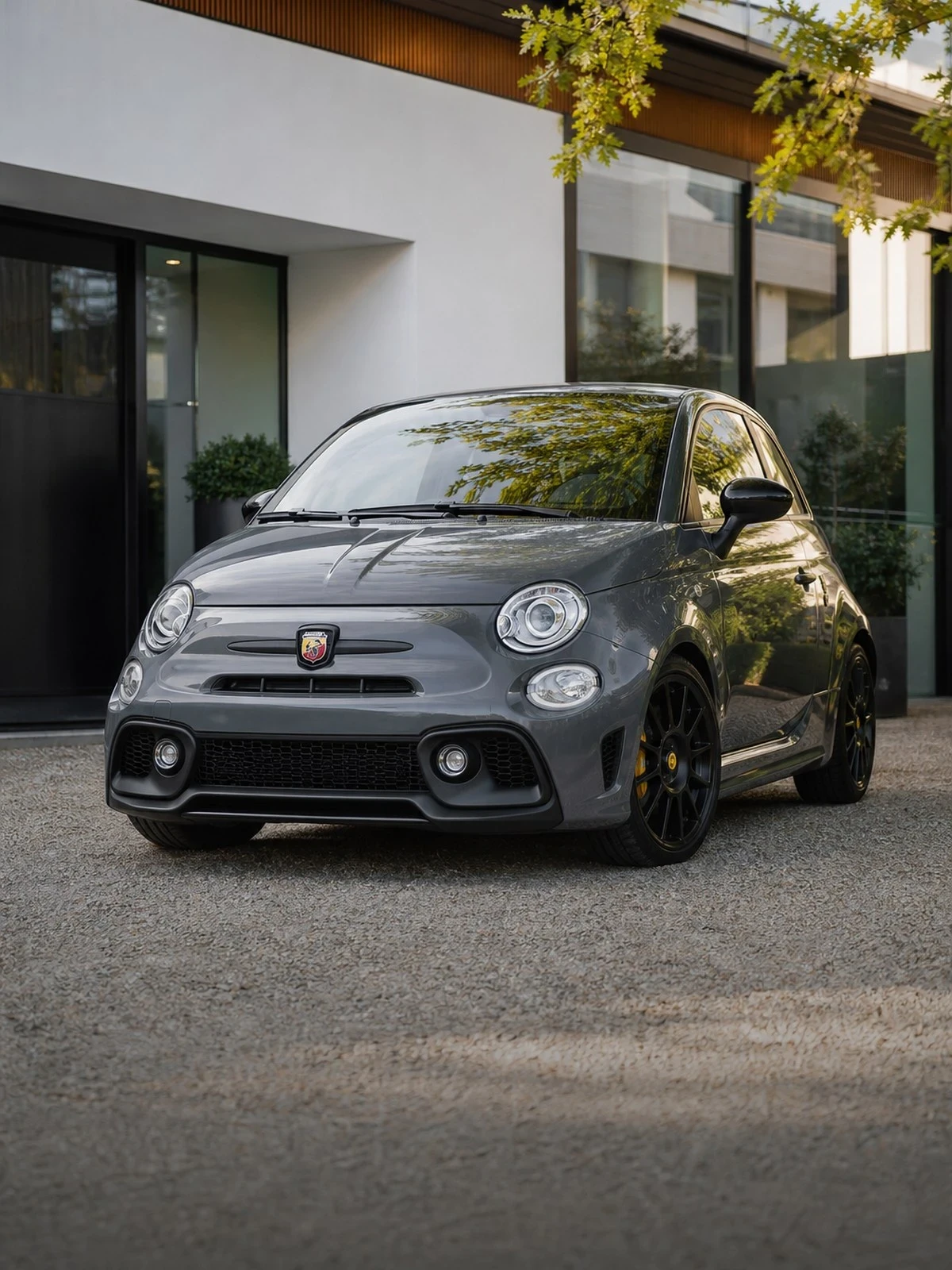
An Abarth is a city car with the power of a sports car. On this car it is that ratio of power to kerb weight that determines both acceptance and the rate.
This page in another language: Nederlands
Work out for yourself what it would cost.
Enter your details; you will receive a proposal within one working day.
A premium indication, not personal advice. Prefer to talk it through? Call 072 - 509 24 56.
Abarth is not a platform in its own right but a development: the 595 and 695 sit on the floorpan of the Fiat 500, the 124 Spider on that of a compact roadster. The body stays small and light, the engine does not. On this type of car, insurers look mainly at power per kilo rather than at dimensions, which puts an Abarth in a higher rating group than an ordinary small car of the kind you will find on our page about MINI.
Few models are modified as often. A different exhaust, larger wheels, a lowering kit, a sports air filter or a remapped engine turns up constantly on second-hand examples. Anything that differs from the factory specification must be declared when you apply; Article 7:928 DCC places that duty of disclosure on you. If you do not, the insurer may under Article 7:930 DCC reduce or refuse the payout, even where the modification had nothing to do with the damage.
The second question is how the car is used. Many Abarths sit alongside a family car and cover few kilometres. That brings the rate down, but ties you to the mileage band you declared. What own-damage cover includes is set out under comprehensive cover.
We compare your car insurance across dozens of insurers, explain where the real differences lie, and arrange the switch from start to finish — without you having to chase it yourself.
 Car insurance
 Compare
 Get covered
The structure of the cover in three parts, with an overview per situation below.
Damage you cause to others.
Causes beyond your control.
Including damage you cause yourself.
What is covered
| Situation | Third-party liability | Third-party, fire and theft | Comprehensive |
|---|---|---|---|
| Damage to the other party | Yes | Yes | Yes |
| Theft | No | Yes | Yes |
| Fire and storm | No | Yes | Yes |
| Damage you cause yourself | No | No | Yes |
| Wear and mechanical defects | No | No | No |
| Driving without a valid licence | No | No | No |
This overview is general in nature and is not personal advice. What is actually covered, including exclusions, limits and the excess, is set out in the policy conditions and the insurance card (verzekeringskaart) of the insurer; you receive both before you take out cover. Taking out cover without advice? Then read what execution only means for you.
Insurers weigh these details differently. That is where your saving is.
We look at the terms as well as the premium, and stay your point of contact when there is a claim.
We are not tied to one insurer and compare on the basis of an objective analysis of several companies.
You call or email someone who knows your file. No menu options, no changing call centres.
We cancel your old policy and align the start date, so you are never a day without cover.
We report the claim and monitor how it is handled. In urgent cases you can reach us on the emergency line.
Customers rate our service on four aspects: personal service, service delivery, availability and the outcome. The reviews are collected and published by NH1816 and come from customers who have actually taken out a policy with Finass Advies B.V. or reported a claim.
Four points that make the difference between a policy that pays out and one that does not.
A Record Monza exhaust, a different set of wheels or a remap increases the value and sometimes the power. Undeclared parts are not an insured interest when you claim: the insurer will pay no more than for the standard specification. If the modification increases the power, it also affects the rating group on which the premium was based. Report every change in writing and keep the confirmation; telling a mechanic is not notice to the insurer.
These cars make short journeys, mostly in built-up areas. What comes to us is not head-on collisions but kerbing damage to wide wheels, a cracked front spoiler on a speed bump, scrapes along the sills and parking damage caused by others. Under comprehensive cover that is paid for, but your excess applies per event and an at-fault claim counts against your no-claims years. With small amounts like these it pays to work out in advance whether claiming is sensible.
The 124 Spider has a fabric hood. Vandalism to that roof, or cutting through it, falls under own-damage cover, and cutting it counts as forced entry. What is taken from the car does not: luggage, clothing, tools and loose electronics are not part of the vehicle. Loose or built-in audio and navigation equipment not fitted at the factory also carries its own limit in the conditions.
If you run the Abarth as a second car, you fall into a low mileage band. That declaration is binding. If the odometer consistently runs higher, report it; otherwise the insurer may reduce the payout proportionately. Note too who drives: no-claims years belong to the main driver. Lending the car to someone who is not known as a driver can affect the cover.
This is what people ask us most.
Yes. Every departure from the factory specification belongs on the policy, even where the power is unchanged. Undeclared parts are not paid for when you claim and can, under Article 7:930 of the Dutch Civil Code, affect the whole payout. When you apply, give a list of what has been fitted and have it recorded up to what amount those items are insured.
It is possible, but not with every company. Because of the combination of low weight and high power, insurers more often set a minimum age here or require a number of no-claims years. We set several insurers' acceptance conditions side by side, so that you do not run into a refusal that then has to be declared on your next application.
Under comprehensive cover, yes, because that is damage you cause yourself. Under third-party, fire and theft, no: that cover names only external causes such as fire, storm, theft and glass damage. For a single damaged wheel, first take your excess into account and bear in mind the loss of no-claims years; paying yourself is often cheaper.
That depends on the market value and on the modifications fitted. If the car carries thousands of euros of parts that you have had insured separately, you largely lose those under third-party, fire and theft. If the car is paid for and the value is limited, third-party, fire and theft is often the more logical choice.
Every situation is different. For these situations we have a separate page.
Request a quote without obligation. We will look at which insurer best matches your activities and your risk.
Prefer to call? 072 - 509 24 56, weekdays 09:00–17:00.
Claim on the road? Emergency line 06 - 55 20 40 72.
Finass Verzekert is a trading name of Finass Advies B.V. We advise on and arrange non-life insurance on the basis of an objective analysis of several insurers, and receive commission for this from the insurer, which is included in the premium. You pay no separate advice fee. Before you take out cover, we establish your wishes and needs.
You will find our licence, KvK and Kifid details and our complaints procedure at the foot of every page.
This page was compiled by Finass Verzekert (LinkedIn). Last updated on .
The information on this page is general in nature and is not personal advice.
Maandag- Vrijdag: 09:00- 17:00
We use cookies and similar technologies to improve your experience on our website.