

Third-party liability
- Required by law
- As long as the registration is in your name
- Suspend the registration when not in use
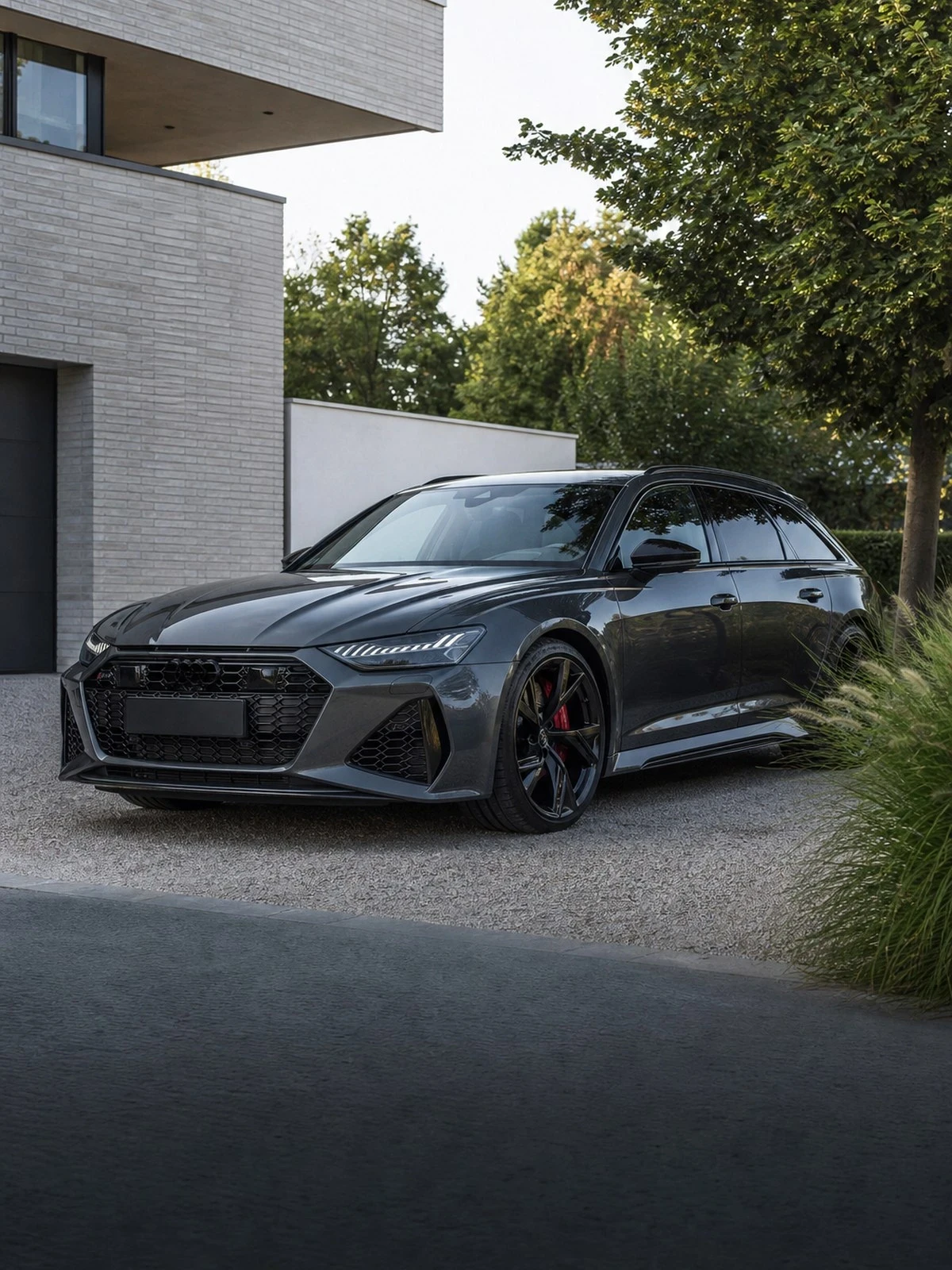
With the RS6, acceptance is not about the engine but about the lock: security, key management and where the car is kept decide whether an insurer will take the risk.
This page in another language: Nederlands
Work out for yourself what it would cost.
Enter your details; you will receive a proposal within one working day.
A premium indication, not personal advice. Prefer to talk it through? Call 072 - 509 24 56.
The RS6 is a large, fast estate that remains sought after on the second-hand market. Insurers place cars in that segment in a higher theft class, and that translates into requirements on acceptance: an approved alarm or immobiliser system, often supplemented by a tracking system, and an agreement about where the car is kept at night. Those requirements appear on the policy as warranty clause and they are not advice.
The practical problem is called keyless entry. On a car that unlocks and starts as soon as the key is nearby, the signal from that key can be picked up and amplified. The car then thinks the key is there. No signs of forced entry are left behind, and that is precisely what makes handling the claim difficult: the insurer will want to know where both keys were and whether the system was switched on. So keep keys in a shielded pouch or tin.
If things do go wrong, Article 7:941 DCC requires you to report the theft as soon as possible. Report it to the police straight away, hand in both keys and the complete registration document, and register the vehicle with the national stolen vehicle register. For how the cover is built up, see comprehensive cover.
We compare your car insurance across dozens of insurers, explain where the real differences lie, and arrange the switch from start to finish — without you having to chase it yourself.
 Car insurance
 Compare
 Get covered
The structure of the cover in three parts, with an overview per situation below.
Damage you cause to others.
Causes beyond your control.
Including damage you cause yourself.
What is covered
| Situation | Third-party liability | Third-party, fire and theft | Comprehensive |
|---|---|---|---|
| Damage to the other party | Yes | Yes | Yes |
| Theft | No | Yes | Yes |
| Fire and storm | No | Yes | Yes |
| Damage you cause yourself | No | No | Yes |
| Wear and mechanical defects | No | No | No |
| Driving without a valid licence | No | No | No |
This overview is general in nature and is not personal advice. What is actually covered, including exclusions, limits and the excess, is set out in the policy conditions and the insurance card (verzekeringskaart) of the insurer; you receive both before you take out cover. Taking out cover without advice? Then read what execution only means for you.
Insurers weigh these details differently. That is where your saving is.
We look at the terms as well as the premium, and stay your point of contact when there is a claim.
We are not tied to one insurer and compare on the basis of an objective analysis of several companies.
You call or email someone who knows your file. No menu options, no changing call centres.
We cancel your old policy and align the start date, so you are never a day without cover.
We report the claim and monitor how it is handled. In urgent cases you can reach us on the emergency line.
Customers rate our service on four aspects: personal service, service delivery, availability and the outcome. The reviews are collected and published by NH1816 and come from customers who have actually taken out a policy with Finass Advies B.V. or reported a claim.
Four points that make the difference between a policy that pays out and one that does not.
If your policy states an approved alarm or tracking system class, that installation must be fitted, certified and switched on. If the car is stolen while the system was not activated or the maintenance certificate had expired, the insurer can refuse to pay. Keep the installation certificate and the annual inspection certificates with your policy papers, and report any change of installer or subscription.
In a relay attack the signal from your key is picked up inside the house and passed on to the car. There is no forced entry, no glass damage and no alarm. So do not leave keys by the front door, use a shielding pouch and, where possible, switch on the key's motion detection so that it stops transmitting once it is at rest. When you report the theft, state precisely where both keys were; that question comes up in every theft file.
Theft while the key was in the ignition or in the car is excluded under practically every policy. That also applies at the charging point, at the pump and on the drive with the engine running. If you cannot produce both keys after a theft, the insurer will hold the claim until it is clear where the missing key is. If a key is missing after a burglary at your home, report that immediately and have the locks recoded.
Besides the points mentioned, the following remain excluded: joyriding or misappropriation by someone to whom you handed the car voluntarily, damage while driving on a circuit or in speed events, and wear or mechanical defects. If you fail to mention an earlier theft or an earlier refusal when you apply, that touches on the duty of disclosure in Article 7:928 DCC and the payout can be reduced under Article 7:930 DCC.
This is what people ask us most.
Not by law, but at this value and theft class an insurer often sets it as a condition of acceptance. If the requirement appears on the policy as a warranty clause, the system must be fitted, certified and active, including a current subscription. If that subscription lapses, you no longer meet the clause and the insurer can refuse to pay after a theft.
In principle yes, because theft is the insured event and not the method. But the insurer will investigate: where both keys were, whether the security was switched on and whether the police report tallies. If you cannot produce both keys, the handling stalls. So co-operate with the investigation and supply the documents requested straight away.
Report it to the police immediately and notify your insurer; Article 7:941 of the Dutch Civil Code requires notification as soon as possible. Then hand in both keys, the registration document and the purchase invoice, and have the vehicle registered as missing. Bear in mind that the conditions set a waiting period before any payment is made.
Against a relay attack it does: a shielding pouch blocks the signal, so the key cannot be picked up and amplified inside the house. Many keys also have a motion sensor that stops transmission once the key is at rest. That function can often be enabled through the dealer. Both measures cost little and remove the most commonly used method.
Every situation is different. For these situations we have a separate page.
Request a quote without obligation. We will look at which insurer best matches your activities and your risk.
Prefer to call? 072 - 509 24 56, weekdays 09:00–17:00.
Claim on the road? Emergency line 06 - 55 20 40 72.
Finass Verzekert is a trading name of Finass Advies B.V. We advise on and arrange non-life insurance on the basis of an objective analysis of several insurers, and receive commission for this from the insurer, which is included in the premium. You pay no separate advice fee. Before you take out cover, we establish your wishes and needs.
You will find our licence, KvK and Kifid details and our complaints procedure at the foot of every page.
This page was compiled by Finass Verzekert (LinkedIn). Last updated on .
The information on this page is general in nature and is not personal advice.
Maandag- Vrijdag: 09:00- 17:00
We use cookies and similar technologies to improve your experience on our website.