Third-party liability insurance
- Damage to other vehicles
- Injury to third parties
- Damage to objects
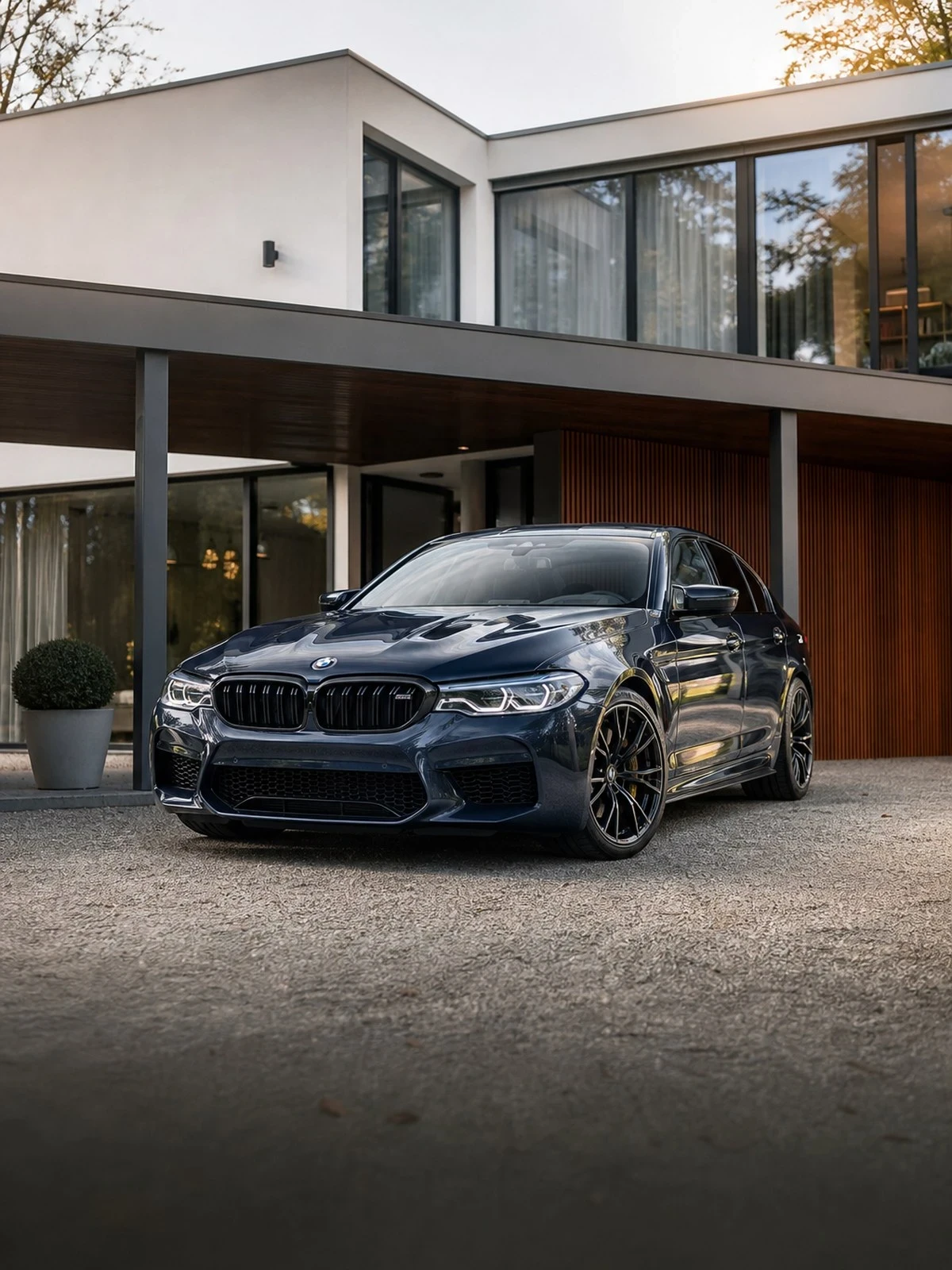
With the M5 the first question is not what the premium will be, but which insurer will accept the combination of this power output and this driver at all.
This page in another language: Nederlands
The calculator and the quote form below are in Dutch. Prefer to do this in English? Email info@finassverzekert.nl or call 072 - 509 24 56 and we will take it from there.
Work out for yourself what it would cost.
Enter your details; you will receive a proposal within one working day.
A premium indication, not personal advice. Prefer to talk it through? Call 072 - 509 24 56.
The M5 is a large saloon with a power output well above average. That has consequences at the start of the process: many companies apply an upper limit in kilowatts, a minimum age for the driver and a minimum number of no-claims years. An application that is correct on paper can still be refused because the car falls outside the underwriting framework. That is not a question of premium but of access.
If you are refused somewhere, that counts on the next application. Almost every application form asks whether an insurer has previously refused you, cancelled a policy or imposed special conditions. You answer that question truthfully: Article 7:928 of the Dutch Civil Code imposes the duty of disclosure and Article 7:930 of the Dutch Civil Code determines the consequences where something has been concealed. Concealment produces a policy that turns out to be worthless on the first large claim.
And there is the liability side. Mass and speed determine the severity of injury in a collision, and injury claims are the most expensive thing third-party liability cover has to deal with. For the two-door version with a different pattern of use, read Insuring a BMW M4.
We compare your youngtimer insurance across dozens of insurers, explain where the real differences lie, and arrange the switch from start to finish — without you having to chase it yourself.
 Youngtimer insurance
 Compare
 Get covered
The structure of the cover in three parts, with an overview per situation below.
Damage you cause to others with the vehicle. Not your own vehicle.
Also, damage to your own vehicle from external causes.
Including damage to your own vehicle through your own fault.
What is covered
| Situation | Third-party liability | Third-party liability + fire and theft | Comprehensive |
|---|---|---|---|
| Damage to another vehicle | Yes | Yes | Yes |
| Theft of your BMW M5 | No | Yes | Yes |
| Windscreen damage or stone chips | No | Yes | Yes |
| Storm, hail and fire damage | No | Yes | Yes |
| Driving into a bollard yourself | No | No | Yes |
| Track use, wear and intent | No | No | No |
This overview is general in nature and is not personal advice. What is actually covered, including exclusions, limits and the excess, is set out in the policy conditions and the insurance card (verzekeringskaart) of the insurer; you receive both before you take out cover. Taking out cover without advice? Then read what execution only means for you.
Insurers weigh these details differently. That is where your saving is.
We look at the terms as well as the premium, and stay your point of contact when there is a claim.
We are not tied to one insurer and compare on the basis of an objective analysis of several companies.
You call or email someone who knows your file. No menu options, no changing call centres.
We cancel your old policy and align the start date, so you are never a day without cover.
We report the claim and monitor how it is handled. In urgent cases you can reach us on the emergency line.
Customers rate our service on four aspects: personal service, service delivery, availability and the outcome. The reviews are collected and published by NH1816 and come from customers who have actually taken out a policy with Finass Advies B.V. or reported a claim.
Four points that make the difference between a policy that pays out and one that does not.
Insurers work with power limits and with requirements for the driver: a minimum age, a number of years holding a licence and a claim-free record. If you do not meet those, you do not reach the standard rates but end up with an underwriting agent or a specialist provider. That is a realistic route, but with different conditions. Have your situation put to several companies before you register the car in your name.
An earlier refusal, cancellation or rescission has to be declared, even where it concerned another car insurance. The same applies to a criminal record within the period asked about. Article 7:928 of the Dutch Civil Code makes that a duty and Article 7:930 of the Dutch Civil Code gives the insurer the right, where something has been concealed, to reduce or refuse the payment. A refusal declared honestly often still leads to a policy. A concealed refusal never leads to a payment.
Third-party liability cover pays for the damage you cause to others, and with injury that mounts up a long way: loss of earning capacity, care, adaptations to the home. Article 2 of the Dutch Motor Insurance Liability Act (WAM) ensures the victim is paid, even where you breached a policy condition. The insurer may then recover that amount from you. Outside the Netherlands different statutory minimums apply; check your cover for the countries where you drive.
Excluded are: taking part in competitions, speed events and use on a circuit, including during training; driving under the influence of alcohol or drugs and driving without a valid licence; and damage caused intentionally or through wilful recklessness (Article 7:952 of the Dutch Civil Code). Hire and shared use also fall outside it. In cases of extreme speeding the insurer can use the right of recovery the WAM gives it.
Repairs call for an M-certified repairer. Not every repairer may work on it.
Not every company applies the same policy for this make. With unusual versions, the question is not what it costs but who will accept it.
This is what people ask us most.
A refusal means the car falls outside that company's underwriting framework, not that you are uninsurable. There are underwriting agents and specialist providers that do accept heavier cars, sometimes with extra requirements as to storage, security or drivers. State the earlier refusal on the next application; that is compulsory and in practice rarely a blockage if you declare it of your own accord.
Yes. The question about earlier cancellations, refusals and special conditions appears on virtually every form and falls under the duty of disclosure in Article 7:928 of the Dutch Civil Code. If you conceal it and it comes to light after a claim, the insurer can, under Article 7:930 of the Dutch Civil Code, reduce or refuse the payment entirely and cancel the policy after all. Declaring it costs premium, concealing it costs cover.
You can and it brings the premium down. The policy schedule then states that only you drive, or only drivers above a certain age. The downside is that a claim caused by someone outside that leads to an increased excess or to the absence of own-damage cover. The third-party liability cover does continue to work towards the injured party under the WAM, possibly with recovery from you.
The injured party is paid. That is guaranteed by Article 2 of the Dutch Motor Insurance Liability Act (WAM) whatever you did wrong. For you the position is different. Where there is wilful recklessness or intent, the exclusion in Article 7:952 of the Dutch Civil Code applies to your own damage and the insurer can recover the amount paid to the third party from you. With injury claims that recovery mounts up a long way.
Every situation is different. For these situations we have a separate page.
Request a quote without obligation. We will look at which insurer best matches your activities and your risk.
Prefer to call? 072 - 509 24 56, weekdays 09:00–17:00.
Claim on the road? Emergency line 06 - 55 20 40 72.
Finass Verzekert is a trading name of Finass Advies B.V. We advise on and arrange non-life insurance on the basis of an objective analysis of several insurers, and receive commission for this from the insurer, which is included in the premium. You pay no separate advice fee. Before you take out cover, we establish your wishes and needs.
You will find our licence, KvK and Kifid details and our complaints procedure at the foot of every page.
This page was compiled by Finass Verzekert. Last updated on .
The information on this page is general in nature and is not personal advice.
Maandag- Vrijdag: 09:00- 17:00
We use cookies and similar technologies to improve your experience on our website.