

Third-party liability insurance
- Damage to other vehicles
- Injury to third parties
- Damage to objects
A youngtimer policy is not a discount but a separate set of conditions, with requirements as to age, use and storage that you have to meet all year round.
This page in another language: Nederlands
Work out for yourself what it would cost.
Enter your details; you will receive a proposal within one working day.
A premium indication, not personal advice. Prefer to talk it through? Call 072 - 509 24 56.
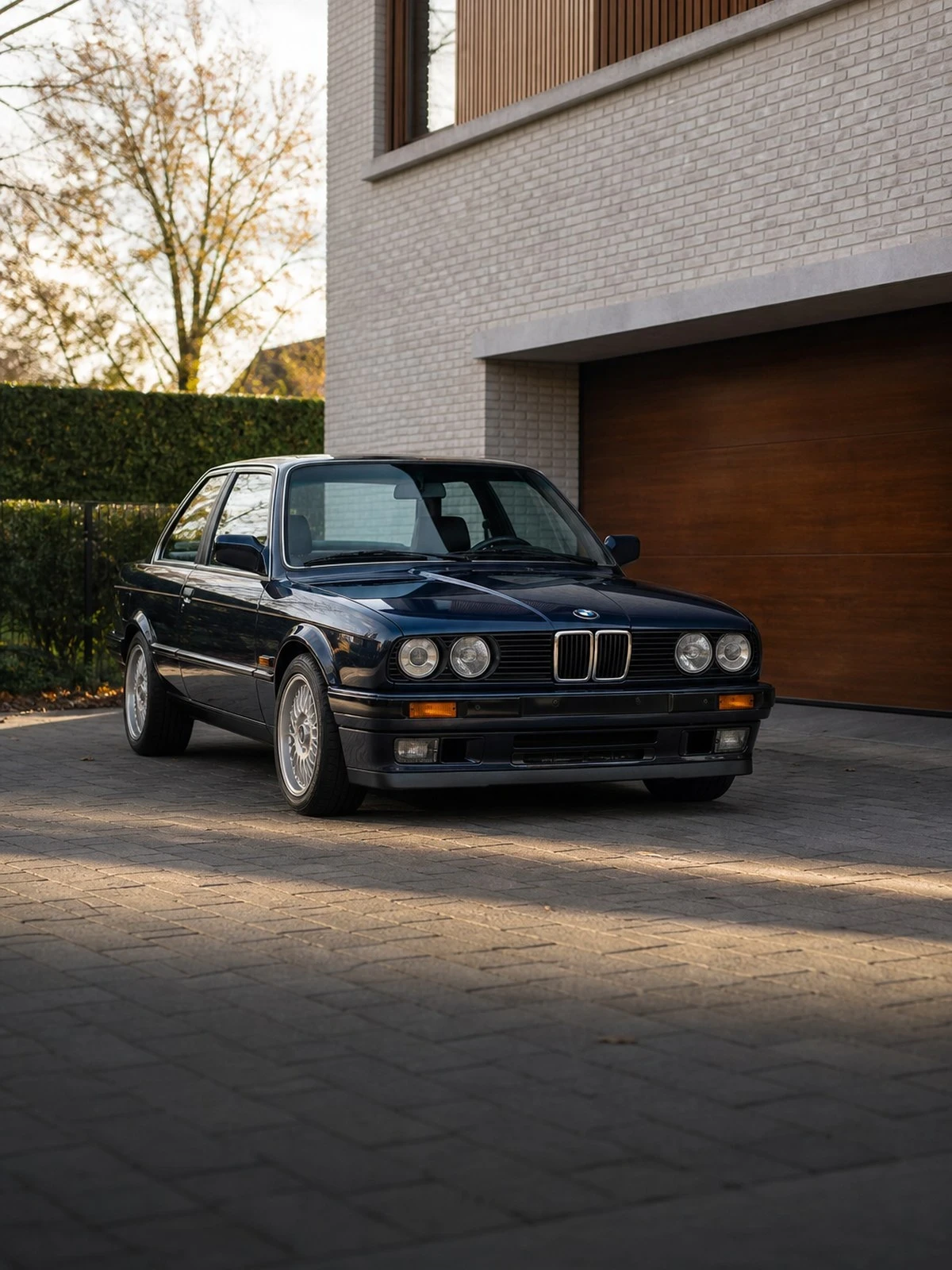
For a BMW of roughly fifteen years old or more, insurers offer a separate type of policy. Conditions attach to it: another car must be available for everyday use, the annual mileage is limited, the car is kept in storage and the driver has to meet a minimum age. If you meet those points, the car is assessed more favourably. If you no longer meet them during the term, that is a change in risk you have to report.
The second question is the value. On an ordinary policy a loss adjuster establishes the market value after the claim, and that works out badly on a car where the market varies. With a valuation report from a recognised expert the amount is fixed in advance; Article 7:960 of the Dutch Civil Code makes such a valuation binding as long as the report is valid. Have the condition, the odometer reading and the history recorded in the report.
The third point is what is simply wrong with an old car. Rust, wear and deferred maintenance are excluded in every form of own-damage cover. For other makes from the same period, read Insuring a Mercedes-Benz youngtimer.
We compare your youngtimer insurance across dozens of insurers, explain where the real differences lie, and arrange the switch from start to finish — without you having to chase it yourself.
 Youngtimer insurance
 Compare
 Get covered
The structure of the cover in three parts, with an overview per situation below.
Damage you cause to others with the vehicle. Not your own vehicle.
Also, damage to your own vehicle from external causes.
Including damage to your own vehicle through your own fault.
What is covered
| Situation | Third-party liability | Third-party liability + fire and theft | Comprehensive |
|---|---|---|---|
| Damage to another vehicle | Yes | Yes | Yes |
| Theft of your BMW youngtimer | No | Yes | Yes |
| Windscreen damage or stone chips | No | Yes | Yes |
| Storm, hail and fire damage | No | Yes | Yes |
| Driving into a bollard yourself | No | No | Yes |
| Track use, wear and intent | No | No | No |
This overview is general in nature and is not personal advice. What is actually covered, including exclusions, limits and the excess, is set out in the policy conditions and the insurance card (verzekeringskaart) of the insurer; you receive both before you take out cover. Taking out cover without advice? Then read what execution only means for you.
Insurers weigh these details differently. That is where your saving is.
We look at the terms as well as the premium, and stay your point of contact when there is a claim.
We are not tied to one insurer and compare on the basis of an objective analysis of several companies.
You call or email someone who knows your file. No menu options, no changing call centres.
We cancel your old policy and align the start date, so you are never a day without cover.
We report the claim and monitor how it is handled. In urgent cases you can reach us on the emergency line.
Customers rate our service on four aspects: personal service, service delivery, availability and the outcome. The reviews are collected and published by NH1816 and come from customers who have actually taken out a policy with Finass Advies B.V. or reported a claim.
Four points that make the difference between a policy that pays out and one that does not.
The second car, the limited mileage and the locked storage are not wishes but clauses on your policy schedule. If the youngtimer starts going to work every day after all, or the other car disappears from your household, the risk on which the underwriting was based changes. Report that in writing. If it emerges after a claim that the situation had long been different, the insurer can rely on Article 7:930 of the Dutch Civil Code against you.
For a well-maintained E30, E36, E39 or E46 the asking price can be well above the average market value. A valuation report fixes the value in advance and prevents you ending up in an argument with a loss adjuster's report after a total loss. Such a report has a limited period of validity and has to be renewed afterwards, certainly if you are restoring the car. Have photographs, the odometer reading, the version and originality recorded in the report.
Rusted-through wheel arches, a worn clutch, a leaking radiator hose: those are not insured events but the condition of the car. Consequential damage from a defect you knew about also falls outside the cover. Keep service invoices and inspection reports; they show that you kept the car up to standard and are the first thing requested in a fire or claims investigation. Without that documentation your position is weak.
Bodywork, interior parts and version-specific components are becoming ever harder to obtain new for these models. The repairer then falls back on used or reproduction parts, and conditions differ on payment for those. Ask in advance how your insurer deals with used parts and whether you may nominate a specialist yourself. Replacement transport is usually not included as standard on a youngtimer policy.
Parts are becoming scarcer, which pushes up repair time and costs.
Not every company applies the same policy for this make. With unusual versions, the question is not what it costs but who will accept it.
This is what people ask us most.
In reality a car qualifies from about fifteen years old, but the limit differs per insurer and some apply a different age or an upper limit after which the classic car policy begins. Alongside the age of the car, the conditions of use count. Have your situation put to several companies. The age limit alone does not determine whether you fit.
On most youngtimer covers you do. The scheme assumes the car is not your everyday transport. That is why insurers ask for a second car in the household. If that car disappears, report it straight away. If you keep driving without reporting it on a policy whose conditions no longer fit, you run the risk that a claim is not paid in full.
No. Rust is a gradual process and counts as wear, which is excluded in every form of own-damage cover. The consequences of rust, such as a sagging mounting or a leak, are also at your expense. What can be covered is sudden external damage. Have the underside checked periodically and keep the invoices; that is your only supporting evidence in a claim.
In a total loss or theft the market value is then established by a loss adjuster acting for the insurer, on the basis of comparable cars in the market. For a well-maintained example that often works out lower than what you paid or invested yourself. You can dispute the assessment and instruct an independent loss adjuster, but that takes time. A valuation in advance avoids the whole argument.
Every situation is different. For these situations we have a separate page.
Request a quote without obligation. We will look at which insurer best matches your activities and your risk.
Prefer to call? 072 - 509 24 56, weekdays 09:00–17:00.
Claim on the road? Emergency line 06 - 55 20 40 72.
Finass Verzekert is a trading name of Finass Advies B.V. We advise on and arrange non-life insurance on the basis of an objective analysis of several insurers, and receive commission for this from the insurer, which is included in the premium. You pay no separate advice fee. Before you take out cover, we establish your wishes and needs.
You will find our licence, KvK and Kifid details and our complaints procedure at the foot of every page.
This page was compiled by Finass Verzekert (LinkedIn). Last updated on .
The information on this page is general in nature and is not personal advice.
Maandag- Vrijdag: 09:00- 17:00
We use cookies and similar technologies to improve your experience on our website.