

Third-party liability
- Required by law
- As long as the registration is in your name
- Suspend the registration when not in use
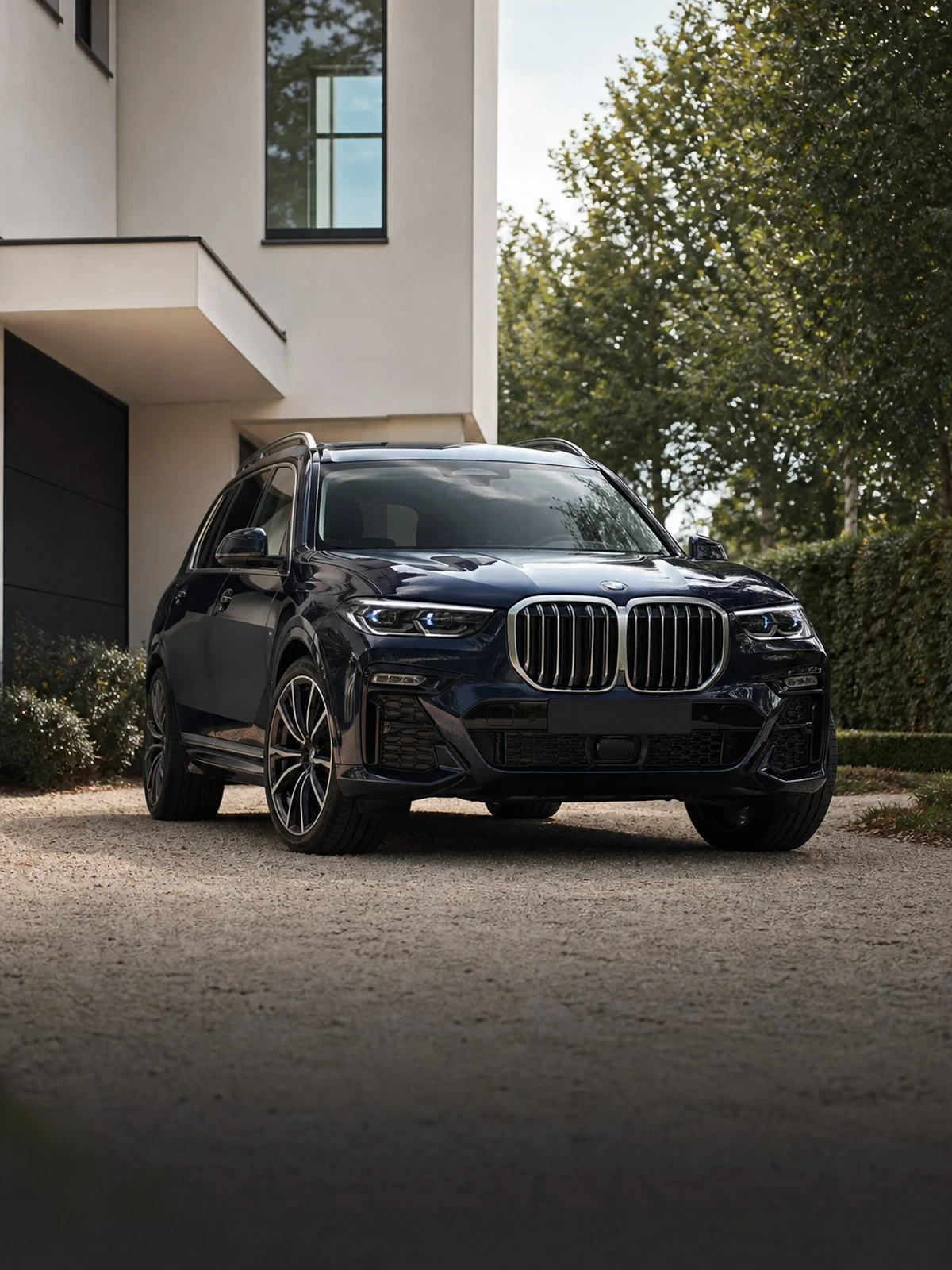
The X7 is so large that most claims come not from traffic but from stationary obstacles: barriers, ramps and garage doors.
This page in another language: Nederlands
Work out for yourself what it would cost.
Enter your details; you will receive a proposal within one working day.
A premium indication, not personal advice. Prefer to talk it through? Call 072 - 509 24 56.
The X7 is the largest model in the marque's SUV range: long, wide and tall, with a turning circle that barely fits in a multi-storey car park. That shifts the claims picture. Where an ordinary car collides with another car, this one hits fixed objects: a ceiling beam, a sprinkler pipe, a barrier, the edge of a ramp or the frame of your own garage.
For insurance purposes those are two separate questions. The damage to the car itself falls under own-damage cover and only under the comprehensive version, because this is damage you cause yourself. The damage to someone else's building or installation falls under the third-party cover in Article 2 of the Dutch Motor Insurance Liability Act (WAM), because as the driver you caused it unlawfully within the meaning of Article 6:162 DCC.
It can work the other way round too. If the height sign at the entrance is missing, a barrier comes down too early or a defective structure comes loose, the possessor of the building may be liable under Article 6:174 DCC. Record the situation photographically on the spot. Those images determine afterwards who pays. For the forms of cover, see comprehensive or third-party, fire and theft.
We compare your car insurance across dozens of insurers, explain where the real differences lie, and arrange the switch from start to finish — without you having to chase it yourself.
 Car insurance
 Compare
 Get covered
The structure of the cover in three parts, with an overview per situation below.
Damage you cause to others.
Causes beyond your control.
Including damage you cause yourself.
What is covered
| Situation | Third-party liability | Third-party, fire and theft | Comprehensive |
|---|---|---|---|
| Damage to the other party | Yes | Yes | Yes |
| Theft | No | Yes | Yes |
| Fire and storm | No | Yes | Yes |
| Damage you cause yourself | No | No | Yes |
| Wear and mechanical defects | No | No | No |
| Driving without a valid licence | No | No | No |
This overview is general in nature and is not personal advice. What is actually covered, including exclusions, limits and the excess, is set out in the policy conditions and the insurance card (verzekeringskaart) of the insurer; you receive both before you take out cover. Taking out cover without advice? Then read what execution only means for you.
Insurers weigh these details differently. That is where your saving is.
We look at the terms as well as the premium, and stay your point of contact when there is a claim.
We are not tied to one insurer and compare on the basis of an objective analysis of several companies.
You call or email someone who knows your file. No menu options, no changing call centres.
We cancel your old policy and align the start date, so you are never a day without cover.
We report the claim and monitor how it is handled. In urgent cases you can reach us on the emergency line.
Customers rate our service on four aspects: personal service, service delivery, availability and the outcome. The reviews are collected and published by NH1816 and come from customers who have actually taken out a policy with Finass Advies B.V. or reported a claim.
Four points that make the difference between a policy that pays out and one that does not.
Know the exact height of your car including roof rails, a roof box or a cycle carrier, and allow for the suspension setting: with air suspension the car sits considerably lower in its lowest setting than at the ride height for rough surfaces. If you drive into a car park that the sign says is too low, it is your mistake and not the operator's. Without comprehensive cover the damage to your own roof then remains entirely at your expense.
If you drive into the garage door, the carport or the garden gate of your own home, third-party cover does not pay: it is intended for damage to others. For the damage to your own building you have to turn to your home or buildings insurance (opstalverzekering), which has exclusions of its own. In rented accommodation it is different: the landlord is then a third party, and their loss does in principle fall under the car's third-party cover.
Surround-view cameras, parking sensors and automatic parking functions help, but the driver remains responsible. A sensor that fails to see a low concrete edge or a protruding pipe is no ground for putting the damage onto the manufacturer. Where a system demonstrably fails because of a defect, product liability under Article 6:185 DCCcomes into play, but that is a heavy burden of proof and is separate from your own own-damage cover.
Not covered are damage to property you own or have in your care, damage caused by ignoring a sign you could have seen, and damage to loose roof bars, roof boxes or cycle carriers. A fall in value after repair and damage while the car is hired out also stay outside it. Intent and wilful recklessness fall under Article 7:952 DCC and lead to a refusal.
This is what people ask us most.
The damage to the building falls under your car's third-party cover, because as the driver you cause it to someone else. The damage to your own roof only falls under comprehensive cover. If a height sign was missing or the structure was defective, you can hold the operator liable under Article 6:174 of the Dutch Civil Code; photograph the situation straight away.
Not through the car insurance. Third-party cover pays only for damage to others, and your own building is not that. For that you have to turn to your home or buildings insurance. If you rent the property, the landlord is a third party and their loss does in principle fall under the car's third-party cover. The damage to the car itself runs through own-damage cover.
Yes. A single-vehicle collision with a fixed object is an at-fault claim and puts your no-claims step back, even where nobody else was involved. So ask for a repair estimate first and set it against your excess. Do report the incident within the period in your conditions, even if you decide to pay yourself.
Your own-damage cover pays for the repair of your own car and your third-party cover for the damage to others. The systems change nothing about that. The driver remains responsible for manoeuvring. Only where there is a demonstrable defect in the product can the manufacturer be held liable under Article 6:185 of the Dutch Civil Code, but that burden of proof lies entirely with you.
Every situation is different. For these situations we have a separate page.
Request a quote without obligation. We will look at which insurer best matches your activities and your risk.
Prefer to call? 072 - 509 24 56, weekdays 09:00–17:00.
Claim on the road? Emergency line 06 - 55 20 40 72.
Finass Verzekert is a trading name of Finass Advies B.V. We advise on and arrange non-life insurance on the basis of an objective analysis of several insurers, and receive commission for this from the insurer, which is included in the premium. You pay no separate advice fee. Before you take out cover, we establish your wishes and needs.
You will find our licence, KvK and Kifid details and our complaints procedure at the foot of every page.
This page was compiled by Finass Verzekert (LinkedIn). Last updated on .
The information on this page is general in nature and is not personal advice.
Maandag- Vrijdag: 09:00- 17:00
We use cookies and similar technologies to improve your experience on our website.