

Third-party liability
- Required by law
- As long as the registration is in your name
- Suspend the registration when not in use
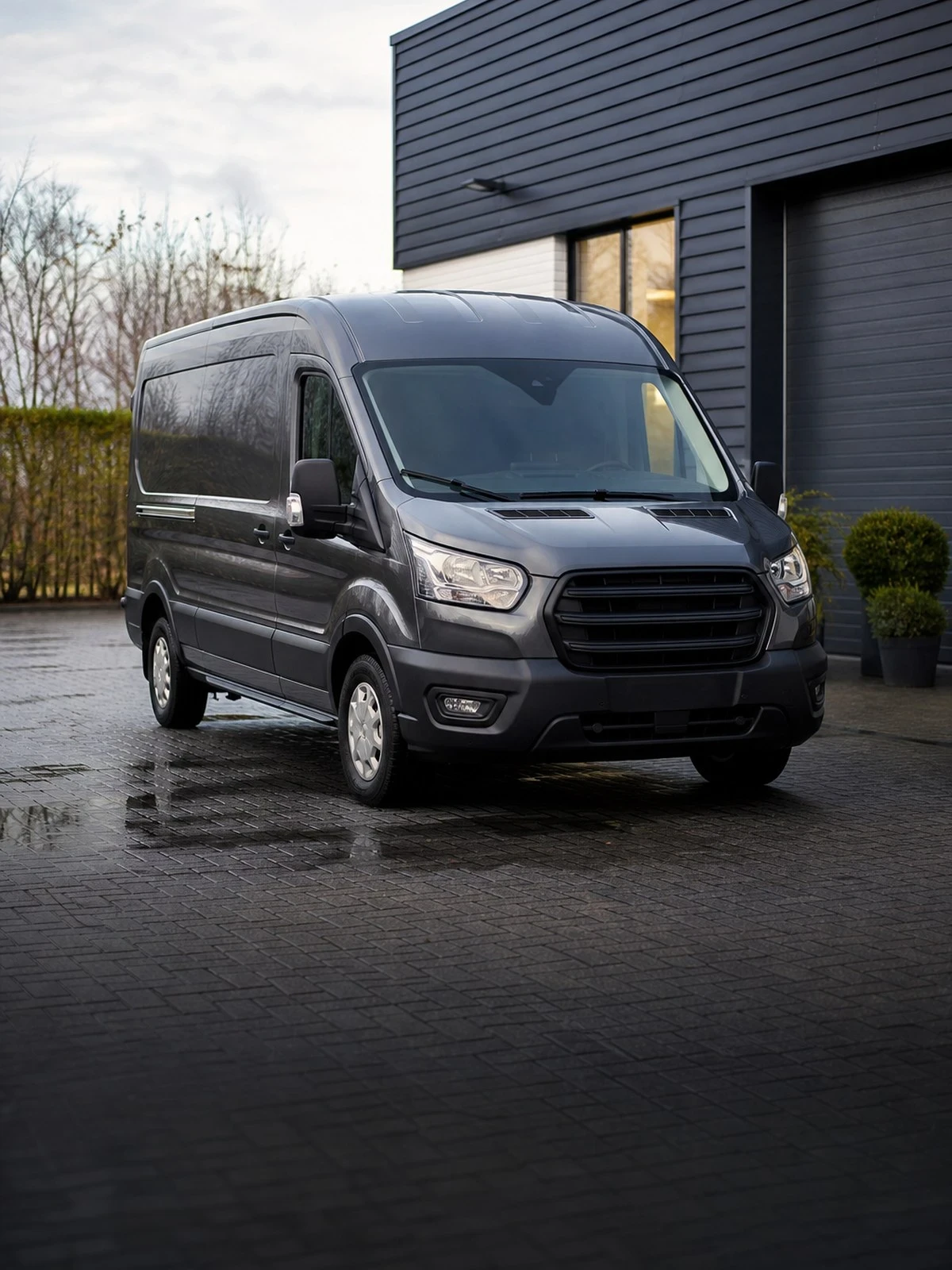
The name Transit appears on four different vehicles; which one is on your registration determines the cover, the licence and the premium.
This page in another language: Nederlands
Work out for yourself what it would cost.
Enter your details; you will receive a proposal within one working day.
A premium indication, not personal advice. Prefer to talk it through? Call 072 - 509 24 56.
Ford uses the Transit name across a whole range: from a small van on a passenger car platform to a heavy van that comes close to the limit of a category B licence. Insurers assess those variants not as one model but as separate vehicle classes. The permitted maximum mass and the body code on the registration are therefore no formality, but the starting point of acceptance.
On top of that, use counts heavily on this model. A Transit taking materials to your own building site is one thing. A Transit delivering parcels for a client every day is another. The second is carriage for third parties and falls outside an ordinary van insurance as long as it has not been declared.
What you carry is never insured under the vehicle policy. For the load, tools and materials, separate goods in transit insurance is needed. That applies to all vans and is set out on the page about the Volkswagen Crafter.
We compare your van insurance across dozens of insurers, explain where the real differences lie, and arrange the switch from start to finish — without you having to chase it yourself.
 Van insurance
 Compare
 Get covered
The structure of the cover in three parts, with an overview per situation below.
Damage you cause to others.
Causes beyond your control.
Including damage you cause yourself.
What is covered
| Situation | Third-party liability | Third-party, fire and theft | Comprehensive |
|---|---|---|---|
| Damage to the other party | Yes | Yes | Yes |
| Theft | No | Yes | Yes |
| Fire and storm | No | Yes | Yes |
| Damage you cause yourself | No | No | Yes |
| Wear and mechanical defects | No | No | No |
| Driving without a valid licence | No | No | No |
This overview is general in nature and is not personal advice. What is actually covered, including exclusions, limits and the excess, is set out in the policy conditions and the insurance card (verzekeringskaart) of the insurer; you receive both before you take out cover. Taking out cover without advice? Then read what execution only means for you.
Insurers weigh these details differently. That is where your saving is.
We look at the terms as well as the premium, and stay your point of contact when there is a claim.
We are not tied to one insurer and compare on the basis of an objective analysis of several companies.
You call or email someone who knows your file. No menu options, no changing call centres.
We cancel your old policy and align the start date, so you are never a day without cover.
We report the claim and monitor how it is handled. In urgent cases you can reach us on the emergency line.
Customers rate our service on four aspects: personal service, service delivery, availability and the outcome. The reviews are collected and published by NH1816 and come from customers who have actually taken out a policy with Finass Advies B.V. or reported a claim.
Four points that make the difference between a policy that pays out and one that does not.
The Courier, Connect, Custom and the large Transit differ in mass, payload and drive. If the wrong variant is declared, the basis of calculation is wrong and after a claim the insurer can rely on Article 7:928 of the Dutch Civil Code on the duty of disclosure; Article 7:930 of the Dutch Civil Code then gives it room to pay proportionately less. So take the details literally from the registration document.
If you take materials to your own jobs, that is own transport. If you deliver consignments for a parcel service or a wholesaler, that is professional carriage of goods with many more stops, more loading and unloading and a higher claims profile. Insurers only accept that where it has been declared in advance. If you do not state it and something happens during a delivery round, the cover is open to question.
Many Transits are driven with a double cab and colleagues in the back. Third-party cover pays for injury to occupants of the other vehicle, but not to the driver themselves; occupants' indemnity insurance is needed for that. If an employee drives, you as the employer are liable under Article 6:170 of the Dutch Civil Code and Article 7:611 of the Dutch Civil Code requires you to arrange proper insurance for employees who take part in traffic for their work.
Not covered are: the load and the tools in the load space, wear and mechanical defects such as a failed clutch or turbo, damage while driving without a valid entitlement, and damage caused by loading above the permitted mass. An undeclared conversion to carrying passengers falls outside it as well. Article 7:952 of the Dutch Civil Code excludes intent and recklessness, including driving under the influence.
This is what people ask us most.
Only as long as the permitted maximum mass stays within the limit for a category B licence. The heavy variants and a combination with a trailer quickly exceed it. If you drive without the correct entitlement, own-damage cover lapses and the insurer recovers the other party's loss from you, even though that party remains protected by the WAM.
Yes. Carrying consignments for a client is a different risk from driving to your own jobs: more stops, more loading and unloading and more town traffic. Insurers have their own acceptance and rate for that. If you do not declare it and damage occurs during a delivery round, the payout can be reduced or refused.
The vehicle then changes from a van to passenger carrying and the declaration on the policy is no longer correct. A conversion changes the fitting out on the registration and sometimes the tax status. Report a change of that kind before you take to the road with it; otherwise, if occupants travelling in it are injured, there is no basis on which to pay that loss.
Yes. Article 6:170 of the Dutch Civil Code places liability for the mistakes of subordinates with the employer. You cannot simply recover that loss from the employee: Article 7:661 DCC only allows that in cases of intent or wilful recklessness. So you may not deduct the excess from wages as a matter of course without a valid written agreement.
Every situation is different. For these situations we have a separate page.
Request a quote without obligation. We will look at which insurer best matches your activities and your risk.
Prefer to call? 072 - 509 24 56, weekdays 09:00–17:00.
Claim on the road? Emergency line 06 - 55 20 40 72.
Finass Verzekert is a trading name of Finass Advies B.V. We advise on and arrange non-life insurance on the basis of an objective analysis of several insurers, and receive commission for this from the insurer, which is included in the premium. You pay no separate advice fee. Before you take out cover, we establish your wishes and needs.
You will find our licence, KvK and Kifid details and our complaints procedure at the foot of every page.
This page was compiled by Finass Verzekert (LinkedIn). Last updated on .
The information on this page is general in nature and is not personal advice.
Maandag- Vrijdag: 09:00- 17:00
We use cookies and similar technologies to improve your experience on our website.