

Third-party liability
- Required by law
- As long as the registration is in your name
- Suspend the registration when not in use
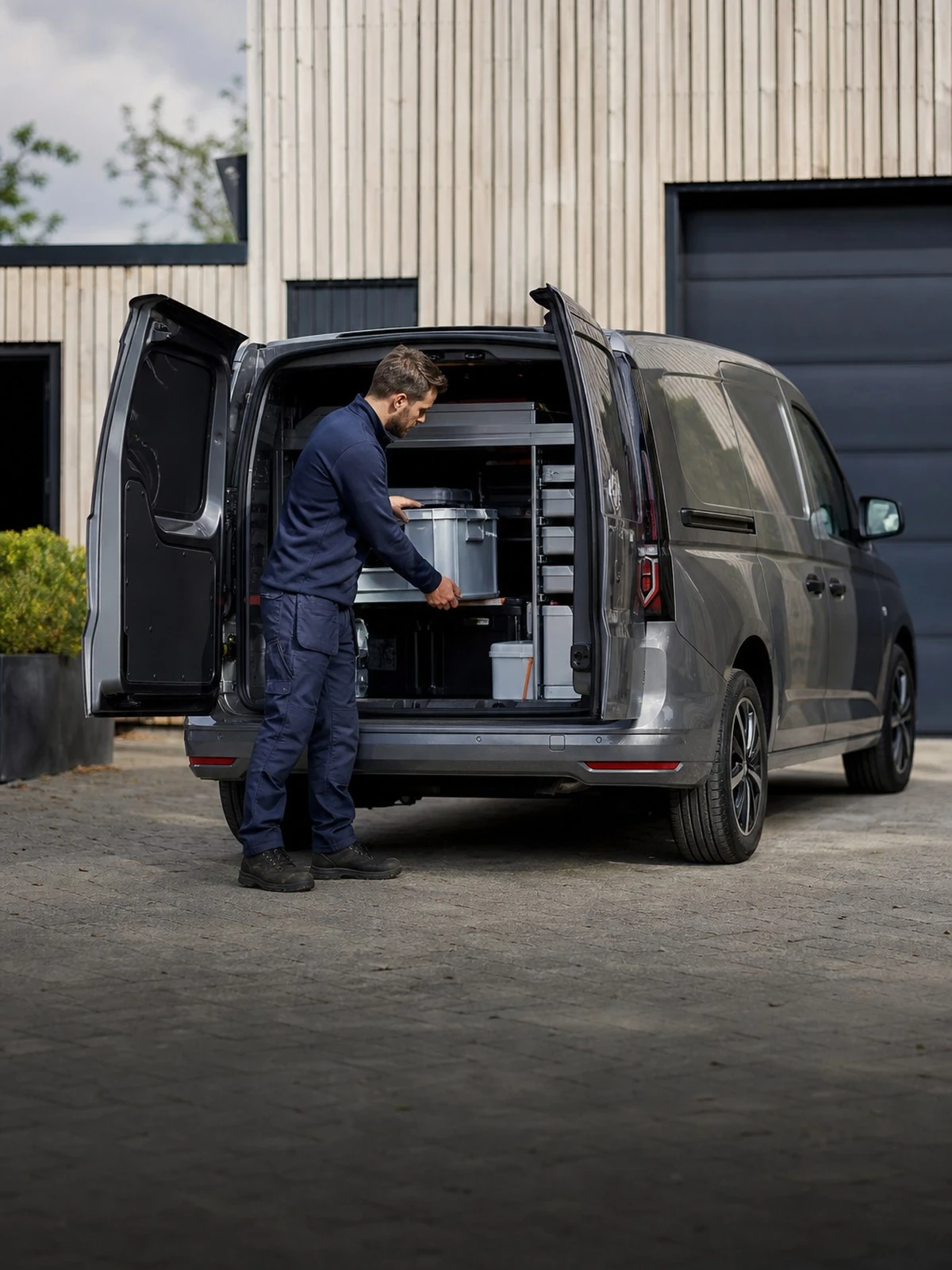
A company van carries tools, stock and usually staff as well, and it is precisely those three that are not automatically covered by the motor policy.
This page in another language: Nederlands · Deutsch
The calculator and the quote form below are in Dutch. Prefer to do this in English? Email info@finassverzekert.nl or call 072 - 509 24 56 and we will take it from there.
Work out for yourself what it would cost.
Enter your details; you will receive a proposal within one working day.
A premium indication, not personal advice. Prefer to talk it through? Call 072 - 509 24 56.
A van with a Dutch registration falls under the insurance obligation in Article 2 of the Dutch Motor Insurance Liability Act (WAM). That obligation continues for as long as the registration is in your company's name, including during a period when the van is standing idle on the company site. Third-party liability cover pays for the damage you cause to others; own-damage cover concerns the vehicle itself. Everything you carry falls outside both.
The difference from a car lies in the use. Own-account carriage for your own business, daily delivery of parcels or meals, hire to third parties and haulage for others are different risks for an insurer, with different rates. What you declare must match what actually happens; that duty of disclosure is set out in Article 7:928 of the Dutch Civil Code and the consequences of an incorrect disclosure in Article 7:930 of the Dutch Civil Code.
If your staff drive the van, employer's liability is added. Damage a member of staff causes to someone else during work ends up with you under Article 6:170 of the Dutch Civil Code. If you also tow a trailer with the van, look at business trailer insurance; for a van with a historic registration there is a separate arrangement.
We compare your van insurance across dozens of insurers, explain where the real differences lie, and arrange the switch from start to finish — without you having to chase it yourself.
 Van insurance
 Compare
 Get covered
The structure of the cover in three parts, with an overview per situation below.
Damage you cause to others.
Causes beyond your control.
Including damage you cause yourself.
What is covered
| Situation | Third-party liability | Third-party, fire and theft | Comprehensive |
|---|---|---|---|
| Damage to the other party | Yes | Yes | Yes |
| Theft | No | Yes | Yes |
| Fire and storm | No | Yes | Yes |
| Damage you cause yourself | No | No | Yes |
| Wear and mechanical defects | No | No | No |
| Driving without a valid licence | No | No | No |
This overview is general in nature and is not personal advice. What is actually covered, including exclusions, limits and the excess, is set out in the policy conditions and the insurance card (verzekeringskaart) of the insurer; you receive both before you take out cover. Taking out cover without advice? Then read what execution only means for you.
Insurers weigh these details differently. That is where your saving is.
We look at the terms as well as the premium, and stay your point of contact when there is a claim.
We are not tied to one insurer and compare on the basis of an objective analysis of several companies.
You call or email someone who knows your file. No menu options, no changing call centres.
We cancel your old policy and align the start date, so you are never a day without cover.
We report the claim and monitor how it is handled. In urgent cases you can reach us on the emergency line.
Customers rate our service on four aspects: personal service, service delivery, availability and the outcome. The reviews are collected and published by NH1816 and come from customers who have actually taken out a policy with Finass Advies B.V. or reported a claim.
Four points that make the difference between a policy that pays out and one that does not.
Own-damage cover pays for the vehicle: bodywork, glass, engine and the permanently fitted parts. Tools, stock, samples and customers' goods fall entirely outside it, even with comprehensive cover. That calls for a tools or own-account carriage cover, with its own sum insured and usually a requirement of demonstrable forced entry. If your van is broken into, the motor policy pays for the lock and the door, and nothing towards the contents. State in your application what is normally kept in the van.
A racking system, a tool cabinet, a refrigeration unit, a tail lift, a roof rack or advertising lettering increase the value of the vehicle, but only count when they have been declared at the start of the insurance. If you fail to do so, a total loss is settled on the bare van and not on your fitted-out workshop on wheels. Ask for written confirmation of the fitted equipment insured and keep the invoices for it with your policy.
Who may drive the van is set out in the drivers clause. If you let someone drive who does not fall within it, the insurer may limit the claim or recover its outlay. For your staff, the duty of care under Article 7:658 of the Dutch Civil Code also applies, together with the principle that under Article 7:611 of the Dutch Civil Code an employer makes proper arrangements for employees who take part in traffic on his instructions. Occupants' cover is the instrument for that.
Falling outside the cover are: the load and the tools in the load space; damage to goods during loading and unloading; haulage for others, courier runs or hire that have not been declared; damage caused by overloading or an improperly secured load; theft where the key was left in or near the vehicle; fines and criminal penalties; and damage caused intentionally or recklessly, for which Article 7:952 of the Dutch Civil Code applies.
This is what people ask us most.
No. A motor policy covers the vehicle, not what you carry in it. For tools, machines and stock you need a separate tools or own-account carriage cover. That has its own sum insured, its own excess and usually the condition that there are signs of forced entry. Emptying the van overnight is an additional requirement with many insurers.
They can, but it should be stated on the policy. Commuting and private use by staff is a different form of use from purely business journeys, and the place where the van is parked changes with it. Also declare who drives it on a regular basis. If reality differs from what you declared, the insurer can rely on Article 7:930 of the Dutch Civil Code in the event of a claim.
Yes. Delivery is a risk class of its own because of the number of stops, the time pressure and the constant getting in and out. Occasional delivery runs belong in your declaration too. If it emerges after a claim that you deliver on a regular basis while the policy states own-account carriage, that is a ground for refusing payment, even if the journey itself was not a delivery run.
The claim goes on the policy the vehicle is on, regardless of who was driving. With business registration, the build-up therefore runs through your company and not through the member of staff. With a small at-fault claim it is worth working out in advance whether paying it yourself is cheaper than the loss of a step and the higher premium in the years that follow.
Every situation is different. For these situations we have a separate page.
Request a quote without obligation. We will look at which insurer best matches your activities and your risk.
Prefer to call? 072 - 509 24 56, weekdays 09:00–17:00.
Claim on the road? Emergency line 06 - 55 20 40 72.
Finass Verzekert is a trading name of Finass Advies B.V. We advise on and arrange non-life insurance on the basis of an objective analysis of several insurers, and receive commission for this from the insurer, which is included in the premium. You pay no separate advice fee. Before you take out cover, we establish your wishes and needs.
You will find our licence, KvK and Kifid details and our complaints procedure at the foot of every page.
This page was compiled by Finass Verzekert (LinkedIn). Last updated on .
The information on this page is general in nature and is not personal advice.
Maandag- Vrijdag: 09:00- 17:00
We use cookies and similar technologies to improve your experience on our website.