

Insuring a classic moped
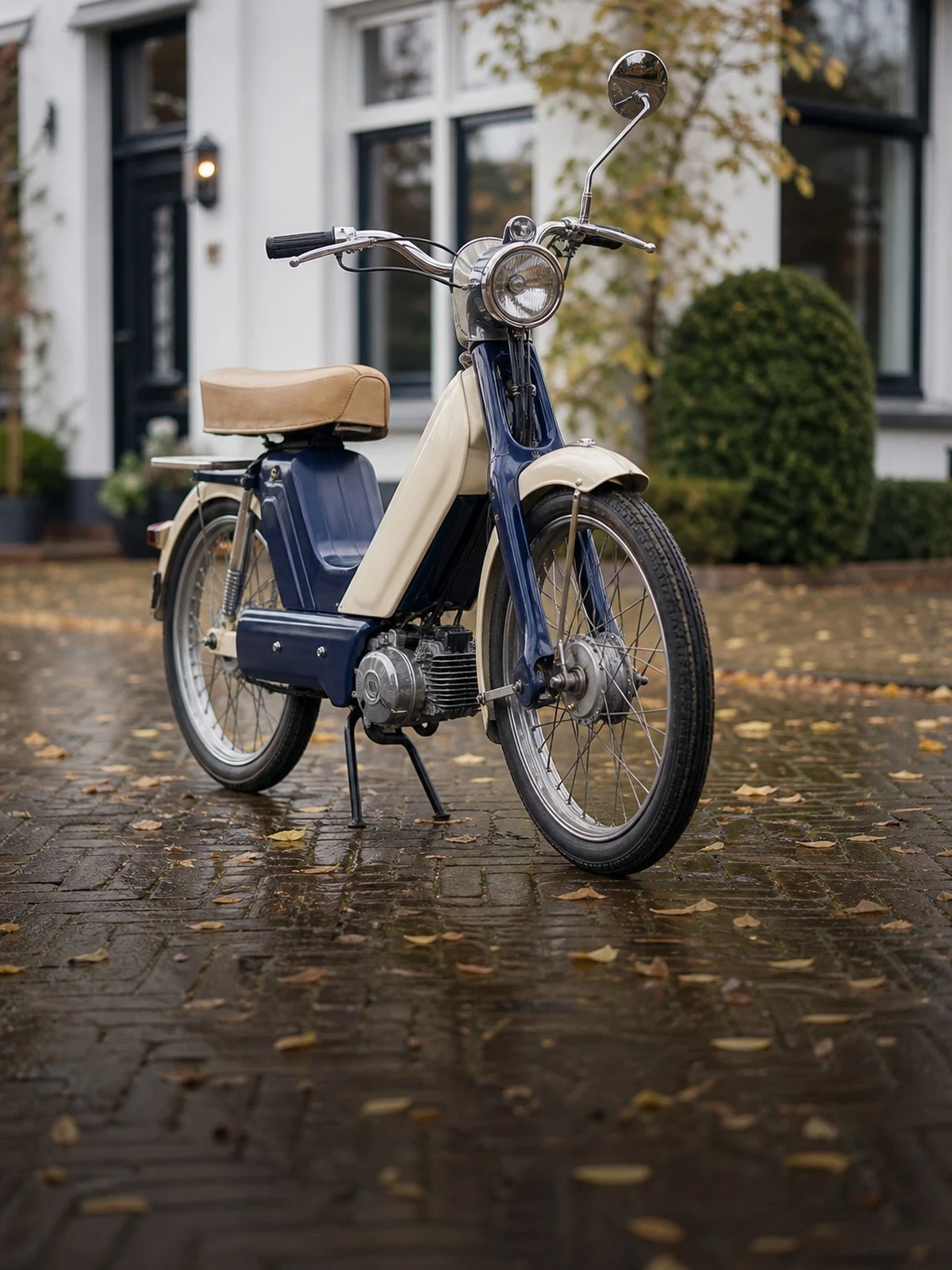
A restored Puch or Zundapp is on paper an old moped with a low market value. Without an agreement about the value, you find that out only after the loss.
- Several insurers compared objectively
- 9.5 customer rating for a new policy
- AFM licence 12016589
- Personal 072 - 509 24 56, weekdays 9–17
This page in another language: Nederlands
Work out for yourself what it would cost.
Enter your details; you will receive a proposal within one working day.
- We compare the offerings of several insurers
- An adviser checks whether the cover suits your situation
- We arrange the switch, including cancellation
A premium indication, not personal advice. Prefer to talk it through? Call 072 - 509 24 56.
- Independent advice
- Several insurers
- Switching arranged
- Help with claims
In brief
The same insurance obligation applies to a classic moped as to a new scooter: as soon as the vehicle goes on the public road, third-party liability cover is compulsory under Article 2 of the Dutch Motor Insurance Liability Act (WAM). The difference lies in the own-damage cover. The standard rule is market value, and the market value of a fifty-year-old moped is a fraction of what you have spent on the restoration. The general explanation of the product is on the moped insurance page.
The solution is a an agreed value: a valuation by an expert that is put on the policy, or a statement of value accepted by the insurer with photographs and invoices. Without such a record the insurer establishes the value only after the event, and Article 7:960 of the Dutch Civil Code provides that the payment may not put you in a distinctly better position. Valuations also have a period of validity; once it expires you fall back on market value. How this works for larger classics is set out under classic car insurance.
Insurers accept vehicles of this kind because the use is limited. Attached to that are clauses: a minimum age for the vehicle and for the rider, storage in a locked space, a limited number of miles per year and sometimes the requirement that you also have a vehicle for everyday use. If you do start using the moped daily to commute, report it; it is a change in the risk.
This page deals with one situation. The full overview is on Compare scooter insurance.
Independent, personal, sorted quickly
We compare your classic car insurance across dozens of insurers, explain where the real differences lie, and arrange the switch from start to finish — without you having to chase it yourself.
 Classic car insurance
 Compare
 Get covered
Why arrange it through Finass Verzekert?
We look at the terms as well as the premium, and stay your point of contact when there is a claim.
Independent
We are not tied to one insurer and compare on the basis of an objective analysis of several companies.
One fixed adviser
You call or email someone who knows your file. No menu options, no changing call centres.
Switching without hassle
We cancel your old policy and align the start date, so you are never a day without cover.
Help with claims
We report the claim and monitor how it is handled. In urgent cases you can reach us on the emergency line.
What to look out for
Four points that decide the outcome of a claim on a classic moped.
Originality and the quality of the repair
With a classic the question is not only whether it will be repaired, but with what. Ask whether there is room for original or new old stock parts and whether the cost of dismantling and of searching for parts counts. If the repair is done with modern replacements, the value of the vehicle falls; payment for that loss of value is not standard.
Parts in the shed are not a vehicle
A second engine, a stock of pistons, a spray booth or special tools do not fall under the vehicle policy. That is home contents or business stock, depending on where it is kept and whose it is. If you keep a collection in a shed or a lock-up garage, check the cover and the sub-limits of your home contents insurance for outbuildings.
What happens during the restoration
Damage that arises during work on the vehicle itself, such as fire caused by welding or grinding, is excluded on many policies or covered only if the insurer knows about it. The same applies to a vehicle lying in pieces: for insurance purposes that is no longer a roadworthy motor vehicle. Discuss a restoration period in advance.
Wear, rust and inherent defect
Three items stay outside the cover on every classic vehicle: wear and tear and ageing, rust and corrosion, and damage caused by an inherent defect such as a seizure or a leaking tank. Taking part in speed events and manoeuvring competitions is excluded as well. A tour on the public road does not usually come under that, but have it confirmed.
What does your premium depend on?
- Fixed or agreed value: the basis for the own-damage premium
- Year of manufacture and originality: an original machine is assessed differently from a conversion
- Annual mileage: limited use is the reason acceptance is possible at all
- Storage: a locked garage or shed as against outside or in the street
- Age and experience of the driver: often tied to a minimum age in the clauses
- Type of cover: third-party only or with own-damage cover at a fixed value
Insurers weigh these details differently. That is where your saving is.
What is covered
| Situation | Third-party liability | Comprehensive |
|---|---|---|
| You ride the classic moped into a parked car | Yes | Yes |
| The moped is stolen from your locked shed | No | Yes |
| A fire in the shed that starts while you are welding the frame | No | No |
| The moped is lost in a fire while the valuation expired last year | No | Provided that |
| Your stock of spare parts in the lock-up garage is lost in that same fire | No | No |
| You come off on a bend and the original frame is bent | No | Yes |
What is on the moped is vehicle. What lies beside it in the shed belongs on another policy.
Frequently asked questions
This is what people ask us most.
Do I have to insure the moped if it only stands in the shed?
As long as the registration is in your name and the vehicle could go on the road, the insurance obligation under Article 2 of the Dutch Motor Insurance Liability Act (WAM) applies. Unlike a car, a moped or light moped registration cannot be suspended. To end the obligation, the vehicle has to be transferred, exported or scrapped. For a vehicle that genuinely does not run, limited fire and theft cover is sometimes open to discussion.
What is the difference between an agreed value and market value?
With market value the insurer determines after the loss what the vehicle was worth at that moment, with a deduction for age and condition. With an agreed value the amount is stated on the policy in advance, supported by a report, and that value is the starting point for as long as the valuation is valid. For a restored vehicle that difference is decisive.
Does a tuned or converted classic qualify?
An original machine is insurable. A vehicle with an altered construction or increased power output often is not. Tuning also makes the vehicle a different category from the one for which it was approved, so the own-damage cover falls away. Report changes that depart from the original condition in advance, with photographs.
Can I put several classic cars on one policy?
That is possible at several companies, with its own value and form of cover for each vehicle. The advantage is one renewal date and one set of clauses. The drawback is that a strict storage requirement then applies to every vehicle. With a mixed collection of mopeds and larger classics it is worth setting this alongside classic car insurance for comparison.
Every situation is different. For these situations we have a separate page.
- Compare classic car insuranceThe main page
- Insuring a classic vanAgreed value, clause on use, storage
- Insuring a classic carValuation, fixed value, limited use
- Insuring a classic motorcycleValuation, limited use, storage
- Insuring a classic car as a passenger carRepair, original parts, second car
- Insuring a classic vanCommercial registration, use, valuation
- Insuring a classic car