

Third-party liability
- Damage to other vehicles and injury
- No cover for your own classic
- Compulsory under Article 2 of the Dutch Motor Insurance Liability Act (WAM)
- Often chosen where the value is low
A classic car does not lose value according to a depreciation table. That is why an ordinary motor policy does not work: what matters is the amount stated in the policy and the conditions of use under which that amount is paid.
This page in another language: Nederlands
The calculator and the quote form below are in Dutch. Prefer to do this in English? Email info@finassverzekert.nl or call 072 - 509 24 56 and we will take it from there.
Work out for yourself what it would cost.
Enter your details; you will receive a proposal within one working day.
A premium indication, not personal advice. Prefer to talk it through? Call 072 - 509 24 56.
The difference between an ordinary motor policy and a classic car policy lies in the basis of value. On a total loss an ordinary policy pays the market value: what the car was worth immediately before the loss, established by a loss adjuster after the event. For a classic car that market value is hard to establish objectively: condition, originality, history and restorations carried out determine the price, and that information is difficult to reconstruct afterwards. A valuation report solves that by fixing the value in advance.
If that report is incorporated into the policy, then under Article 7:960 of the Dutch Civil Code the agreed value is the starting point after a loss. The ban on enrichment in that same article does not stand in the way, provided the valuation was carried out as the law prescribes. The practical gain: after a total loss the argument is no longer about the amount, but at most about whether the report was still valid and whether the vehicle matched the description.
Against that, a classic car policy carries restrictions on use. Insurers ask for an age of usually twenty-five to forty years, a maximum number of miles per year, storage in a locked space, a minimum age for the driver and the presence of another car for everyday use. Here too: Third-party liability cover is compulsory under Article 2 of the Dutch Motor Insurance Liability Act (WAM), as long as the registration is in your name and has not been suspended.
We compare your classic car insurance across dozens of insurers, explain where the real differences lie, and arrange the switch from start to finish — without you having to chase it yourself.
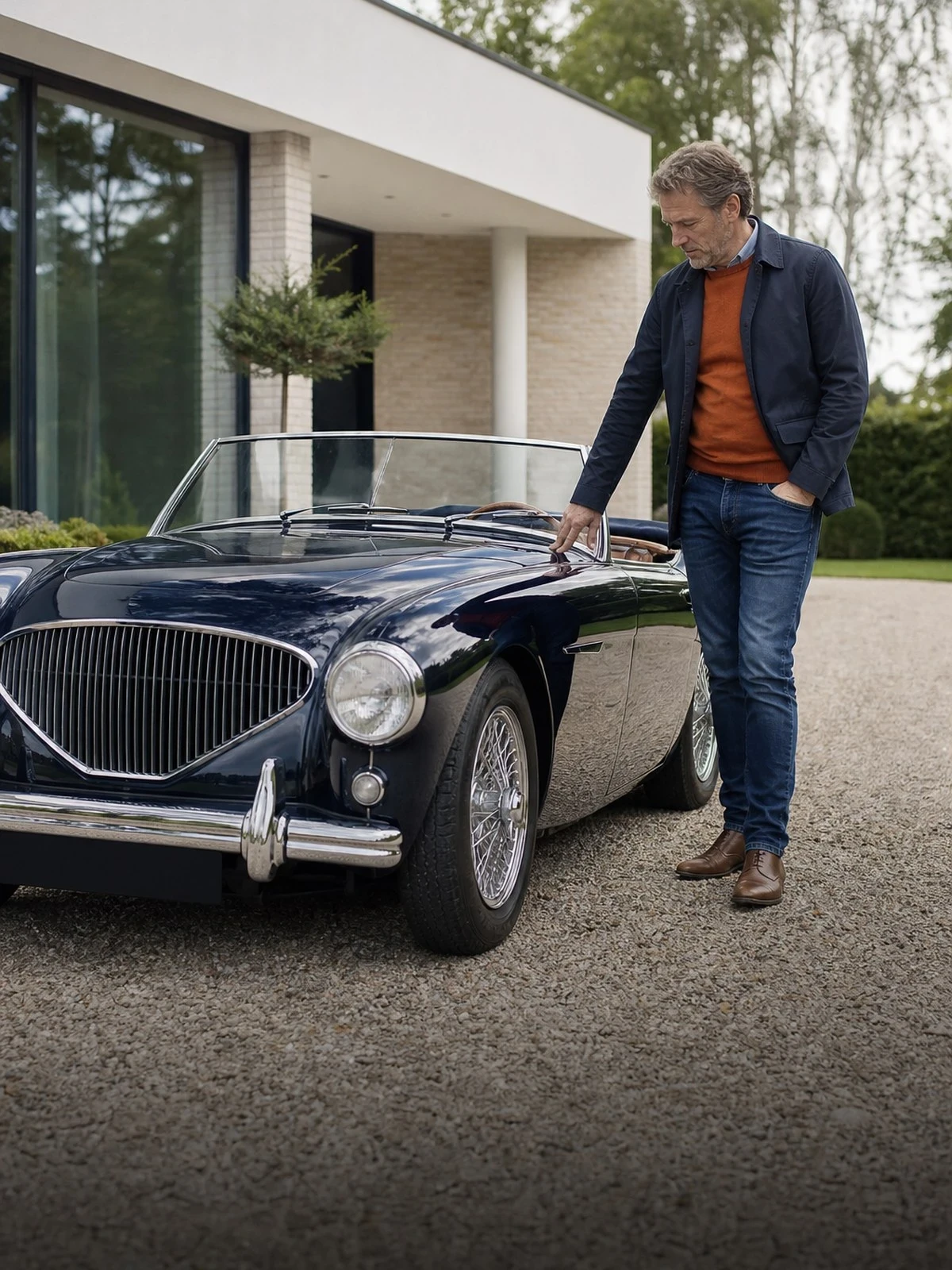 Classic car insurance
 Compare
 Get covered
Three forms of cover, and beneath them the situations that most often lead to argument with classic cars.
The legally required cover for damage you cause to others.
On top of that to third-party liability, a fixed list of events such as theft, fire, storm and glass damage.
Full own-damage cover with a sum insured fixed in advance.
What is covered
| Situation | Third-party liability | Own-damage cover on an agreed value |
|---|---|---|
| Damage you cause to someone else | Yes | Yes |
| Fire or theft while in storage | No | Yes |
| Your own damage after a collision on the road | No | Yes |
| Damage during a tour without timing | Yes | Provided that |
| Use for commuting or business carriage | Provided that | No |
| Rust, wear or a mechanical defect | No | No |
What is actually covered, including exclusions, limits and the excess, is set out in the policy conditions and the insurance card (verzekeringskaart) that you receive before you take out cover.
Insurers weigh these details differently. That is where your saving is.
We look at the terms as well as the premium, and stay your point of contact when there is a claim.
We are not tied to one insurer and compare on the basis of an objective analysis of several companies.
You call or email someone who knows your file. No menu options, no changing call centres.
We cancel your old policy and align the start date, so you are never a day without cover.
We report the claim and monitor how it is handled. In urgent cases you can reach us on the emergency line.
Customers rate our service on four aspects: personal service, service delivery, availability and the outcome. The reviews are collected and published by NH1816 and come from customers who have actually taken out a policy with Finass Advies B.V. or reported a claim.
Four points that decide whether the policy really does what you expect of it after a loss.
Have the car valued by a recognised valuer and have the report incorporated into the policy. The value then applies under Article 7:960 of the Dutch Civil Code as the starting point after a loss. Watch two things. First the period of validity: insurers generally accept a report for a limited number of years. If it expires without a revaluation, you fall back on market value. Second the description: the report must describe the vehicle as it is, including departures from original and restorations carried out. Photographs and invoices from the restoration belong in the file.
The low premium of a classic car policy goes with limited use. Common conditions are a maximum number of kilometres per year, storage in a locked and dry space, a minimum age for the driver and the requirement that you have another car for everyday use. These provisions are not guidelines but policy conditions. If you consistently drive more, or the car stands outside permanently, the insurer can reduce or refuse the payment after a loss. Report changes in the meantime, therefore.
The following, among others, are outside the cover: corrosion, wear and mechanical or electrical failure without a collision. A seized engine or a broken driveshaft is not an insured event, not even where it causes consequential damage; use for commuting, hire or business carriage where the policy assumes hobby use; and taking part in speed, regularity or manoeuvring events, including rallies with timing. Damage caused deliberately or through recklessness is excluded under Article 7:952 of the Dutch Civil Code. Damage arising during work at a restorer often falls under that firm's liability, not under your policy.
For vehicles of forty years and older there is an exemption from vehicle tax, and passenger cars from before 1960 are exempt from the APK (the Dutch MOT). Those are tax and technical rules, not insurance rules: the insurance obligation under Article 2 of the Dutch Motor Insurance Liability Act (WAM) continues to apply in full. Once the MOT obligation falls away, your own maintenance file becomes more important, because after a loss an insurer may ask about the technical condition. Keep demonstrable records of maintenance, tests and restoration work; that helps both at revaluation and when a claim is assessed.
This is what people ask us most.
For insurance purposes there is no fixed threshold. Most insurers accept vehicles from twenty-five to thirty years old on a classic car policy, sometimes at a lower rate from forty years. For tax the threshold is fixed: at forty years and older there is exemption from vehicle excise duty. Those two thresholds therefore do not coincide. For your policy look at the acceptance conditions and not at the tax rules.
The fixed basis of value falls away and on a total loss the insurer generally pays the market value. For a restored vehicle that can mean a considerable difference. Put the expiry date in your diary and arrange a revaluation in good time, particularly in a rising market. Keep the old report. It documents the condition of the vehicle over the years.
Usually not. Classic car policies assume hobby use and exclude commuting and business use, precisely because the low mileage and the favourable rate are based on it. If you want to use the car more often, ask about a policy with a higher mileage allowance or an ordinary motor policy with a valuation clause. Driving outside the agreed purpose can lead to a claim being refused.
A tour without timing and without any speed element is generally covered as normal. As soon as there is timing, a classification or manoeuvring tests, the standard exclusion for speed and regularity events applies. If you are in doubt, ask the insurer for written confirmation before you take part; organisers sometimes offer separate one-day cover for such events.
For insurance purposes a vehicle under restoration is something other than a roadworthy classic. As long as it is not driven, storage or object cover is the better fit: it covers fire, theft and water damage in the workshop, but not the driving risk. Have the value established in the meantime on the basis of the parts and hours spent, and adjust the sum insured as the project progresses.
Every situation is different. For these situations we have a separate page.
Ask for a quotation without obligation. We look at the valuation, the mileage and the storage and compare premiums as well as conditions.
Prefer to call? 072 - 509 24 56, weekdays 09:00–17:00.
Claim on the road? Emergency line 06 - 55 20 40 72.
Finass Verzekert is a trading name of Finass Advies B.V. We advise on and arrange non-life insurance on the basis of an objective analysis of several insurers, and receive commission for this from the insurer, which is included in the premium. You pay no separate advice fee. Before you take out cover, we establish your wishes and needs.
You will find our licence, KvK and Kifid details and our complaints procedure at the foot of every page.
This page was compiled by Finass Verzekert (LinkedIn). Last updated on .
The information on this page is general in nature and is not personal advice.
Maandag- Vrijdag: 09:00- 17:00
We use cookies and similar technologies to improve your experience on our website.