

Insuring a youngtimer van
For an insurer a van between fifteen and thirty years old is neither a classic nor an ordinary van. The discussion is almost always about the value you get back after a loss.
- Several insurers compared objectively
- 9.5 customer rating for a new policy
- AFM licence 12016589
- Personal 072 - 509 24 56, weekdays 9–17
This page in another language: Nederlands
Work out for yourself what it would cost.
Enter your details; you will receive a proposal within one working day.
- We compare the offerings of several insurers
- An adviser checks whether the cover suits your situation
- We arrange the switch, including cancellation
A premium indication, not personal advice. Prefer to talk it through? Call 072 - 509 24 56.
- Independent advice
- Several insurers
- Switching arranged
- Help with claims
In brief
A youngtimer falls between two schemes. The exemptions and flexible conditions of a genuine classic car insurance only start at forty years; below that your van remains, for the insurer, a working vehicle with a low book value. Under ordinary own-damage cover the insurer pays the market value, and on a twenty-year-old commercial vehicle that is low, even if you have spent years on it. Article 7:960 of the Dutch Civil Code prohibits a payment higher than the loss suffered, so without an arrangement in advance you get no more than the market value.
The solution is a agreed value: an expert establishes the value and that is stated on the policy. Such a valuation is usually valid for three years and has to be renewed after that. Insurers do set conditions against it, and that is the second topic of discussion: a mileage limit, storage in a locked space, and a second vehicle for daily commuting. If you consistently exceed the limit without reporting it, that is a change in the risk on which the insurer can fall back after a loss.
Also pay attention to the use. If you drive the van for a business or carry goods for others for payment, a private policy is the wrong place. That belongs on the van insurance or, with a grey registration in the name of a company, on a business policy. For a van older than forty years, look at the classic van.
This page deals with one situation. The full overview is on Compare van insurance.
Independent, personal, sorted quickly
We compare your youngtimer insurance across dozens of insurers, explain where the real differences lie, and arrange the switch from start to finish — without you having to chase it yourself.
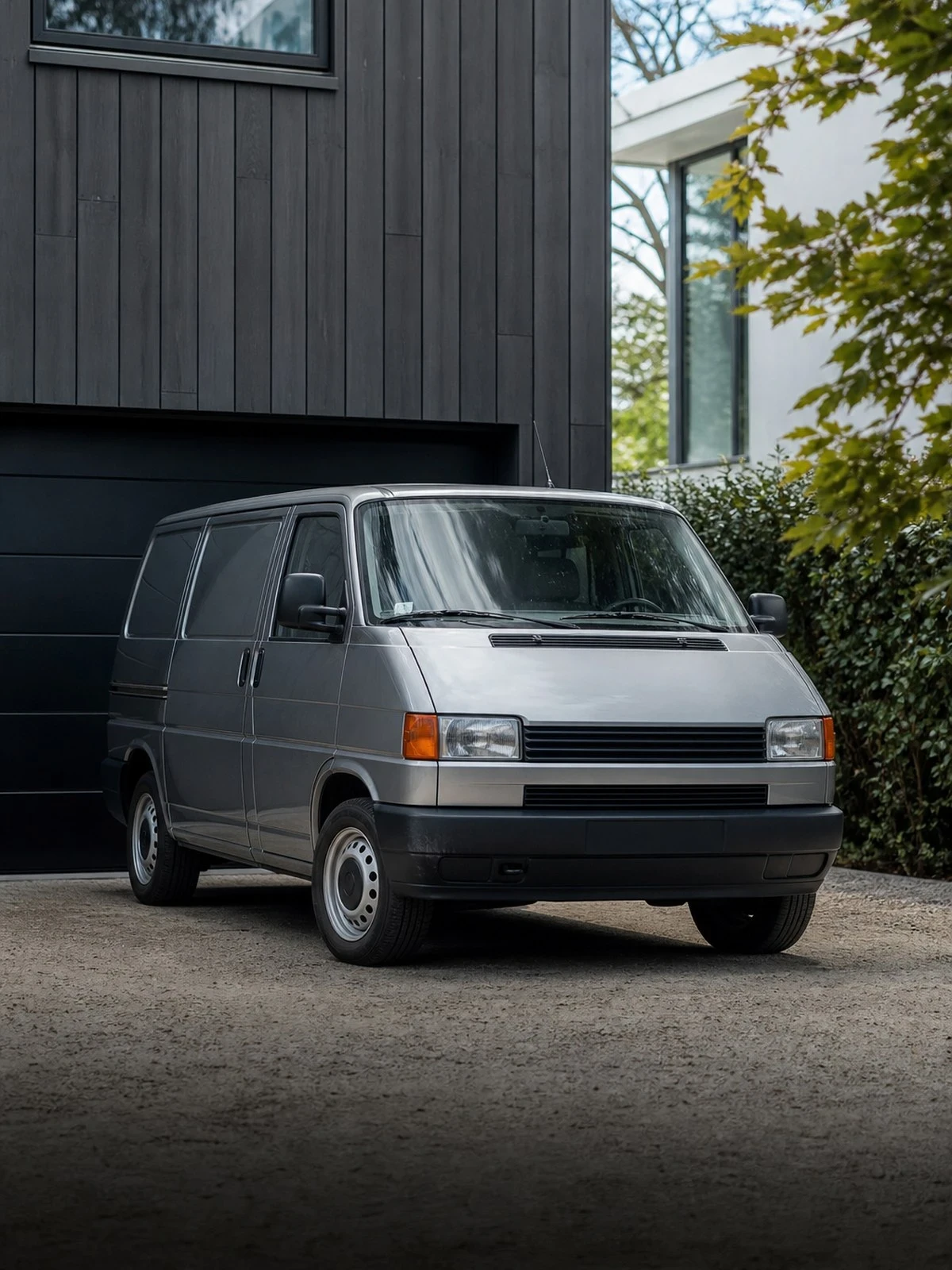 Youngtimer insurance
 Compare
 Get covered
Why arrange it through Finass Verzekert?
We look at the terms as well as the premium, and stay your point of contact when there is a claim.
Independent
We are not tied to one insurer and compare on the basis of an objective analysis of several companies.
One fixed adviser
You call or email someone who knows your file. No menu options, no changing call centres.
Switching without hassle
We cancel your old policy and align the start date, so you are never a day without cover.
Help with claims
We report the claim and monitor how it is handled. In urgent cases you can reach us on the emergency line.
What to look out for
Four points that make the difference in this age category between repair and a written-off van.
An economic total loss from a small dent
Parts for a van from the nineties or the two thousands are often no longer available new. Having a sliding door or a front wing made soon costs more than the market value, after which the insurer declares the vehicle total loss and claims the salvage. If you want to avoid that, agree in advance that repair with used parts is permitted and that you may keep the wreck.
Rust, wear and inherent defect
Almost every own-damage policy excludes damage that results from wear, corrosion, deferred maintenance or an inherent defect of the vehicle. On a youngtimer that is not a theoretical provision: rusted-through floor panels, a worn clutch or a snapped timing belt are never insured. Only the consequential damage to other parts is sometimes covered, provided the policy says so explicitly.
Report conversions and fitted equipment
A youngtimer van is often converted: a small camper, a workshop fit-out, an audio installation or extra lighting. What is not on the application form is not in the sum insured and falls outside the payment in the event of theft or fire. The duty of disclosure in Article 7:928 of the Dutch Civil Code applies when the policy is taken out. If you make changes later, report them in writing.
Security as a condition, not as a discount
Older vans rarely have a current-generation immobiliser. Insurers therefore regularly require an approved alarm or tracking system and overnight storage under lock and key. If the van is parked in the street while the clause sheet requires a locked space, theft is not covered, even though there was indeed a break-in.
What does your premium depend on?
- Year of manufacture and condition: age determines whether own-damage cover is offered at all
- Valued amount or market value: a valuation report changes both the premium and the payment
- Annual mileage: limited use produces a considerably lower rate
- Storage location: garage, shed or the public road
- Security class: alarm or tracking system, often an acceptance requirement
- Age and claims history of the driver: no-claims years count here too
Insurers weigh these details differently. That is where your saving is.
What is covered
| Situation | Third-party liability | Comprehensive |
|---|---|---|
| A dent in the front wing, where repair costs more than the van is worth on paper | No | Yes |
| The workshop fit-out you built into the load space yourself is lost in a fire | Provided that | Provided that |
| A rusted-through floor panel that fails the inspection | No | No |
| Theft of the van after you drove considerably more kilometres than agreed for a year | No | Provided that |
| While reversing out of a parking space you hit your neighbour's car | Yes | Yes |
| The timing belt snaps and the engine seizes | No | No |
If there is no valuation on the policy schedule, the insurer works with market value and a van of this age is quickly a total loss.
Frequently asked questions
This is what people ask us most.
From what age is my van a youngtimer?
In reality insurers apply fifteen years as the lower limit and forty years as the point at which a vehicle becomes a classic. Between those two limits there is no statutory scheme. Each company decides for itself which age it accepts and on what conditions. As a result the rates and the requirements for exactly the same van vary widely.
Do I get the market value or the value I have put into it?
Without a valuation report, the market value, and on an old commercial vehicle that is low. With a valid valuation report the established value is stated on the policy and is the starting point in the event of a total loss. Watch the period of validity: if the report has expired at the time of the loss, you usually fall back on the market value.
May I use it for my work now and then?
Occasional private transport of your own belongings is not a problem, but regular business use or carrying goods for others for payment is. That is a different risk from the one the premium was calculated for. Report it in advance. If it turns out after a loss that the use differs from what you declared, the insurer can rely on Article 7:930 of the Dutch Civil Code and reduce or refuse payment.
Is third-party liability insurance compulsory while the van is standing idle?
For as long as the registration has not been suspended, the insurance obligation in article 2 WAM applies in full, even if the vehicle stands in a barn for months. If you do not want to pay premium for those months, suspend the registration with the RDW (the Dutch vehicle authority). During the suspension you may not use the public road, and many policies let own-damage cover continue on a limited basis at a lower rate.
Every situation is different. For these situations we have a separate page.
- Compare youngtimer insurance & take out cover at a good priceThe main page
- Insuring a business youngtimerMarket value, total loss, electronics
- Insuring a youngtimerFifteen to forty years, value, use
- Insuring a youngtimer for business useAcceptance, clause sheet, reporting changes
- Insuring a Porsche youngtimerPorsche youngtimer, value over time, security, repair
- Insuring a BMW youngtimerBMW youngtimer, value over time, security, repairs
- Insuring a Mercedes Benz youngtimerMercedes-Benz youngtimer, value over time, security, repairs
- Insuring a classic vanAgreed value, clause on use, storage
- Business van insurance by make and modelTheft figures, parts, specification