

Third-party liability insurance
- Damage to other vehicles
- Injury to third parties
- Damage to buildings and objects
- Damage caused by passengers
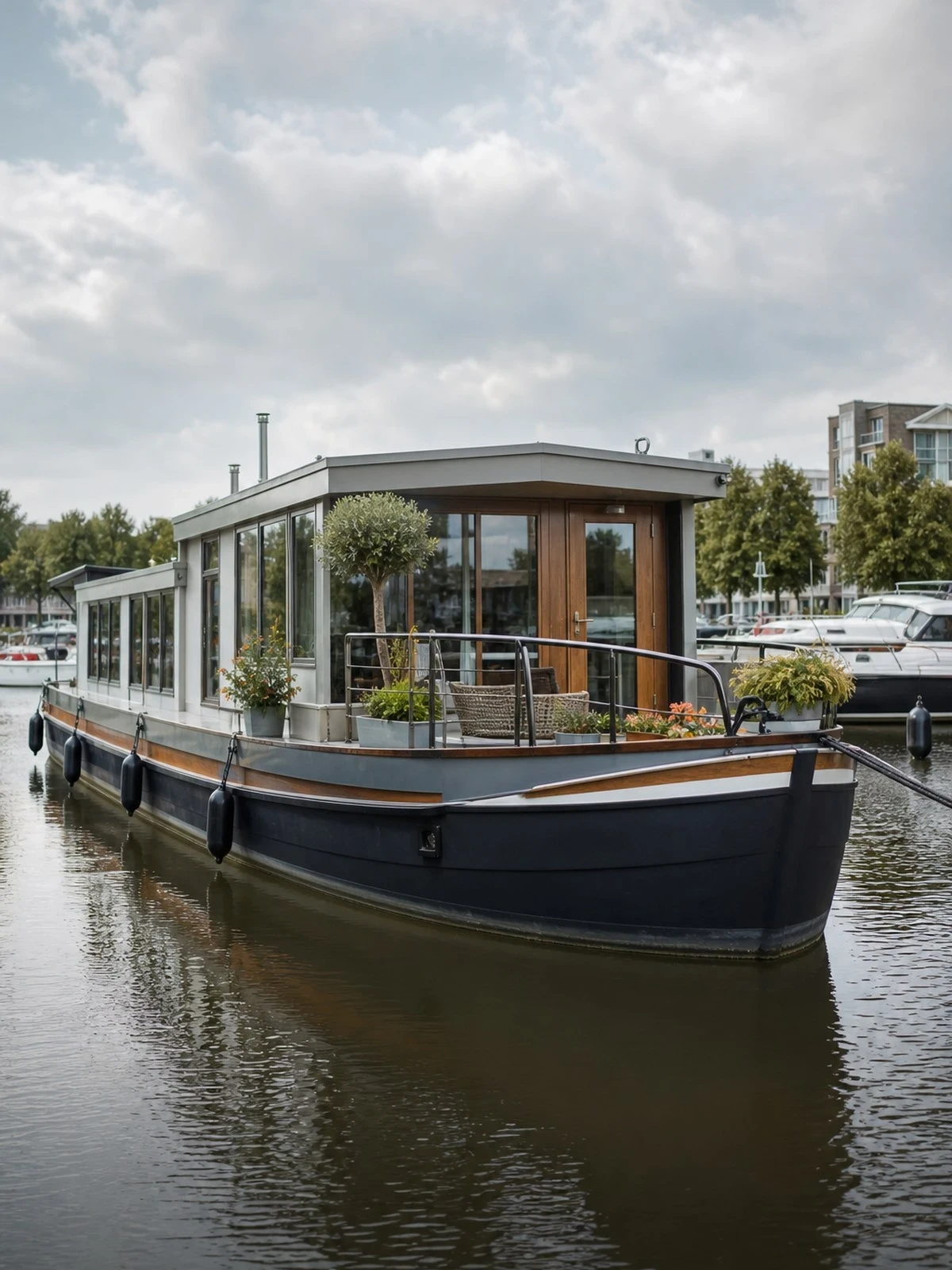
A houseboat is a house that floats: the hull determines whether it stays afloat, and the mooring determines whether you may stay there.
This page in another language: Nederlands
Work out for yourself what it would cost.
Enter your details; you will receive a proposal within one working day.
A premium indication, not personal advice. Prefer to talk it through? Call 072 - 509 24 56.
Unlike a home on foundations, with a houseboat everything hangs on the hull: the steel or concrete hull, the barge or vessel on which the superstructure stands. If that hull is weakened by corrosion or concrete rot, the result is not a leak but the risk that the whole thing sinks. Insurers therefore periodically require a hull inspection, and the report from that determines whether cover is possible and on what conditions.
The second point is the mooring. That is rarely your property: you rent water from a local authority or a harbour company and hold a mooring permit. Damage to the jetty, mooring posts, shore connections and utilities does not automatically fall under the boat policy, and liability for damage your boat causes to third parties runs through Article 6:162 of the Dutch Civil Code and, where a building-like structure is involved, possibly through Article 6:174 of the Dutch Civil Code.
We compare the houseboat product from Nationale-Nederlanden with the rest of the market, looking at the inspection requirements, the treatment of the superstructure and the contents, and the liability section for the mooring. For the belongings on board a separate solution is often needed alongside the hull cover.
We work with dozens of insurers and choose whichever fits your situation best — not whichever pays us the most. That means advice built around you, not around one brand.
 Insurers
 Independent
 Advice
The structure of the cover in three parts, with an overview per situation below.
Third-party liability insurance is required by law and covers damage you cause to others with your boat, not damage to your own boat.
Alongside third-party liability cover, protection against damage to your own car from external causes you cannot prevent.
The most complete cover, including for damage you cause yourself, theft and total loss. We compare Nationale-Nederlanden's comprehensive version with the market.
What is covered
| What we do | At Finass | Direct with Ansvar |
|---|---|---|
| Comparison across several insurers | Yes | No |
| Advice based on your own situation | Yes | Provided it is declared |
| One point of contact for claims | Yes | Provided it is declared |
| Cancellation with your current insurer arranged | Yes | No |
| We determine whether Ansvar is the best choice | Yes | No |
| Advice fees for you as a customer | No | No |
What we do
| What we do | At Finass | Direct with Nationale |
|---|---|---|
| Comparison across several insurers | Yes | No |
| Advice based on your own situation | Yes | Sometimes |
| One point of contact for claims | Yes | Sometimes |
| Cancellation with your current insurer arranged | Yes | No |
| We determine whether Nationale is the best choice | Yes | No |
| Advice fees for you as a customer | No | No |
This overview concerns our service, not the cover. What is actually covered is set out in the policy conditions and on the insurer's insurance card (verzekeringskaart); you receive both before you take out cover.
Insurers weigh these details differently. That is where your saving is.
We look at the terms as well as the premium, and stay your point of contact when there is a claim.
We are not tied to one insurer and compare on the basis of an objective analysis of several companies.
You call or email someone who knows your file. No menu options, no changing call centres.
We cancel your old policy and align the start date, so you are never a day without cover.
We report the claim and monitor how it is handled. In urgent cases you can reach us on the emergency line.
Customers rate our service on four aspects: personal service, service delivery, availability and the outcome. The reviews are collected and published by NH1816 and come from customers who have actually taken out a policy with Finass Advies B.V. or reported a claim.
Four points that make the difference between a policy that pays out and one that does not.
Steel hulls rust from the inside, concrete barges suffer concrete rot around the reinforcing steel. Both processes are slow and are therefore excluded as gradual action. What can be covered is the sudden consequential damage when water comes in. Have the hull measured periodically and keep the reports: without a recent measurement, the insurer will almost always ask after a sinking whether the defect was already known.
The hull cover relates to the hull and the superstructure. What is inside, from the kitchen to the bookcase, falls under a contents section with its own limit. Fixed alterations you have made yourself can fall between the two if they have not been reported. When taking out cover, list what is fixed and what is loose, and record it with photographs and invoices.
The jetty, the mooring posts and the connections for water, electricity and drainage are usually owned by the landlord or the local authority. If your boat damages them in high water or a storm, that is a liability matter. Check whether your policy has a liability section for the houseboat and whether the mooring tenancy agreement places liability on you for the parts you use yourself.
Almost always excluded are damage from rust, corrosion, concrete rot, woodworm and osmosis, damage from deferred maintenance of mooring equipment, and damage arising during work at a yard without that having been reported. Letting the houseboat to third parties and business use also fall outside the private cover. If you move the boat, report it in advance: transport over water is normally a risk to be insured separately.
Contents & equipment Insuring the contents and equipment as well.
This is what people ask us most.
Almost always. Insurers periodically require a wall thickness measurement for a steel hull or testing for concrete rot in a barge. Without a recent report, hull cover is often unobtainable, or an exclusion applies for damage connected with the state of the hull. Keep all the reports. When you claim they are your evidence that the defect was not already known.
Not automatically. The hull cover relates to the hull and the superstructure. Your furniture, equipment and personal belongings fall under a separate contents section with its own limit. Fixed alterations you have made yourself may or may not belong to the superstructure, depending on the description. Report those alterations when taking out cover and record their value.
In principle you as the owner, under Article 6:162 of the Dutch Civil Code and, with a building-like structure, possibly Article 6:174 DCC. The mooring tenancy agreement also often governs who maintains which part. Check whether your policy has a liability section covering damage to the jetty, mooring posts and neighbouring vessels.
Transport over water is normally a separate risk that does not fall under the ordinary mooring cover. Report a move or a visit to a yard in advance, so that the insurer can determine whether temporary cover is needed. If your mooring changes permanently, that is information you have to report. The surroundings, after all, determine a large part of the risk.
Every situation is different. For these situations we have a separate page.
Request a quote without obligation. We will look at which insurer best matches your activities and your risk.
Prefer to call? 072 - 509 24 56, weekdays 09:00–17:00.
Claim on the road? Emergency line 06 - 55 20 40 72.
Finass Verzekert is a trading name of Finass Advies B.V. We advise on and arrange non-life insurance on the basis of an objective analysis of several insurers, and receive commission for this from the insurer, which is included in the premium. You pay no separate advice fee. Before you take out cover, we establish your wishes and needs.
You will find our licence, KvK and Kifid details and our complaints procedure at the foot of every page.
This page was compiled by Finass Verzekert (LinkedIn). Last updated on .
The information on this page is general in nature and is not personal advice.
Maandag- Vrijdag: 09:00- 17:00
We use cookies and similar technologies to improve your experience on our website.