

Basic cover
- Fire & lightning strike
- Storm & precipitation
- Explosion & induction
- Smoke & soot damage
A buildings policy turns on one question: what would it cost to rebuild this building, and what exactly forms part of the building?
This page in another language: Nederlands
Work out for yourself what it would cost.
Enter your details; you will receive a proposal within one working day.
A premium indication, not personal advice. Prefer to talk it through? Call 072 - 509 24 56.
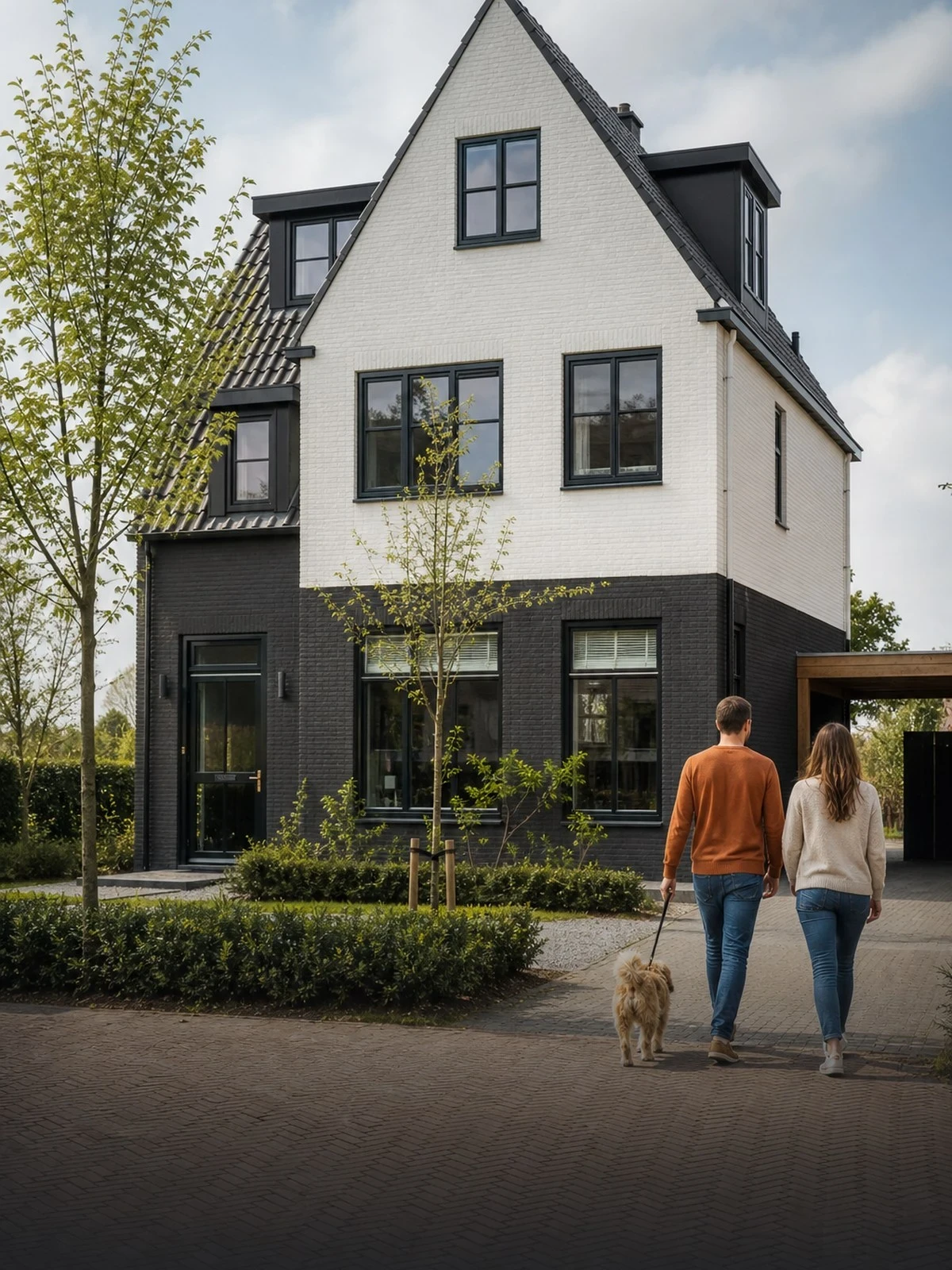
The Bewust home insurance is the buildings cover for the home you live in yourself. What is insured is the building with everything permanently attached to it: the foundations, the roof, the fitted kitchen and bathroom, the central heating system, floors, sunblinds on the facade, solar panels on the roof, and usually the shed and the boundary fencing as well. The loose items inside belong to the home contents insurance.
The basis for calculation is the rebuild value, not the market value and not the mortgage. You establish it using a rebuild value calculator or a valuation; where the figures are correct, a guarantee against underinsurance usually applies. If the building changes, for example through an extension, a dormer window or an attached consulting room, that basis changes with it and the policy should be adjusted.
Besides damage to the building itself, you run a liability risk. Under Article 6:174 DCC the possessor of a defective structure is liable for the damage it causes: a roof tile falling onto a parked car, a facade panel coming loose, a chimney toppling over. That claim does not go to the buildings policy but to your liability insurance in the right place.
We work with dozens of insurers and choose whichever fits your situation best — not whichever pays us the most. That means advice built around you, not around one brand.
 Insurers
 Independent
 Advice
The structure of the cover in three parts, with an overview per situation below.
The basic cover insures the core of your Bewust home insurance. We show what Ansvar Idea and other insurers offer within it.
As well as fire and storm, also burglary, theft and water damage to your home.
The most complete cover. We compare Ansvar Idea's extended version with the market.
What is covered
| Situation | Standard | With extension |
|---|---|---|
| Fire, smoke and lightning strike | Yes | Yes |
| Storm from force 7 upwards | Yes | Yes |
| Water damage from a burst pipe | Yes | Yes |
| Glass breakage | Provided it is declared | Yes |
| Groundwater coming through the floor | No | No |
| Wear and deferred maintenance | No | No |
What we do
| What we do | At Finass | Direct with Ansvar |
|---|---|---|
| Comparison across several insurers | Yes | No |
| Advice based on your own situation | Yes | Sometimes |
| One point of contact for claims | Yes | Sometimes |
| Cancellation with your current insurer arranged | Yes | No |
| We determine whether Ansvar is the best choice | Yes | No |
| Advice fees for you as a customer | No | No |
This overview concerns our service, not the cover. What is actually covered is set out in the policy conditions and on the insurer's insurance card (verzekeringskaart); you receive both before you take out cover.
Insurers weigh these details differently. That is where your saving is.
We look at the terms as well as the premium, and stay your point of contact when there is a claim.
We are not tied to one insurer and compare on the basis of an objective analysis of several companies.
You call or email someone who knows your file. No menu options, no changing call centres.
We cancel your old policy and align the start date, so you are never a day without cover.
We report the claim and monitor how it is handled. In urgent cases you can reach us on the emergency line.
Customers rate our service on four aspects: personal service, service delivery, availability and the outcome. The reviews are collected and published by NH1816 and come from customers who have actually taken out a policy with Finass Advies B.V. or reported a claim.
Four points that make the difference between a policy that pays out and one that does not.
Subsidence of the home, cracking caused by settlement of the ground and decay of wooden piles are excluded under virtually every buildings policy. These involve a gradual process linked to the groundwater level and the construction method, not a sudden event. The costs of repairing the foundations are therefore uninsured too, however drastic and expensive that repair may be.
Water penetrating through a floor or a cellar wall is excluded, as is flooding caused by the failure of a primary flood defence. Water that unexpectedly escapes from a pipe, a roof or a sanitary installation is covered. Rainfall coming in through an open window or a blocked gutter is often a grey area. The conditions describe this differently from one insurer to another.
Damage resulting from a design or workmanship fault, from poor materials or from maintenance that has been left undone is not covered. A roof leaking because the covering has reached the end of its life, a sagging beam, window frames that have rotted away: those are maintenance items. If the fault was made during construction, the route lies to the builder, not to the policy.
During refurbishment the house is open, materials are lying about and work with naked flames is carried out; prolonged vacancy also changes the risk. Both must be disclosed. Article 7:928 DCC requires an accurate statement at the outset and Article 7:930 DCC allows the insurer to reduce the payout where a change in risk has not been notified.
This is what people ask us most.
In an owner-occupied home a fitted kitchen belongs to the buildings, as do the bathroom, the floor and the boiler. If you rent the home and had the kitchen installed yourself, it counts as a tenant's improvement and falls under the contents policy. When you claim, that classification determines which insurer handles the matter.
Not always. Some policies include glass in the basic cover, others offer it as a separate section. What is then covered is breakage of panes forming part of the building, including fitting the new glass. Glass in greenhouses, garden houses, mirrors and screens is usually excluded; that belongs to the contents or remains uninsured.
If a tree blows over and damages your roof, you simply report it under your own buildings policy; storm damage is a covered event. If the tree was demonstrably dead or unsound, your insurer may recover the loss from the neighbour under Article 6:162 DCC. That recovery takes place without your involvement.
Disclose it in advance, with an indication of the nature and duration of the work and whether the house will remain occupied. During refurbishment the risks of fire, water and theft are higher and additional conditions often apply. Afterwards, establish the rebuild value again, because an extension or dormer window increases the cost of rebuilding.
Request a quote without obligation. We will look at which insurer best matches your activities and your risk.
Prefer to call? 072 - 509 24 56, weekdays 09:00–17:00.
Claim on the road? Emergency line 06 - 55 20 40 72.
Finass Verzekert is a trading name of Finass Advies B.V. We advise on and arrange non-life insurance on the basis of an objective analysis of several insurers, and receive commission for this from the insurer, which is included in the premium. You pay no separate advice fee. Before you take out cover, we establish your wishes and needs.
You will find our licence, KvK and Kifid details and our complaints procedure at the foot of every page.
This page was compiled by Finass Verzekert (LinkedIn). Last updated on .
The information on this page is general in nature and is not personal advice.
Maandag- Vrijdag: 09:00- 17:00
We use cookies and similar technologies to improve your experience on our website.