

Third-party liability
- Damage to other vehicles and injury
- Compulsory under Article 2 of the Dutch Motor Insurance Liability Act (WAM)
- No cover for your own motorcycle
- Applies even while the machine stands still
A motorcycle is a motor vehicle, so the statutory duty to insure applies as soon as the vehicle stands or is ridden on the public road. Above that, you choose for yourself how much cover you want for the machine itself.
This page in another language: Nederlands
Work out for yourself what it would cost.
Enter your details; you will receive a proposal within one working day.
A premium indication, not personal advice. Prefer to talk it through? Call 072 - 509 24 56.
A motorcycle falls under the duty to insure in Article 2 of the Dutch Motor Insurance Liability Act (WAM). As long as the machine has a registration and is not suspended, valid third-party liability cover must be in force: even if the vehicle stands indoors all winter. The RDW (the Dutch vehicle authority) checks this administratively. An uninsured registration leads to a penalty, whether or not the machine has been ridden. Third-party liability pays only for the damage you cause to someone else with the machine: their vehicle, their property and their injury.
Damage to the machine itself falls under own-damage cover. Third-party, fire and theft covers a fixed list of events, including theft, fire, storm and a collision with animals at large. Comprehensive adds your own fault to that: a fall on a bend, tipping over in the car park or a collision you caused yourself. Because a motorcycle in a fall is often written off in one go, own-damage cover weighs more heavily on this vehicle than on a car of the same value.
Two elements need extra attention on a motorcycle: protection against theft and helmet and motorcycle clothing. For own-damage cover, insurers usually set requirements for the lock and sometimes for a tracking system. If those are not met, theft is not covered. Helmet, jacket, trousers, gloves and boots are not automatically covered by the policy, but with many insurers they can be included as a separate section.
We compare your motorcycle insurance across dozens of insurers, explain where the real differences lie, and arrange the switch from start to finish — without you having to chase it yourself.
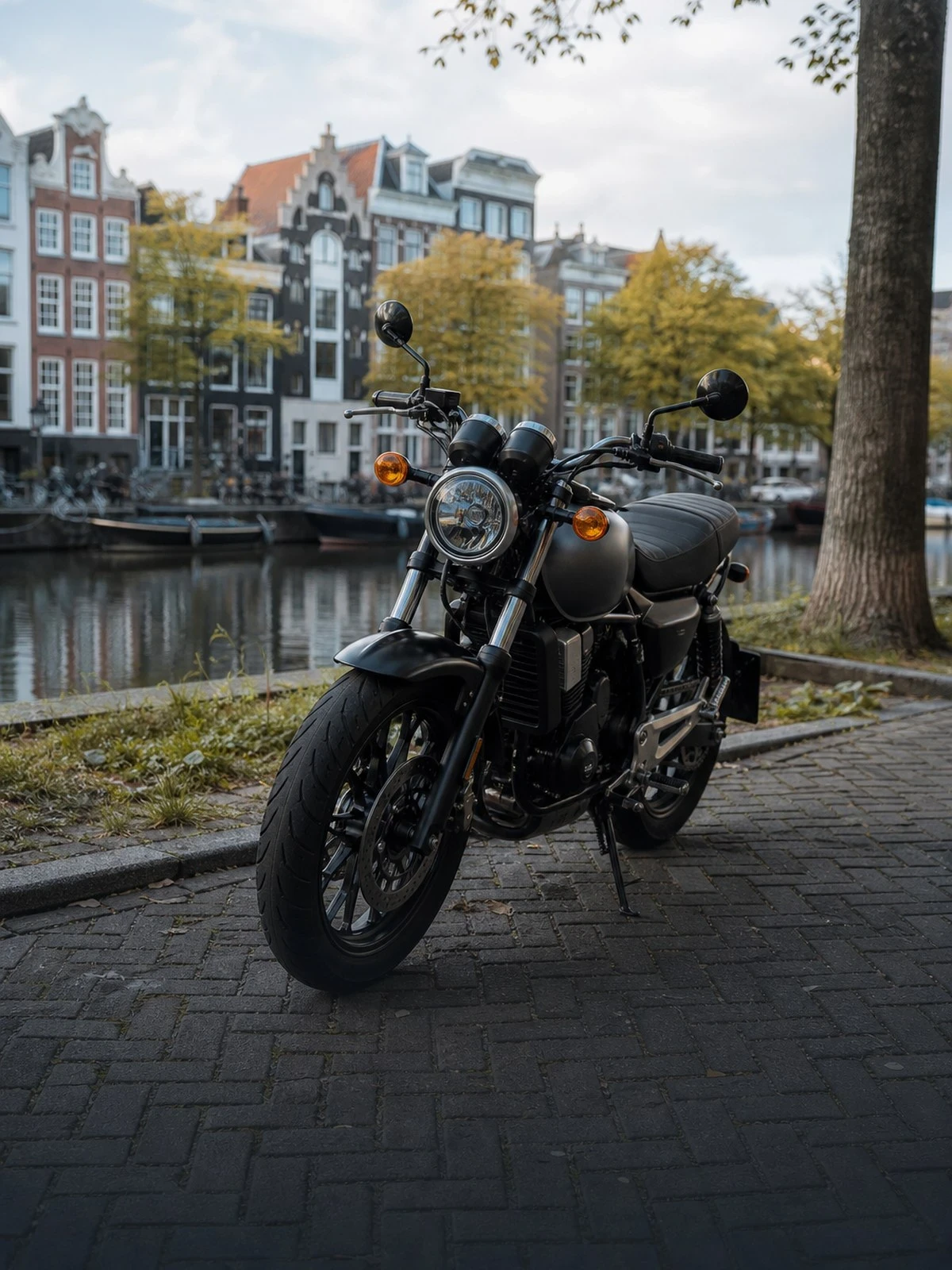 Motorcycle insurance
 Compare
 Get covered
Three forms of cover, with beneath them the situations that arise most often for motorcyclists.
The legally required cover for damage you cause to others with the motorcycle.
Alongside third-party liability, a fixed list of events over which you have no influence.
Damage to your own machine through your own fault or with no other party involved, as well.
What is covered
| Situation | Third-party liability | Comprehensive |
|---|---|---|
| Damage you cause to someone else with the motorcycle | Yes | Yes |
| Theft of the machine with the prescribed lock in use | No | Yes |
| A fall on a bend with no other party involved | No | Yes |
| Helmet and motorcycle clothing after an insured accident | No | Provided that |
| Damage during circuit training or a competition | No | No |
| Engine damage through wear or deferred maintenance | No | No |
What is actually covered, including exclusions, limits and the excess, is set out in the policy conditions and the insurance card (verzekeringskaart) that you receive before you take out cover.
Insurers weigh these details differently. That is where your saving is.
We look at the terms as well as the premium, and stay your point of contact when there is a claim.
We are not tied to one insurer and compare on the basis of an objective analysis of several companies.
You call or email someone who knows your file. No menu options, no changing call centres.
We cancel your old policy and align the start date, so you are never a day without cover.
We report the claim and monitor how it is handled. In urgent cases you can reach us on the emergency line.
Customers rate our service on four aspects: personal service, service delivery, availability and the outcome. The reviews are collected and published by NH1816 and come from customers who have actually taken out a policy with Finass Advies B.V. or reported a claim.
Four points that determine whether the insurer actually pays out when a claim is made.
The registration certificate shows the vehicle category. That determines whether the vehicle is insured as a motorcycle, moped or three-wheeled motor vehicle, which licence you need and whether a speed restriction applies. If you ride on a licence that is not valid for that category: for example a heavier machine on an A2 licence, or riding while disqualified — the damage to your own machine is not covered and the insurer recovers from you what has been paid to the other party.
Own-damage cover on a motorcycle is almost always conditional. Insurers usually require an an approved lock, on more expensive machines supplemented by an alarm or a tracking system with a subscription. If that requirement is in your policy and the machine was stolen without the lock having been used, or the tracking system subscription has expired, the theft is not paid for. Keep the keys and the purchase invoice. After a theft the insurer asks for both.
The following, among others, are outside the cover: taking part in competitions, speed trials and training on a circuit, even where it is a free riding day without timing; riding off-road or on closed practice grounds where the policy gives no cover; driving without a valid licence or under the influence; and wear, mechanical defects and deferred maintenance without a collision. Damage caused by intent or recklessness is excluded under Article 7:952 of the Dutch Civil Code.
A different exhaust, an increase in power, a fairing set or a modified chassis change the risk. Report them before taking out the policy: at inception the duty of disclosure in Article 7:928 of the Dutch Civil Code and a breach of it can void the payout (Article 7:930 of the Dutch Civil Codeapplies). The same goes for where the machine is kept: a machine that stands on the street at night is assessed differently from one in a locked garage. Report a loss as soon as reasonably possible (Article 7:941 of the Dutch Civil Code).
This is what people ask us most.
Yes, as long as the registration is in your name and has not been suspended. The duty to insure under Article 2 of the Dutch Motor Insurance Liability Act (WAM) attaches to the registration, not to use. If you want to take the machine off the road, suspend the registration with the RDW; the obligation then lapses, but you may also not use the public road. Many insurers also have a winter arrangement at a lower premium.
Not automatically. Helmet, jacket, trousers, gloves and boots fall under the policy only if you take out a separate section for them, usually up to a maximum amount and with depreciation for age. Payment usually follows only where there is damage to the machine at the same time that falls under the cover. Check the limit: a complete outfit soon costs more than the standard amount.
No. Riding on a circuit falls outside virtually every motorcycle policy, even on a touring day without timing or a competitive element. The same applies to speed trials, gymkhanas and training. If you do want to go on the circuit, separate temporary cover is needed. Do not assume it without written confirmation from your insurer.
An increase in power or the removal of a restriction is an increase in risk and must be reported. If you do not, the insurer can reduce or refuse payment for a claim under Article 7:930 of the Dutch Civil Code and terminate the policy. Where a technical deviation is established, the licence category may moreover no longer match, which affects cover further.
A passenger falls under the third-party liability cover: their injury is paid for as third-party loss. Your own injury is not; accident cover or indemnity cover for occupants is needed for that. If you have several machines, you take out a policy per registration, but many insurers give a discount for a second vehicle and let no-claims years built up carry on.
Sometimes. A number of insurers let no-claims years from a car policy count towards motorcycle insurance, while others keep the build-up strictly separate per type of vehicle. The rules differ per company and are set out in the premium appendix. Always state your actual number of no-claims years on the application. Those details are verified in the central register.
Every situation is different. For these situations we have a separate page.
Request a quote without obligation using the registration number. We check the form of cover, the security requirements and the cover for your motorcycle clothing.
Prefer to call? 072 - 509 24 56, weekdays 09:00–17:00.
Claim on the road? Emergency line 06 - 55 20 40 72.
Finass Verzekert is a trading name of Finass Advies B.V. We advise on and arrange non-life insurance on the basis of an objective analysis of several insurers, and receive commission for this from the insurer, which is included in the premium. You pay no separate advice fee. Before you take out cover, we establish your wishes and needs.
You will find our licence, KvK and Kifid details and our complaints procedure at the foot of every page.
This page was compiled by Finass Verzekert (LinkedIn). Last updated on .
The information on this page is general in nature and is not personal advice.
Maandag- Vrijdag: 09:00- 17:00
We use cookies and similar technologies to improve your experience on our website.