

Liability
- Damage to third parties
- Employers' liability
- Care, custody and control as an extension
With a trike it is not the appearance but the vehicle category on the registration certificate that determines which driving licence you need and which cover is possible.
This page in another language: Nederlands
Work out for yourself what it would cost.
Enter your details; you will receive a proposal within one working day.
A premium indication, not personal advice. Prefer to talk it through? Call 072 - 509 24 56.
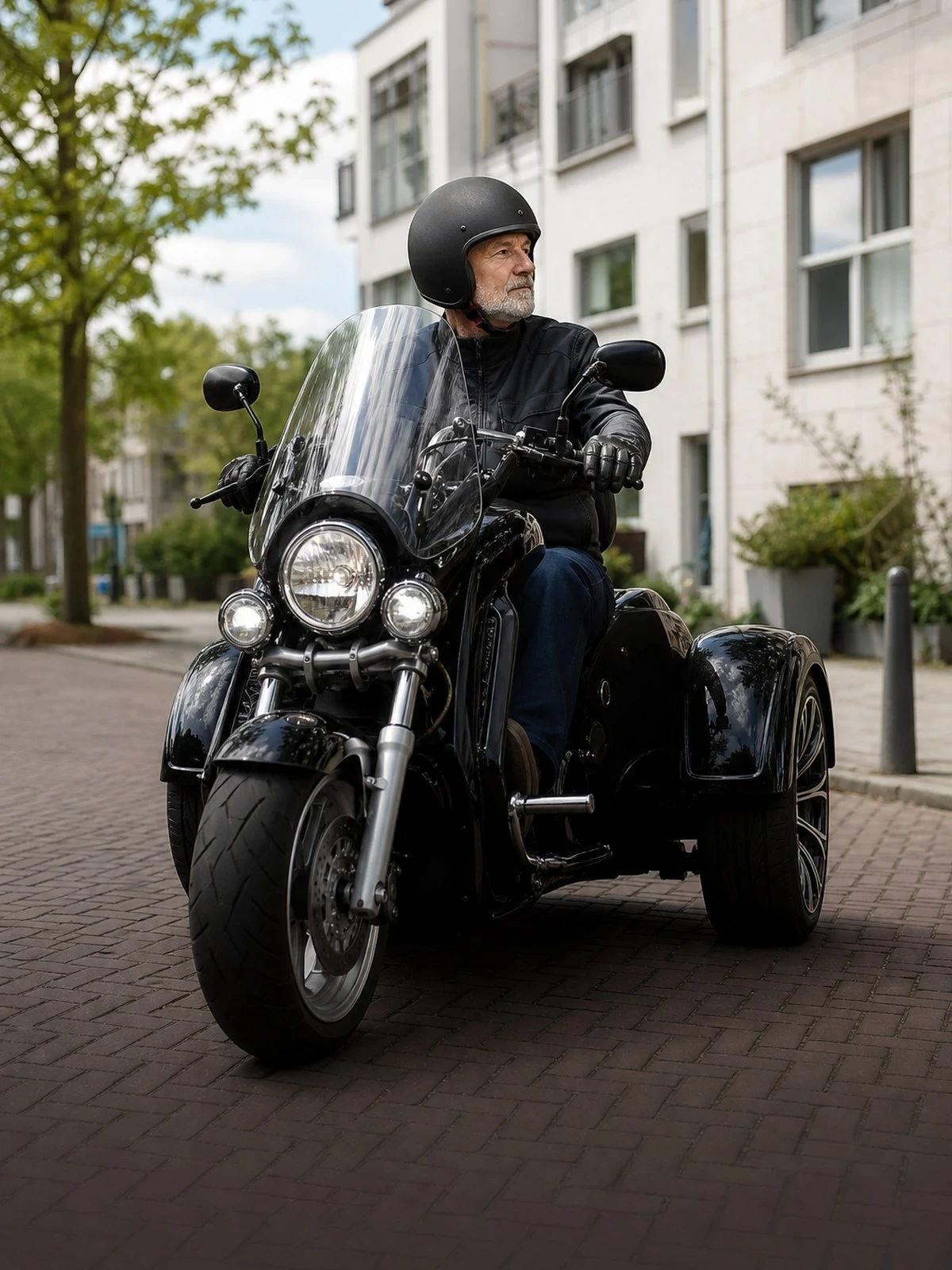
Depending on their construction, weight and power, trikes are registered either as a motorcycle or as a three-wheeled motor vehicle. That distinction is not a formality: it determines the driving licence required, whether a helmet is compulsory and how the insurer assesses the vehicle. Driving without the required licence is an absolute exclusion on every motor vehicle policy, including under own-damage cover and even if the collision was not your fault.
Insurance is compulsory under Article 2 of the Dutch Motor Insurance Liability Act (WAM) for as long as the vehicle has a registration number, even if it stands indoors all winter. Suspending the registration with the RDW (the Dutch vehicle authority) is the only way to set that obligation aside temporarily. Third-party liability cover pays for the damage you cause to others; damage to the trike itself is covered only under third-party, fire and theft or comprehensive cover.
Many trikes have been converted or built by their owner. That is the most awkward point for the own-damage value: there is no list price and no comparable model. In that case we have the value established in advance, so that there is no argument about what the vehicle was worth if it is a total loss. See also the cover for quads, trikes and the MP3.
We compare your moped insurance across dozens of insurers, explain where the real differences lie, and arrange the switch from start to finish — without you having to chase it yourself.
 Moped insurance
 Compare
 Get covered
The structure of the cover in three parts, with an overview per situation below.
AVB for property damage and injury, BAV for professional errors.
Business contents, goods and lost turnover during downtime.
Sickness absence, accidents and the traffic risk.
What is covered
| Situation | AVB | BAV | Cyber |
|---|---|---|---|
| Injury to a visitor or customer | Yes | No | No |
| Damage to a client's property | Sometimes | No | No |
| Financial loss caused by an advisory or calculation error | No | Yes | No |
| Downtime after a ransomware attack | No | No | Yes |
| Data breach involving personal data | No | Sometimes | Yes |
| Damage to property in your care | No | No | No |
This overview is general in nature and is not personal advice. What is actually covered, including exclusions, limits and the excess, is set out in the policy conditions and the insurance card (verzekeringskaart) of the insurer; you receive both before you take out cover. Taking out cover without advice? Then read what execution only means for you.
Insurers weigh these details differently. That is where your saving is.
We look at the terms as well as the premium, and stay your point of contact when there is a claim.
We are not tied to one insurer and compare on the basis of an objective analysis of several companies.
You call or email someone who knows your file. No menu options, no changing call centres.
We cancel your old policy and align the start date, so you are never a day without cover.
We report the claim and monitor how it is handled. In urgent cases you can reach us on the emergency line.
Customers rate our service on four aspects: personal service, service delivery, availability and the outcome. The reviews are collected and published by NH1816 and come from customers who have actually taken out a policy with Finass Advies B.V. or reported a claim.
Four points that make the difference between a policy that pays out and one that does not.
Part I states the vehicle category. If it names a motorcycle category, the motorcycle licence with its associated power restriction applies. For a three-wheeled motor vehicle a different category may apply. Look at this before you take to the road and not after something has happened, because in the event of a claim an insurer first checks whether the driver was entitled to drive. If not, cover lapses entirely.
A different engine, a wider rear frame, different suspension or a modified exhaust changes the risk and sometimes the type approval. Article 7:928 of the Dutch Civil Code requires you to declare everything relevant to the assessment when the policy starts. If that changes later, the same applies. An undeclared increase in power gives grounds for a defence of non-disclosure in the event of a claim, and the payment may be reduced or refused.
For home-built and converted machines there is no market value table. Have the vehicle valued and include the valuation as an annex to the policy, together with the parts fitted. Without a valuation the loss adjuster sets a value himself in the event of a total loss or theft, and for a home-built machine that is almost always lower than what you have invested in parts and labour.
Excluded are taking part in competitions, speed trials and driver training on a circuit. Driving under the influence means the third-party damage paid out is recovered from you personally. If you hire out the trike or let someone else use it for payment, that is commercial use and does not fall under a private policy. And under own-damage cover, theft is covered only if the prescribed security was fitted and in use.
This is what people ask us most.
That follows from the vehicle category on Part I of your registration certificate, not from what the vehicle looks like. Two trikes standing side by side may be registered differently. Check the category and compare it with the categories on your driving licence. If you drive without the required entitlement there is no cover, and the insurer recovers from you the amounts paid to third parties.
Yes, for as long as the registration is active in your name. Article 2 WAM links the insurance obligation to the registration and not to use. If you would rather not pay for the winter period, suspend the registration with the RDW; during a suspension the obligation lapses, but the vehicle may not stand or be driven anywhere on the public road either.
Third-party liability cover pays for injury to your passenger, because a passenger is an injured third party. The driver is not, and remains uninsured for his own injury. If you want to cover that, you need a personal accident policy for riders or an occupants' indemnity policy; the latter pays the actual loss instead of a fixed sum.
Often you can, but not automatically. Insurers want a valid registration, photographs and a valuation report from a recognised valuer. Without a valuation, part of the market accepts third-party liability only. Have the valuation renewed periodically, because a valuation report is valid for a limited period, after which the insurer is no longer bound by it.
Every situation is different. For these situations we have a separate page.
Request a quote without obligation. We will look at which insurer best matches your activities and your risk.
Prefer to call? 072 - 509 24 56, weekdays 09:00–17:00.
Claim on the road? Emergency line 06 - 55 20 40 72.
Finass Verzekert is a trading name of Finass Advies B.V. We advise on and arrange non-life insurance on the basis of an objective analysis of several insurers, and receive commission for this from the insurer, which is included in the premium. You pay no separate advice fee. Before you take out cover, we establish your wishes and needs.
You will find our licence, KvK and Kifid details and our complaints procedure at the foot of every page.
This page was compiled by Finass Verzekert (LinkedIn). Last updated on .
The information on this page is general in nature and is not personal advice.
Maandag- Vrijdag: 09:00- 17:00
We use cookies and similar technologies to improve your experience on our website.