

Third-party liability
- Required by law
- As long as the registration is in your name
- Suspend the registration when not in use
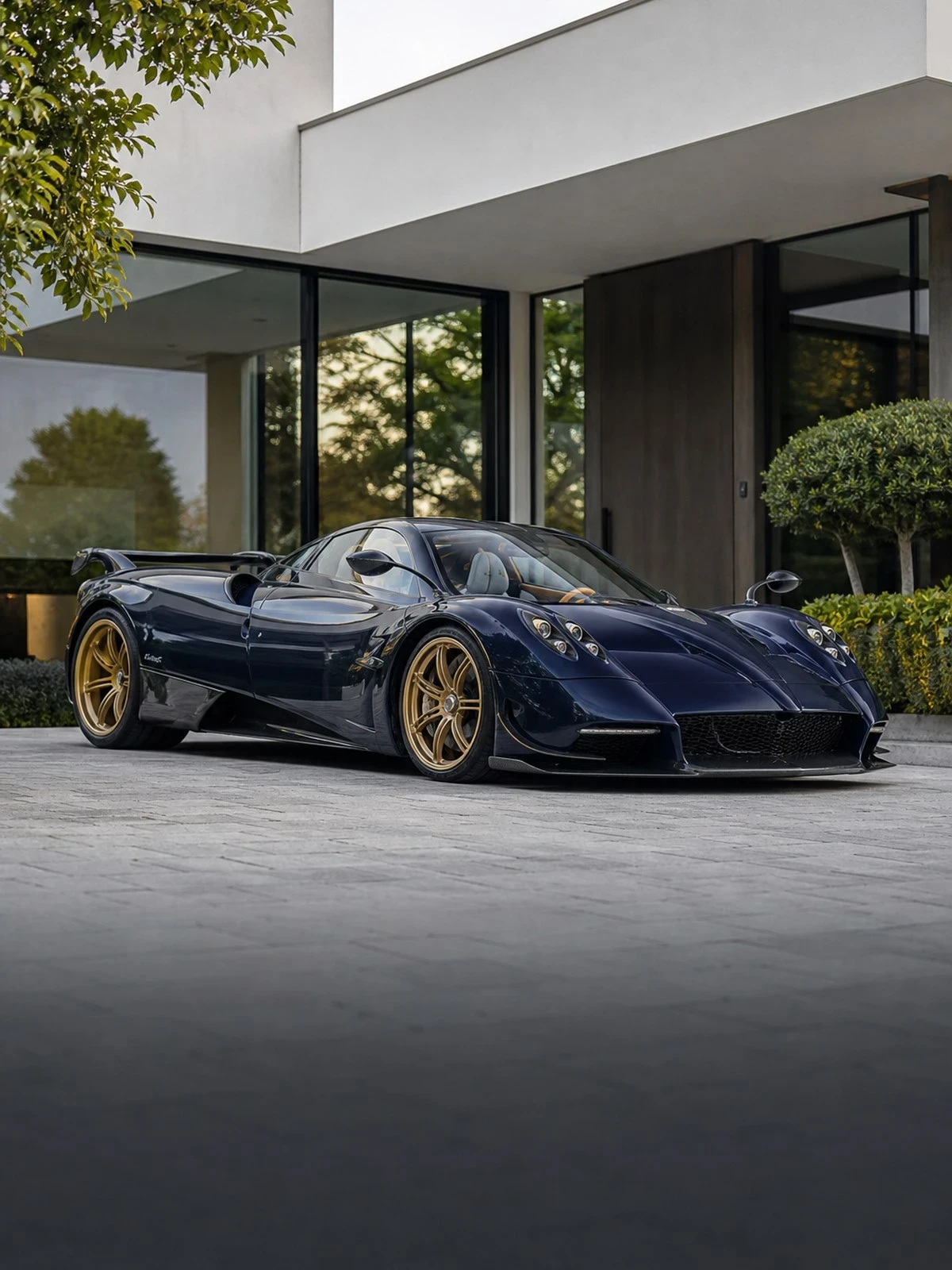
A Pagani is built by hand in very small numbers. The cover therefore turns on the exposed carbon bodywork, the supply of parts and the storage.
This page in another language: Nederlands
Work out for yourself what it would cost.
Enter your details; you will receive a proposal within one working day.
A premium indication, not personal advice. Prefer to talk it through? Call 072 - 509 24 56.
The bodywork is the core problem here. Panels are built up from carbon fibre that stays visible, sometimes in combination with titanium. On a painted panel, paint damage can be repaired locally. On exposed carbon with a clear finish that is virtually impossible without a difference in colour and weave. In practice the whole panel is replaced. That explains why a scratch or a scrape here calls for a payment that would be unthinkable on an ordinary sports car.
Parts come from hand production in small series. There is no stock waiting. Delivery times mount up and the car stands idle in the meantime. For the policy that means two things: record at which point the repair will take place and whether transport there falls within your cover, and bear in mind that the payment concerns the repair and not the period during which you are without the car.
Because there is hardly any comparable supply, the value is fixed in advance in a valuation report. That agreement is binding under Article 7:960 of the Dutch Civil Code, but applies only for as long as the report is current. Once the period of validity has expired, you fall back on market value. The car is often part of a collection of several objects. In that case, consider whether one policy with a schedule per object is more practical. See also the McLaren.
We compare your car insurance across dozens of insurers, explain where the real differences lie, and arrange the switch from start to finish — without you having to chase it yourself.
 Car insurance
 Compare
 Get covered
The structure of the cover in three parts, with an overview per situation below.
Damage you cause to others.
Causes beyond your control.
Including damage you cause yourself.
What is covered
| Situation | Third-party liability | Third-party, fire and theft | Comprehensive |
|---|---|---|---|
| Damage to the other party | Yes | Yes | Yes |
| Theft | No | Yes | Yes |
| Fire and storm | No | Yes | Yes |
| Damage you cause yourself | No | No | Yes |
| Wear and mechanical defects | No | No | No |
| Driving without a valid licence | No | No | No |
This overview is general in nature and is not personal advice. What is actually covered, including exclusions, limits and the excess, is set out in the policy conditions and the insurance card (verzekeringskaart) of the insurer; you receive both before you take out cover. Taking out cover without advice? Then read what execution only means for you.
Insurers weigh these details differently. That is where your saving is.
We look at the terms as well as the premium, and stay your point of contact when there is a claim.
We are not tied to one insurer and compare on the basis of an objective analysis of several companies.
You call or email someone who knows your file. No menu options, no changing call centres.
We cancel your old policy and align the start date, so you are never a day without cover.
We report the claim and monitor how it is handled. In urgent cases you can reach us on the emergency line.
Customers rate our service on four aspects: personal service, service delivery, availability and the outcome. The reviews are collected and published by NH1816 and come from customers who have actually taken out a policy with Finass Advies B.V. or reported a claim.
Four points that make the difference between a policy that pays out and one that does not.
On painted panels, damage is touched up and resprayed. With exposed carbon the weave lies under a clear layer. Every repair is visible in the pattern. The practical route is replacement of the complete panel, including reapplying the finish. So report light scratches and scrapes as damage too, and have the expert record whether a local repair is technically sound before a cheaper route is chosen.
Production is by hand and there is no parts warehouse as there is for a series-built car. Body parts and specific components are made to order, with waiting times that run into months. Your own-damage cover pays for the repair, not for the time off the road. If you want a payment for the period the car is unavailable, or for storage at the repairer, that has to be included as additional cover; it is not there as standard.
If the car stands in a collector's garage with other vehicles, the storage itself is a risk factor: fire spreads, and a leak or a defect in another object affects your car too. Insurers therefore ask about fire compartmentation, detection and the number of objects in the same space. Have the storage described exactly and report it if anything changes about the location or the way it is fitted out.
Outside the cover are: taking part in track days, concours runs with timing and speed tests; mechanical failure, wear and engine damage without a collision; damage during transport on a trailer or by a haulier, which falls under separate transport cover; loss of value after a technically correct repair; and damage or theft at a location that differs from the storage described in the policy.
This is what people ask us most.
Because the weave is visible under a clear finish. Touching up locally always shows a difference in colour, gloss or pattern, so that the panel no longer looks right. The usual solution is replacement of the complete panel, which is made to order. That turns superficial damage into a lengthy and costly repair.
Yes, with a new valuation report. If the market changes or you have work carried out that affects the value, a revaluation is the way to bring the policy into line. Do not wait until the period of validity has expired; between the expiry of the old report and the drawing up of a new one, the market value applies.
They can, and with a collection that is often practical: one policy with a specification per object, each with its own valuation figure. The advantage is that changes and storage requirements are arranged in one place. The disadvantage is that an event in the storage, such as a fire, affects several objects at once; so have it checked how the limit per event is built up.
The journey there on the public road usually is, provided it falls within the territorial limits. Taking part is not always covered: as soon as time is measured or there is an element of speed or handling, it falls under the exclusion. Ask for the rules of the event and declare your participation in advance, so that day cover can be arranged if necessary.
Every situation is different. For these situations we have a separate page.
Request a quote without obligation. We will look at which insurer best matches your activities and your risk.
Prefer to call? 072 - 509 24 56, weekdays 09:00–17:00.
Claim on the road? Emergency line 06 - 55 20 40 72.
Finass Verzekert is a trading name of Finass Advies B.V. We advise on and arrange non-life insurance on the basis of an objective analysis of several insurers, and receive commission for this from the insurer, which is included in the premium. You pay no separate advice fee. Before you take out cover, we establish your wishes and needs.
You will find our licence, KvK and Kifid details and our complaints procedure at the foot of every page.
This page was compiled by Finass Verzekert (LinkedIn). Last updated on .
The information on this page is general in nature and is not personal advice.
Maandag- Vrijdag: 09:00- 17:00
We use cookies and similar technologies to improve your experience on our website.