

Third-party liability
- Compulsory from registration onwards
- Damage to other vehicles
- Injury to third parties
Almost no Harley is still as it left the factory, and that makes establishing the value, rather than the form of cover, the hardest part of this policy.
This page in another language: Nederlands
Work out for yourself what it would cost.
Enter your details; you will receive a proposal within one working day.
A premium indication, not personal advice. Prefer to talk it through? Call 072 - 509 24 56.
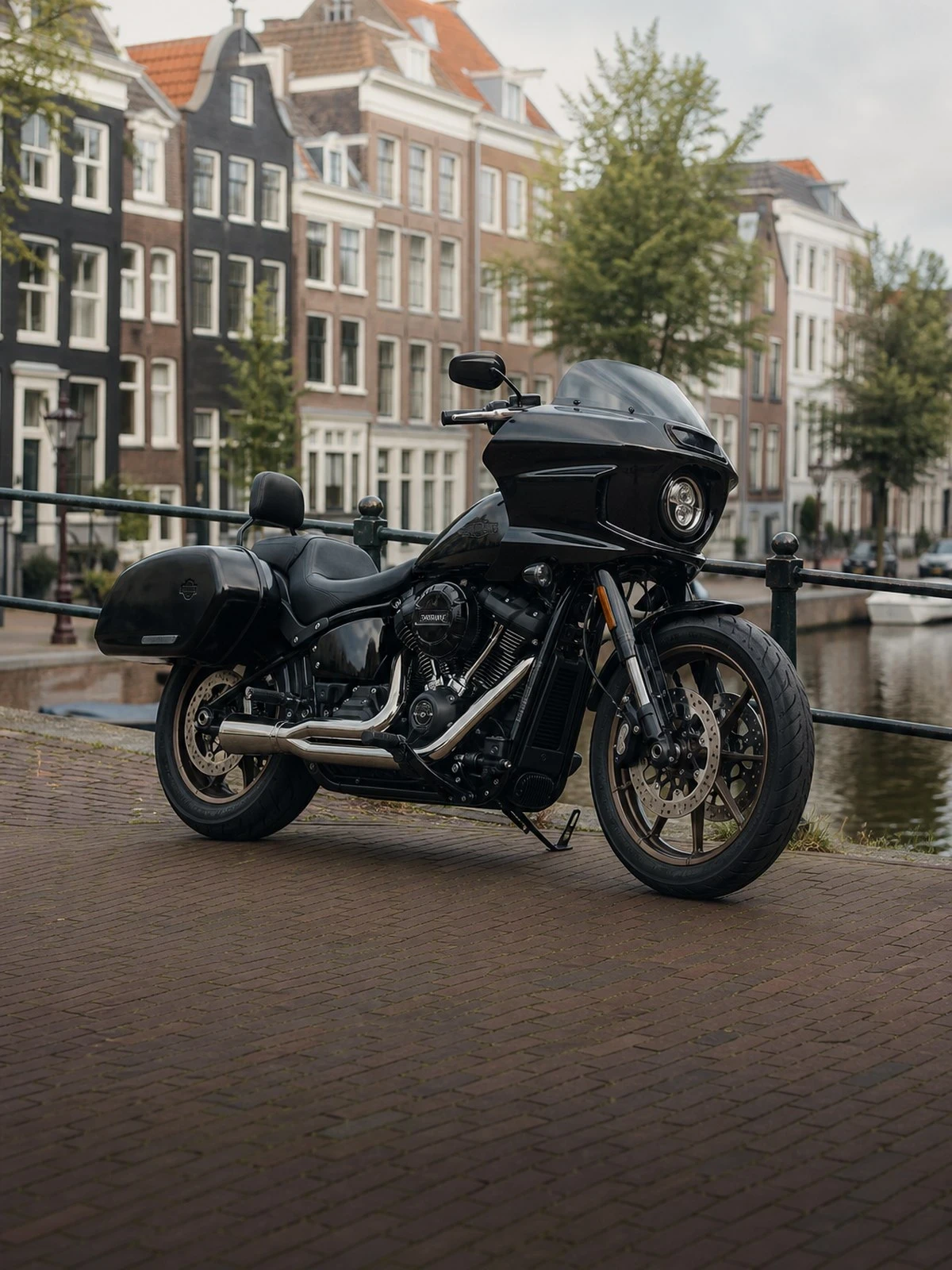
You insure a Harley-Davidson as a motor vehicle, with third-party liability as the statutory minimum and above that third-party, fire and theft or comprehensive. What is different with this make is that the settlement on theft or total loss does not come out right by itself. A list price describes a specification that is barely seen on the road, while the exhaust, handlebars, seat, panniers, chrome and paintwork make up a considerable part of the actual value.
The solution is a agreed value valuation: an expert establishes the value and records it in a report. Under Article 7:960 of the Dutch Civil Code you may not end up better off from an insurance policy, but a valid agreed valuation binds the insurer to the amount established. Without a report you remain dependent on an estimate after the event, with receipts that are no evidence of value.
There is also, more often than elsewhere with this make, the question of whether the machine is still technically what the registration says. Modified frame parts, a different engine or altered steering are not accessories but changes to the vehicle.
We compare your motorcycle insurance across dozens of insurers, explain where the real differences lie, and arrange the switch from start to finish — without you having to chase it yourself.
 Motorcycle insurance
 Compare
 Get covered
The structure of the cover in three parts, with an overview per situation below.
Damage you cause to others with your motorcycle.
Theft, fire, storm and glass damage.
Including your own fault and a single-vehicle fall.
What is covered
| Situation | Third-party liability | Third-party, fire and theft | Comprehensive |
|---|---|---|---|
| Damage to another road user | Yes | Yes | Yes |
| Theft with an approved lock | No | Yes | Yes |
| Fire or storm in storage | No | Yes | Yes |
| A single-vehicle fall with no other party | No | No | Yes |
| Motorcycle clothing and helmet | No | No | Sometimes |
| Track use and speed competitions | No | No | No |
This overview is general in nature and is not personal advice. What is actually covered, including exclusions, limits and the excess, is set out in the policy conditions and the insurance card (verzekeringskaart) of the insurer; you receive both before you take out cover. Taking out cover without advice? Then read what execution only means for you.
Insurers weigh these details differently. That is where your saving is.
We look at the terms as well as the premium, and stay your point of contact when there is a claim.
We are not tied to one insurer and compare on the basis of an objective analysis of several companies.
You call or email someone who knows your file. No menu options, no changing call centres.
We cancel your old policy and align the start date, so you are never a day without cover.
We report the claim and monitor how it is handled. In urgent cases you can reach us on the emergency line.
Customers rate our service on four aspects: personal service, service delivery, availability and the outcome. The reviews are collected and published by NH1816 and come from customers who have actually taken out a policy with Finass Advies B.V. or reported a claim.
Four points that make the difference between a policy that pays out and one that does not.
A valuation report describes the machine as it is now, including add-ons and finish, and binds the insurer to that amount on a total loss. Such a report has a limited period of validity. If it expires, you fall back on market value. Have it revalued after every major modification, because on these machines the configuration changes faster than the policy. Keep the report away from the machine.
If work is done on the frame, engine, steering or brakes, the vehicle itself changes. Some modifications require an inspection and an amendment of the registration details. If the machine is not registered as it is ridden, you have two problems at once when a claim is made: an argument with the insurer about the duty of disclosure, and a vehicle that is formally not permitted on the road.
Damaged chrome is replaced and damaged paintwork is resprayed, often not only on the part that was hit but on the adjoining panel as well to avoid a difference in colour. Hand-painted or layered paintwork is moreover not easy to reproduce. So ask in advance whether such finishing falls within the valuation and what new-for-old deduction the insurer applies to replaced parts.
These machines generally cover limited mileage and stand still for most of the year. That shifts the emphasis from riding risk to fire and theft risk at the storage address. Insurers include clauses about that: a locked space, an anchored lock, sometimes a tracker. If the machine is regularly kept somewhere other than the policy address, that address has to be correct, otherwise the theft cover is open to challenge.
Almost every insurer requires an ART-approved lock, often category 4 or higher, and for more expensive motorcycles a tracker or locked storage. Keep the purchase receipt for the lock and both keys. These are the first things asked for in a claim.
Motorcycle clothing does not fall under the own-damage cover for the motorcycle. Some insurers offer an extension, sometimes only in combination with an accident in which the motorcycle was also damaged. For a full suit plus helmet, the amount quickly exceeds a thousand euros.
This is what people ask us most.
Because that value describes the standard specification. Exhaust, handlebars, seat, panniers, chrome and paintwork fall outside it and on these machines represent a substantial part of the whole. Without a valuation or a separate declaration you are paid for the bare model on theft or total loss and pay for the build-up again yourself.
An agreed valuation has a period stated in the policy conditions. While it runs, the insurer is bound to the amount. After that, settlement falls back on market value and the report is effectively of no further use. Put the end date in your diary and have it revalued, certainly if anything has been added or resprayed since the report.
Yes, and not only to the insurer. Work on the frame, engine, steering or brakes can require an inspection and an amendment of the registration details. If you do not report it, the insurer can rely on the duty of disclosure when a claim is made and reduce or refuse payment. Keep invoices and inspection documents with the valuation report.
Usually it is replaced or resprayed, with a new-for-old deduction on parts subject to wear, and with your excess taken off. Special paintwork is insured only where it is included in the valuation. Ask in advance whether adjoining paintwork is included, because a partial respray almost always leaves a difference in colour.
Every situation is different. For these situations we have a separate page.
Request a quote without obligation. We will look at which insurer best matches your activities and your risk.
Prefer to call? 072 - 509 24 56, weekdays 09:00–17:00.
Claim on the road? Emergency line 06 - 55 20 40 72.
Finass Verzekert is a trading name of Finass Advies B.V. We advise on and arrange non-life insurance on the basis of an objective analysis of several insurers, and receive commission for this from the insurer, which is included in the premium. You pay no separate advice fee. Before you take out cover, we establish your wishes and needs.
You will find our licence, KvK and Kifid details and our complaints procedure at the foot of every page.
This page was compiled by Finass Verzekert (LinkedIn). Last updated on .
The information on this page is general in nature and is not personal advice.
Maandag- Vrijdag: 09:00- 17:00
We use cookies and similar technologies to improve your experience on our website.