

Business contents
- At replacement value as new
- Fire, water and burglary
- Tenant's improvements separately
In an installation business the expensive equipment is rarely in the workshop: it is in the van, and that van stands in the street overnight.
This page in another language: Nederlands
Work out for yourself what it would cost.
Enter your details; you will receive a proposal within one working day.
A premium indication, not personal advice. Prefer to talk it through? Call 072 - 509 24 56.
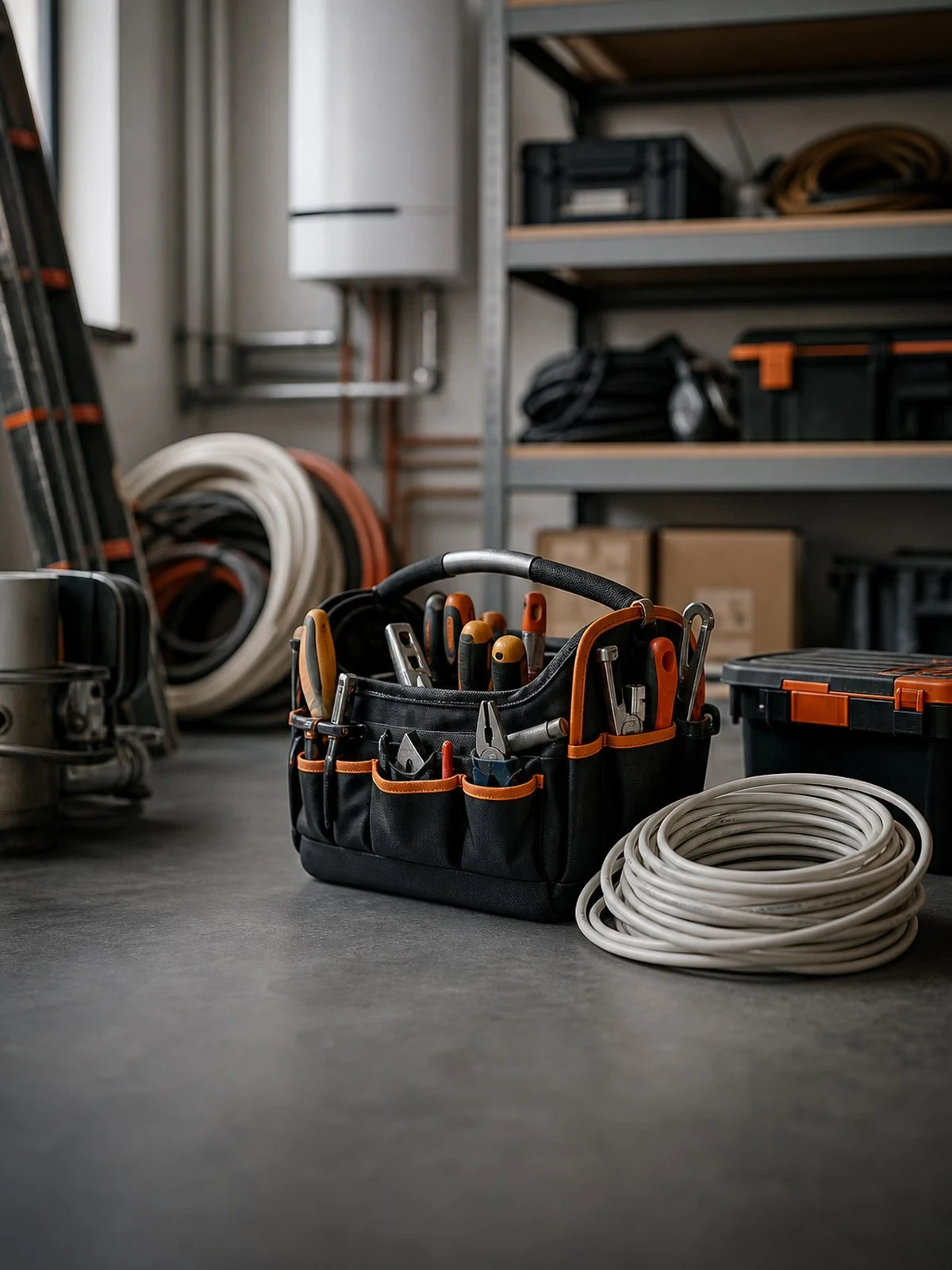
The business contents of an installation business consists of press tools, core drilling equipment, welding and soldering equipment, measuring and test equipment such as leak detectors, insulation testers and thermal imaging cameras, plus the fit-out of the workshop and stores. The goods are pipework materials, copper, cable, fittings and appliances in stock. The catch is that most of it is not at the business address on working days.
Business insurance covers the risk address stated. Tools in the van and materials you drop off at a customer's site in advance do not fall under it unless you include cover away from the address. That extension usually has tight conditions: demonstrable forced entry to the vehicle, sometimes a time window within which the cover applies and sometimes a maximum per event. Read that provision before you sign.
Not covered are theft from an unlocked or undamaged van, materials left unattended at a customer's site, wear and tear and inherent defect of tools, and the installation you fit yourself. A badly pressed joint and the leak that follows belong with the public and employers' liability insurance, not here.
We compare your business contents insurance across dozens of insurers, explain where the real differences lie, and arrange the switch from start to finish — without you having to chase it yourself.
 Business contents insurance
 Compare
 Get covered
The structure of the cover in three parts, with an overview per situation below.
Machinery, equipment, furniture and fixed fittings.
Trading stock, raw materials and finished products.
What is excluded as standard.
What is covered
| Situation | Business contents | Goods |
|---|---|---|
| Fire and smoke damage | Yes | Yes |
| Burglary with signs of forced entry | Yes | Yes |
| Water damage from a burst pipe | Yes | Yes |
| Customers' property being worked on | No | No |
| Spoilage due to refrigeration failure | Sometimes | Sometimes |
| Wear and deferred maintenance | No | No |
This overview is general in nature and is not personal advice. What is actually covered, including exclusions, limits and the excess, is set out in the policy conditions and the insurance card (verzekeringskaart) of the insurer; you receive both before you take out cover. Taking out cover without advice? Then read what execution only means for you.
Insurers weigh these details differently. That is where your saving is.
We look at the terms as well as the premium, and stay your point of contact when there is a claim.
We are not tied to one insurer and compare on the basis of an objective analysis of several companies.
You call or email someone who knows your file. No menu options, no changing call centres.
We cancel your old policy and align the start date, so you are never a day without cover.
We report the claim and monitor how it is handled. In urgent cases you can reach us on the emergency line.
Customers rate our service on four aspects: personal service, service delivery, availability and the outcome. The reviews are collected and published by NH1816 and come from customers who have actually taken out a policy with Finass Advies B.V. or reported a claim.
Four points that make the difference between a policy that pays out and one that does not.
Most installation tools disappear not from premises but from a van. Insurers know that and attach conditions to it: a certified tool chest, an alarm, parking on a locked site or in a garage outside working hours, and in some policies cover only during the day. Take out of the van what you can in the evening and record which machines stay in it permanently, including serial numbers.
Boilers, radiators, pipework and units are often delivered to the customer's site days before installation. As long as those items have not been handed over and paid for, they are yours, but they are not at your address and the customer has no cover for them. Arrange this in advance: set out in the order confirmation when the risk passes and include temporary storage in the policy where necessary.
An installation business's stock consists largely of immediately saleable material. That makes both the stores and the van attractive. Mark your machines, record serial numbers and keep the purchase invoices digitally. It speeds up claims handling and is often the condition for showing what has gone. Report theft within the period stated in the conditions and go to the police (Article 7:941 of the Dutch Civil Code).
Outside the cover remain: the installation you fit and the consequential damage from an installation error, tools you hire or lend to someone else, wear and tear and inherent defect of machines, and money. A van that has not visibly been broken into also usually produces no payment. Work you carry out on a construction project may in addition fall under the Construction all risks (CAR) insurance of the main contractor.
This is what people ask us most.
Only with an extension for cover away from the address, and even then subject to conditions. Many policies require demonstrable forced entry to the vehicle, apply a time window within which cover exists or set a maximum per event. Some insurers require the van to be in a locked space. Look up that provision. It is the most common disagreement with this policy.
Not automatically. They are not at your insured address, and the customer has no cover for property that is still yours. Include temporary storage on site in the policy, or set out in the order confirmation that the risk passes to the client on delivery. Without one of the two, you carry the risk yourself.
No. Business contents insurance is about your own property, not about the work you deliver. Damage at the customer's premises from an installation error is liability and runs through your public and employers' liability insurance. Watch there for the exclusion of the cost of putting right your own work: the water damage is paid for, re-pressing the joint usually is not.
Report it to the police immediately and notify your insurer as soon as possible. That duty to notify is set out in Article 7:941 of the Dutch Civil Code. Provide a list of makes, types, serial numbers and purchase invoices, and photographs of the break-in damage to the vehicle. Without visible signs of forced entry and without evidence of what has gone, a payment is almost never made.
Every situation is different. For these situations we have a separate page.
Request a quote without obligation. We will look at which insurer best matches your activities and your risk.
Prefer to call? 072 - 509 24 56, weekdays 09:00–17:00.
Claim on the road? Emergency line 06 - 55 20 40 72.
Finass Verzekert is a trading name of Finass Advies B.V. We advise on and arrange non-life insurance on the basis of an objective analysis of several insurers, and receive commission for this from the insurer, which is included in the premium. You pay no separate advice fee. Before you take out cover, we establish your wishes and needs.
You will find our licence, KvK and Kifid details and our complaints procedure at the foot of every page.
This page was compiled by Finass Verzekert (LinkedIn). Last updated on .
The information on this page is general in nature and is not personal advice.
Maandag- Vrijdag: 09:00- 17:00
We use cookies and similar technologies to improve your experience on our website.