

Business contents
- At replacement value as new
- Fire, water and burglary
- Tenant's improvements separately
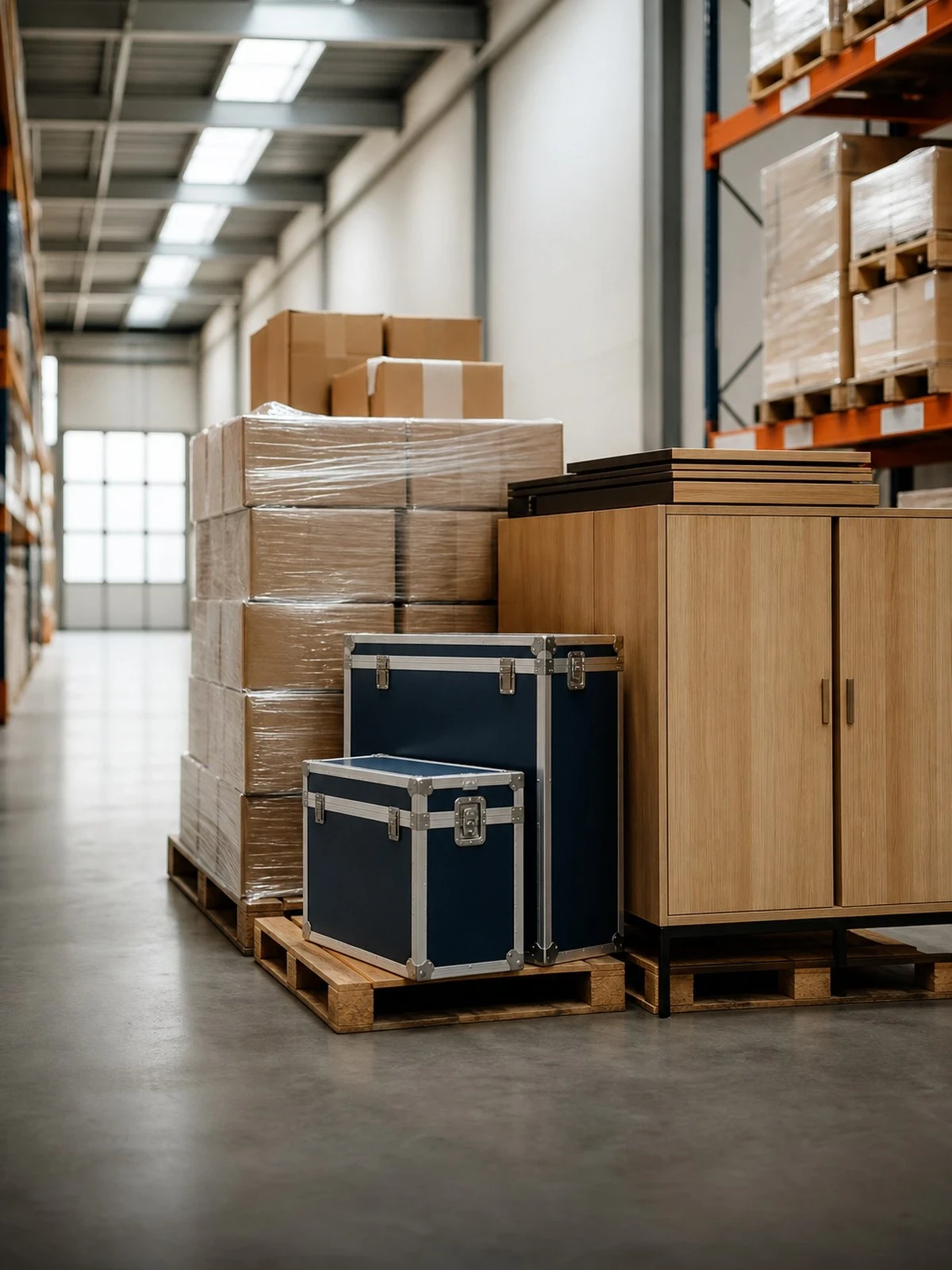
In a warehouse the risk is determined not by value but by how goods are stored: stacking height, aisle width, sprinkler class and exactly what is in the racking.
This page in another language: Nederlands
Work out for yourself what it would cost.
Enter your details; you will receive a proposal within one working day.
A premium indication, not personal advice. Prefer to talk it through? Call 072 - 509 24 56.
The business contents of a warehouse consists of racking, forklifts and reach trucks, conveyors, loading docks, order picking systems and the small office. The goods are the stock, and that item is almost always the largest amount on the policy here. It is also the amount that fluctuates most, because stock breathes with purchasing and the seasons.
For storage buildings, acceptance turns on the set-up. Insurers look at stacking height, at whether a sprinkler installation matches that height and the type of product, at fire compartments, at separate facilities for hazardous substances and at where forklift batteries are charged. If practice differs from what was declared, that affects Article 7:928 of the Dutch Civil Code and the sanction under Article 7:930 of the Dutch Civil Code.
Outside the cover remain: third-party goods you merely store, disappearance and stock discrepancies without signs of forced entry, self-heating and spontaneous combustion of the goods themselves, temperature damage without a separate section, and damage from incorrect stacking. For stock that is not yours, a separate arrangement is needed.
We compare your business contents insurance across dozens of insurers, explain where the real differences lie, and arrange the switch from start to finish — without you having to chase it yourself.
 Business contents insurance
 Compare
 Get covered
The structure of the cover in three parts, with an overview per situation below.
Machinery, equipment, furniture and fixed fittings.
Trading stock, raw materials and finished products.
What is excluded as standard.
What is covered
| Situation | Business contents | Goods |
|---|---|---|
| Fire and smoke damage | Yes | Yes |
| Burglary with signs of forced entry | Yes | Yes |
| Water damage from a burst pipe | Yes | Yes |
| Customers' property being worked on | No | No |
| Spoilage due to refrigeration failure | Sometimes | Sometimes |
| Wear and deferred maintenance | No | No |
This overview is general in nature and is not personal advice. What is actually covered, including exclusions, limits and the excess, is set out in the policy conditions and the insurance card (verzekeringskaart) of the insurer; you receive both before you take out cover. Taking out cover without advice? Then read what execution only means for you.
Insurers weigh these details differently. That is where your saving is.
We look at the terms as well as the premium, and stay your point of contact when there is a claim.
We are not tied to one insurer and compare on the basis of an objective analysis of several companies.
You call or email someone who knows your file. No menu options, no changing call centres.
We cancel your old policy and align the start date, so you are never a day without cover.
We report the claim and monitor how it is handled. In urgent cases you can reach us on the emergency line.
Customers rate our service on four aspects: personal service, service delivery, availability and the outcome. The reviews are collected and published by NH1816 and come from customers who have actually taken out a policy with Finass Advies B.V. or reported a claim.
Four points that make the difference between a policy that pays out and one that does not.
A suppression system is designed for a particular stacking height and a particular type of goods. If you stack higher, switch from wooden pallets to plastic, or add aerosols or batteries to your range, that design no longer fits. Report such changes in advance. If you do not and it turns out after a fire that the installation was never adequate, the duty of disclosure at inception comes into play after all.
The most common loss in a warehouse is not a fire but a reach truck hitting an upright. Damaged racking can collapse completely, taking the stock with it. Whether that falls under your policy depends on the form of cover chosen: on a policy naming only fire, storm, water and burglary, impact does not fall under it. An extended form covering external perils does.
A warehouse has peaks around purchasing moments and seasons. A sum insured based on the annual average means underinsurance at the highest point, and then every claim is settled proportionately. So work with a stock clause under which you declare the position periodically, or have the amount matched to the peak. Also discuss what happens to goods temporarily standing outside or in a rented unit.
Goods you store for someone else are not your own property; you have them in your care and that is excluded on the public and employers' liability insurance. Also outside the cover remain: disappearance without signs of forced entry, stock discrepancies at the count, self-heating and spontaneous combustion, damage from incorrect stacking and wear and tear of handling equipment. For stock in transit, a transit cover needed.
This is what people ask us most.
Not under the ordinary goods item. That covers your own stock. What you keep for someone else is in your care, custody and control, and your liability insurance usually excludes that. If you store for third parties on a structural basis, you need a separate section with a limit matching the maximum value held with you at any one time, and arrangements about liability in the storage contract.
Then do not insure on the annual average. At the highest point you would be underinsured and every claim, even a small one, would be settled proportionately. Work with a stock clause under which you declare the actual position periodically, or set the sum insured to the peak. Also report one-off spikes, for example a large purchase for a promotion period, in advance.
That depends on the form of cover. A policy covering only fire, storm, water and burglary does not pay for impact. An extended form covering external perils usually does. Also look at the liability side: if the forklift travels on public ground, the compulsory insurance requirement in Article 2 WAM applies and separate plant and machinery cover is needed.
Yes. Stacking height is an acceptance detail, because the suppression system is designed around it. The same applies to a change in the type of goods or the use of different pallets. Report it in writing before you make the change. If you do not, the insurer can rely on Articles 7:928 and 7:930 of the Dutch Civil Code when you claim and reduce or refuse payment.
Every situation is different. For these situations we have a separate page.
Request a quote without obligation. We will look at which insurer best matches your activities and your risk.
Prefer to call? 072 - 509 24 56, weekdays 09:00–17:00.
Claim on the road? Emergency line 06 - 55 20 40 72.
Finass Verzekert is a trading name of Finass Advies B.V. We advise on and arrange non-life insurance on the basis of an objective analysis of several insurers, and receive commission for this from the insurer, which is included in the premium. You pay no separate advice fee. Before you take out cover, we establish your wishes and needs.
You will find our licence, KvK and Kifid details and our complaints procedure at the foot of every page.
This page was compiled by Finass Verzekert (LinkedIn). Last updated on .
The information on this page is general in nature and is not personal advice.
Maandag- Vrijdag: 09:00- 17:00
We use cookies and similar technologies to improve your experience on our website.