

Third-party liability
- Required by law
- As long as the registration is in your name
- Suspend the registration when not in use
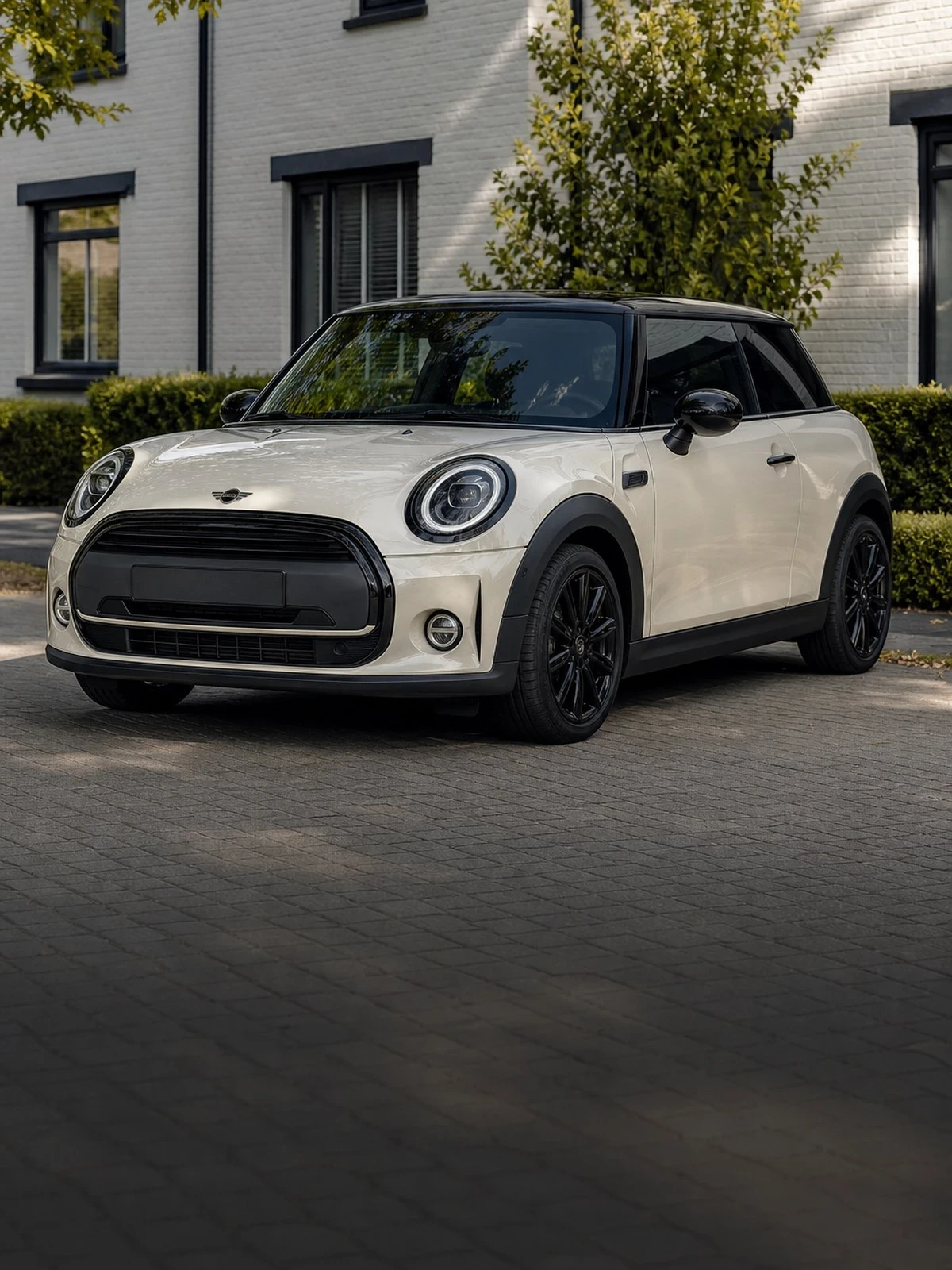
A MINI is more often a second car and a city car than a family car, and that shifts the risk from motorway miles to parking damage and accessories insured with the car.
This page in another language: Nederlands
The calculator and the quote form below are in Dutch. Prefer to do this in English? Email info@finassverzekert.nl or call 072 - 509 24 56 and we will take it from there.
Work out for yourself what it would cost.
Enter your details; you will receive a proposal within one working day.
A premium indication, not personal advice. Prefer to talk it through? Call 072 - 509 24 56.
The way a MINI is used differs from most cars: relatively few kilometres a year, many short journeys in built-up areas and often a second car alongside a larger family car. That means less exposure to serious collisions, but more chance of parking damage, collisions caused by unknown persons and vandalism.
The second distinctive feature is personalisation. A contrasting roof, striping, mirror caps, larger wheels and the equipment of a John Cooper Works package together represent a considerable share of the value. Whether that is paid for when there is a claim depends on whether it was ordered from the factory or added afterwards and declared.
If you also drive a larger car from the same group, the BMW page is a useful addition. For a comparison within the compact segment, it is also worth looking at CUPRA.
We compare your car insurance across dozens of insurers, explain where the real differences lie, and arrange the switch from start to finish — without you having to chase it yourself.
 Car insurance
 Compare
 Get covered
The structure of the cover in three parts, with an overview per situation below.
Damage you cause to others.
Causes beyond your control.
Including damage you cause yourself.
What is covered
| Situation | Third-party liability | Third-party, fire and theft | Comprehensive |
|---|---|---|---|
| Damage to the other party | Yes | Yes | Yes |
| Theft | No | Yes | Yes |
| Fire and storm | No | Yes | Yes |
| Damage you cause yourself | No | No | Yes |
| Wear and mechanical defects | No | No | No |
| Driving without a valid licence | No | No | No |
This overview is general in nature and is not personal advice. What is actually covered, including exclusions, limits and the excess, is set out in the policy conditions and the insurance card (verzekeringskaart) of the insurer; you receive both before you take out cover. Taking out cover without advice? Then read what execution only means for you.
Insurers weigh these details differently. That is where your saving is.
We look at the terms as well as the premium, and stay your point of contact when there is a claim.
We are not tied to one insurer and compare on the basis of an objective analysis of several companies.
You call or email someone who knows your file. No menu options, no changing call centres.
We cancel your old policy and align the start date, so you are never a day without cover.
We report the claim and monitor how it is handled. In urgent cases you can reach us on the emergency line.
Customers rate our service on four aspects: personal service, service delivery, availability and the outcome. The reviews are collected and published by NH1816 and come from customers who have actually taken out a policy with Finass Advies B.V. or reported a claim.
Four points that make the difference between a policy that pays out and one that does not.
If the car covers few kilometres, give a realistic annual mileage. That brings the premium down noticeably. If you consistently exceed the band you have given, the insurer can hold that against you when there is a claim. If you already have a car insured, ask about a second-car arrangement. No-claims years can be assigned to one policy at a time and cannot be used for two cars at once.
A roof, striping and wheels ordered from the factory are included in the list price and are therefore insured with the car. Anything you add later yourself falls under a separate accessories limit that varies from policy to policy. Declare expensive additions and keep the invoices, otherwise the standard specification will be taken as the basis when there is a claim. Being paid more than the actual loss is not possible in any event: Article 7:960 of the Dutch Civil Code stands in the way of that.
The most common damage in town is a dent or a scratch where the person who caused it remains unknown. That damage falls under comprehensive cover and not under third-party, fire and theft, and with most insurers it counts towards your no-claims years because there is no other party to recover from. On a small claim, therefore, first work out whether paying yourself works out cheaper than dropping back through the steps.
On an open version the fabric hood is both bodywork and weak spot. If the hood is cut open to get at the contents, that damage falls under break-in damage, provided there are demonstrable signs of forced entry and you report it to the police. Discolouration, leaks through ageing and a worn mechanism are wear and remain excluded, comprehensive cover included.
This is what people ask us most.
No-claims years belong to one policy at a time and cannot be used twice over. If you insure a second car, many companies do offer a second-car arrangement under which you start on a discount derived from your existing policy. If you sell the first car, you can still transfer its years within the usual period.
Wheels supplied from the factory are included in the list price and are covered. If you have had them fitted afterwards, they fall under the accessories limit of your policy. If their value is above that, declare them separately with the invoices. If you do not, the insurer will pay only the value of the standard wheels when there is a claim.
If no other party is known, the insurer cannot recover the loss anywhere and it counts as a claim. You then drop back through the steps. Where the amount of a claim is close to your excess, paying yourself is often more advantageous. Ask your adviser to do that calculation before you report it.
In a break-in where the hood is cut open, the damage falls under break-in damage within third-party, fire and theft, provided there are signs of forced entry and you report it to the police. Wear is another matter: discolouration, leaks through ageing and a faltering mechanism are maintenance issues and are paid for by no car insurance policy, not even with comprehensive cover.
Every situation is different. For these situations we have a separate page.
Request a quote without obligation. We will look at which insurer best matches your activities and your risk.
Prefer to call? 072 - 509 24 56, weekdays 09:00–17:00.
Claim on the road? Emergency line 06 - 55 20 40 72.
Finass Verzekert is a trading name of Finass Advies B.V. We advise on and arrange non-life insurance on the basis of an objective analysis of several insurers, and receive commission for this from the insurer, which is included in the premium. You pay no separate advice fee. Before you take out cover, we establish your wishes and needs.
You will find our licence, KvK and Kifid details and our complaints procedure at the foot of every page.
This page was compiled by Finass Verzekert (LinkedIn). Last updated on .
The information on this page is general in nature and is not personal advice.
Maandag- Vrijdag: 09:00- 17:00
We use cookies and similar technologies to improve your experience on our website.