

Quote for liability insurance for welders
In welding the risk lies in two things: what the spark reaches and what the weld does later. For the insurer those are two different conversations.
- Several insurers compared objectively
- 9.5 customer rating for a new policy
- AFM licence 12016589
- Personal 072 - 509 24 56, weekdays 9–17
This page in another language: Nederlands
Work out for yourself what it would cost.
Enter your details; you will receive a proposal within one working day.
- We compare the offerings of several insurers
- An adviser checks whether the cover suits your activities
- We arrange the switch, including cancellation
A premium indication, not personal advice. Prefer to talk it through? Call 072 - 509 24 56.
- Independent advice
- Several insurers
- Switching arranged
- Help with claims
In brief
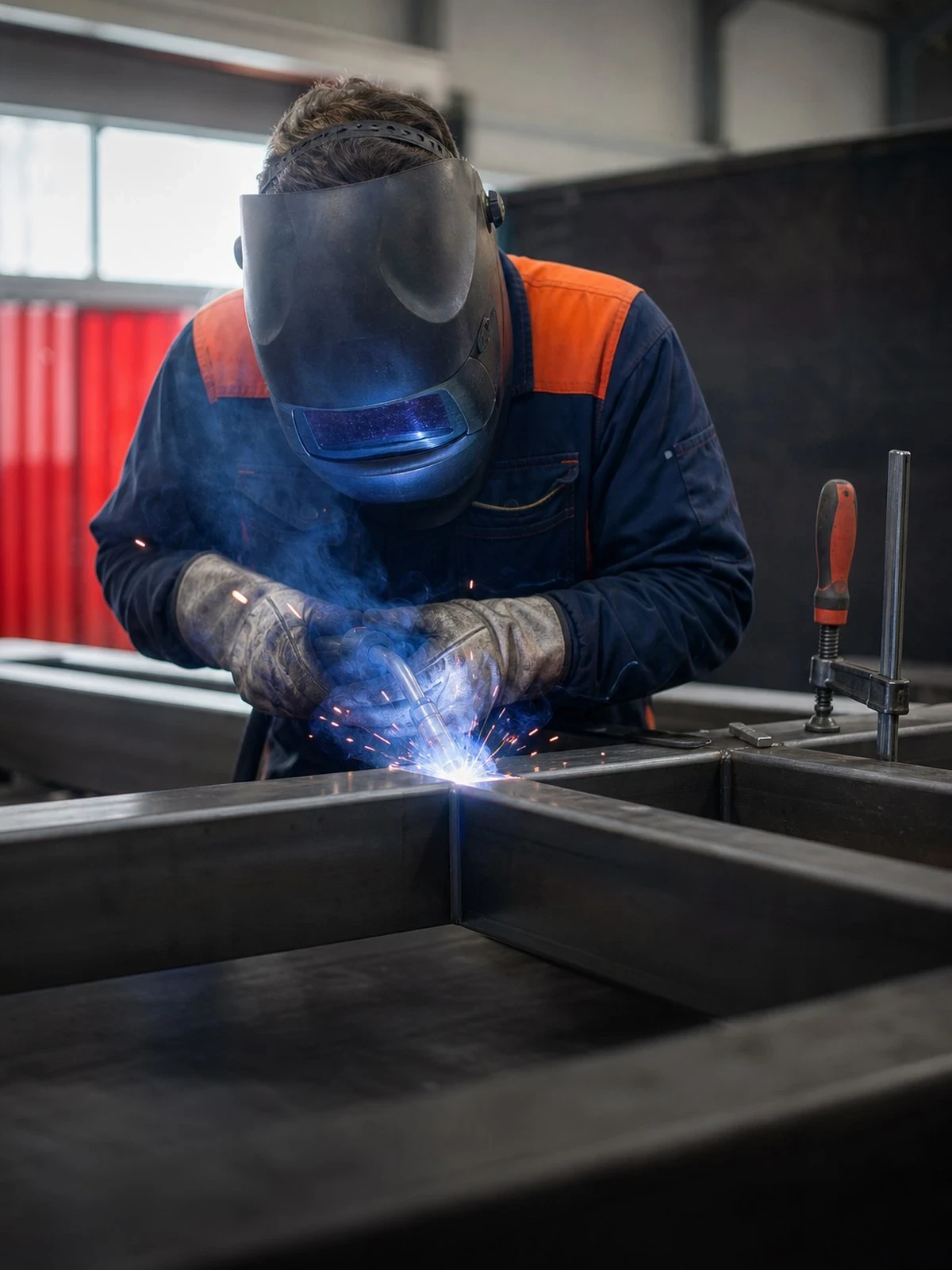
The first risk is fire. Sparks travel further than you can see, grinding sparks roll under a plate, and heat conducts through a wall to a wooden beam or insulation on the other side. A smouldering fire often starts hours after you have left. Insurers will accept this risk, but they attach hot work clause to it: a completed work form, screening off the surroundings, fire extinguishing equipment within reach, and a check after the work is finished. Anyone who works without those measures loses cover at precisely the moment they need it.
The second risk is the weld itself. Porosity, a lack of penetration, a deviation from the welding procedure specification or unsuitable filler material comes to light during visual inspection or non-destructive testing, sometimes only at the first pressure test. Grinding out and rewelding your own weld is your own work and therefore not insured. If a structure fails after handover, the exclusion for goods supplied and work carried out comes into play: damage to the work itself remains yours, while the loss others suffer as a result can fall under the public and employers' liability insurance fall.
The third risk is your own staff. Welding fumes from stainless steel and from coated or treated steel bring exposure to chromium-6, and alongside that there are arc eye, electrocution and work in confined spaces. Article 7:658 of the Dutch Civil Code requires demonstrable extraction, respiratory protection, instruction and supervision; under paragraph 4 this also applies to hired-in welders. In exposure claims, years often pass between the work and the claim.
This page deals with one situation. The full overview is on Compare personal liability insurance (AVP).
Independent, personal, sorted quickly
We compare your personal liability insurance (AVP) across dozens of insurers, explain where the real differences lie, and arrange the switch from start to finish — without you having to chase it yourself.
 Personal liability insurance (AVP)
 Compare
 Get covered
Why arrange it through Finass Verzekert?
We look at the terms as well as the premium, and stay your point of contact when there is a claim.
Independent
We are not tied to one insurer and compare on the basis of an objective analysis of several companies.
One fixed adviser
You call or email someone who knows your file. No menu options, no changing call centres.
Switching without hassle
We cancel your old policy and align the start date, so you are never a day without cover.
Help with claims
We report the claim and monitor how it is handled. In urgent cases you can reach us on the emergency line.
What to look out for
Four points that make the difference in welding between a covered claim and a rejected one.
The hot work clause
This is the most important provision on your policy. It sets out how you must work outside a fixed, purpose-built workshop: a permit or form, flammable material removed or covered, adjoining rooms checked, and a follow-up check once you have finished. If you work in a client's premises, follow their own permit system as well and their requirement for a fire watch.
Rejection is not an insured loss
If your weld is rejected, you bear the cost of grinding out, rewelding, reblasting and having it inspected again. That is the exclusion of your own your own work. The delay your client suffers as a result is usually pure financial loss as well and falls outside the AVB. On a tight programme, treat this risk as something you finance yourself.
Care, custody and control of the structure you weld on
Deformed plate sections, pipes burnt through behind a wall, a damaged coating or a scorched tank deck: damage to the property you are working on falls under the care, custody and control exclusion. If you work in existing installations, ask about separate cover for property in your care and about whether only the part worked on or the whole item is excluded.
Late claims and the moment cover attaches
An occupational disease presents itself years after the exposure. Check the policy conditions to see whether cover is based on the moment of the act or omission or on the moment the claim is submitted. Under the second system you need a run-off period when you end or switch your policy, otherwise a late claim leaves you without cover. Asbestos is also excluded as standard.
What does your premium depend on?
- Payroll and number of welders: including hired-in welders working under your direction
- Workshop or site: welding at third-party sites weighs more heavily than in your own workshop
- Material and welding process: stainless steel and coated steel give extra exposure
- Nature of the structures: load-bearing or pressure-retaining work increases the consequential loss
- Sum insured and excess: fire damage often carries a different excess
- Prevention and certification: recorded procedures and valid welding certificates
Insurers weigh these details differently. That is where your saving is.
What is covered
| Situation | AVB | BAV |
|---|---|---|
| A smouldering fire in the insulation behind the wall, discovered hours after you left | Provided that | No |
| A fitter from another company suffers burns from your grinding and welding sparks | Yes | No |
| A machine belonging to the client is damaged when your weld fails after handover | Yes | No |
| A chromium-6 claim from a welder who worked for you years ago | Provided that | No |
| The delay your client suffers because the inspection had to be postponed | No | Yes |
| A fine from the labour inspectorate after an accident in your workshop | No | No |
In welding, the difference between these two columns rarely lies in the mistake itself, but in what that mistake did to someone else.
Frequently asked questions
This is what people ask us most.
I caused a fire in my client's premises. Is that covered?
In principle yes, because that is damage to someone else's property. The insurer will check whether you complied with the hot work clause. If the screening or the follow-up check was missing, it may reduce or refuse payment. Report the fire at once, because Article 7:941 of the Dutch Civil Code requires you to notify as soon as you could reasonably be aware of it.
Does the insurance cover a rejected weld?
No. Redoing your own work is not loss within the meaning of the policy, but performing the job you were contracted to do. What is covered is the damage the defect causes to others, for example if a fractured weld damages a machine or causes injury. Even then the weld itself remains at your expense.
Are claims about welding fumes and chromium-6 insured?
Injury claims from staff fall under the employers' liability section, provided that section is included. What is decisive is whether you can show that extraction, respiratory protection and instruction were in order. Keep measurements, instruction documents and records, because the burden of proof under Article 7:658 of the Dutch Civil Code lies largely with you as the employer.
Do I need cover other than the AVB?
Usually yes, because the AVB covers only loss suffered by others. Your own equipment, welding machines and accessories are insured under a tools or business contents insurance, and the work you are erecting under an erection all risks insurance. If your production stops after a fire in your own workshop, business interruption insurance is the appropriate cover, and for disputes about invoices and handovers there is business legal expenses insurance.
Every situation is different. For these situations we have a separate page.
- Compare personal liability insurance (AVP)The main page
- Public and employers' liability insurance (AVB) for weldersNaked flames, care, custody and control, consequential loss
- Quote for liability insurance for flange fitters and pipefittersLeaks, care, custody and control, work permits
- Liability for welders in the petrochemical industryCertification, welding procedure, consequential loss
- Liability for flange fitters and pipefittersRecords, certification, loss along the chain
- Liability for weldersFire-hazardous work, checks afterwards, certificates
- Liability for assembly and installation workWork at third-party sites, care, custody and control, hot work
- Liability insurance for installation and assembly workCare, custody and control, commissioning, work after completion
- Business liabilityAVB, BAV, employers' liability