

Liability
- Damage to third parties
- Employers' liability
- Care, custody and control as an extension
Anyone who delivers flange and pipework in one package is responsible not only for individual joints but for a pipe system that has to work as a whole, free of stress and safe.
This page in another language: Nederlands
Work out for yourself what it would cost.
Enter your details; you will receive a proposal within one working day.
A premium indication, not personal advice. Prefer to talk it through? Call 072 - 509 24 56.
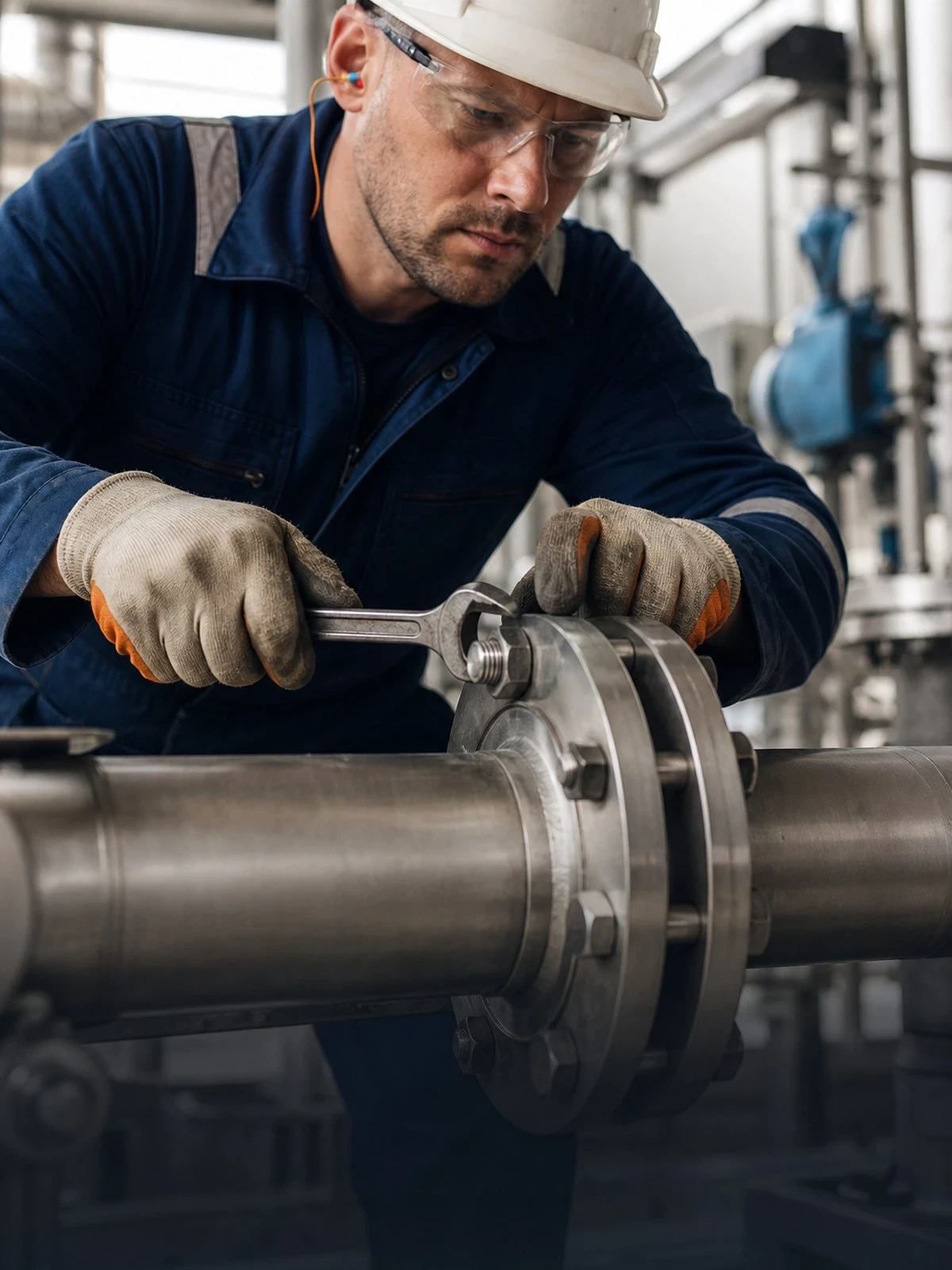
A pipefitter makes bespoke work: prefabricating spools, setting out routes, making fitting pieces, aligning and presenting them to the welder. The kind of mistake involved is different from fitting a single flange. A line pulled into place under stress holds for the first few weeks but fails on the first thermal cycle, and then the question is not who tightened the bolt but who signed off the route.
Because the work almost always takes place in a chain, liability can rarely be laid at the door of one party. You work as a subcontractor, you outsource welding or NDT, and the client turns to the party it can see. Article 6:171 of the Dutch Civil Code makes the client jointly liable towards the injured party for a non-subordinate assistant, after which that liability comes back to you through the contractual chain. Your AVB must therefore cover not only your own work, but also claims passed down through a main contractor.
The third element is that pipefitting is physically demanding, hot work. Cutting, grinding and welding mean sparks, and work in trenches, on scaffolding and in pipe racks means a risk of injury to your own people. Two very different parts of the policy come in there: the hot work clause and your employer's liability under Article 7:658 of the Dutch Civil Code.
We compare your personal liability insurance (AVP) across dozens of insurers, explain where the real differences lie, and arrange the switch from start to finish — without you having to chase it yourself.
 Personal liability insurance (AVP)
 Compare
 Get covered
The structure of the cover in three parts, with an overview per situation below.
AVB for property damage and injury, BAV for professional errors.
Business contents, goods and lost turnover during downtime.
Sickness absence, accidents and the traffic risk.
What is covered
| Situation | AVB | BAV | Cyber |
|---|---|---|---|
| Injury to a visitor or customer | Yes | No | No |
| Damage to a client's property | Sometimes | No | No |
| Financial loss caused by an advisory or calculation error | No | Yes | No |
| Downtime after a ransomware attack | No | No | Yes |
| Data breach involving personal data | No | Sometimes | Yes |
| Damage to property in your care | No | No | No |
This overview is general in nature and is not personal advice. What is actually covered, including exclusions, limits and the excess, is set out in the policy conditions and the insurance card (verzekeringskaart) of the insurer; you receive both before you take out cover. Taking out cover without advice? Then read what execution only means for you.
Insurers weigh these details differently. That is where your saving is.
We look at the terms as well as the premium, and stay your point of contact when there is a claim.
We are not tied to one insurer and compare on the basis of an objective analysis of several companies.
You call or email someone who knows your file. No menu options, no changing call centres.
We cancel your old policy and align the start date, so you are never a day without cover.
We report the claim and monitor how it is handled. In urgent cases you can reach us on the emergency line.
Customers rate our service on four aspects: personal service, service delivery, availability and the outcome. The reviews are collected and published by NH1816 and come from customers who have actually taken out a policy with Finass Advies B.V. or reported a claim.
Four points that make the difference between a policy that pays out and one that does not.
If a spool is forced into place because the bespoke work does not fit, that stress stays in the system and the failure comes months later. Record who supplied the isometric drawings, which dimensional deviations you found and which deviations you reported. If you supply the design yourself, a dimensional error is a professional error with financial loss, and that is a different cover from the AVB.
Sparks from grinding or welding that end up behind insulation cladding or in a cable trough cause a fire hours later. Insurers therefore include a hot work clause: a work permit, fire extinguishing equipment within reach, screening and a fire watch after hot work for a prescribed period. If that procedure has not been followed, the fire damage is not covered. That is not a formality. It is the most commonly used ground for refusing a claim in this work.
If you engage a welder or an NDT firm and the weld fails, the injured party can hold you liable under Article 6:171 of the Dutch Civil Code, even though you did not carry out that work. So check the sum insured and the scope of cover of every subcontractor, and record that you have received a copy of the policy schedule. In reality a subcontractor without adequate cover is an extension of your own exposure.
Where an employee is injured, the burden of proof is reversed: you have to show that you met your duty of care. Work instructions, toolbox talks, inspected tools and supervision are then your file. Article 7:658(4) of the Dutch Civil Code extends that to hired-in workers and self-employed professionals working under your direction. Commuting falls outside it, but under Article 7:611 of the Dutch Civil Code separate motor cover may still be needed.
This is what people ask us most.
No. Damage to the work you carry out is excluded on an AVB. That policy covers damage to other property and to people. For damage to the works themselves during the construction or installation phase there is construction all risks (CAR) or erection insurance. See construction all risks (CAR) insurance for building and installation. Redoing your own work always remains for your own account as well.
Then fire damage falls outside the cover. The hot work clause is a warranty clause: complying with it is a condition of cover, not a recommendation. Record for each work permit who kept the fire watch after the work and until what time. Without that record you have nothing to fall back on when a fire starts hours after you have left.
That is how a chain normally works. The injured party chooses who to hold liable, partly on the basis of Article 6:171 DCC, and does not then pursue matters further itself. You notify the claim to your own insurer within the period set by Article 7:941 DCC, and the insurer then assesses recovery from the subcontractor. So always notify, even if you believe you did nothing wrong.
The form of cover stays the same, but the client sets the requirements: a minimum sum insured, a statement of your activities and sometimes being named as a co-insured on the project policy. If you work under someone else's direction, you may also fall under their duty of care under Article 7:658(4) DCC. See liability for self-employed flange fitters.
Every situation is different. For these situations we have a separate page.
Request a quote without obligation. We will look at which insurer best matches your activities and your risk.
Prefer to call? 072 - 509 24 56, weekdays 09:00–17:00.
Claim on the road? Emergency line 06 - 55 20 40 72.
Finass Verzekert is a trading name of Finass Advies B.V. We advise on and arrange non-life insurance on the basis of an objective analysis of several insurers, and receive commission for this from the insurer, which is included in the premium. You pay no separate advice fee. Before you take out cover, we establish your wishes and needs.
You will find our licence, KvK and Kifid details and our complaints procedure at the foot of every page.
This page was compiled by Finass Verzekert (LinkedIn). Last updated on .
The information on this page is general in nature and is not personal advice.
Maandag- Vrijdag: 09:00- 17:00
We use cookies and similar technologies to improve your experience on our website.