

Quote for liability insurance for flange fitters and pipefitters
Flange and pipework goes wrong in the one place where nothing may leak: a joint under pressure. The loss is then rarely in the flange itself, but in what escapes from it and in the downtime that follows.
- Several insurers compared objectively
- 9.5 customer rating for a new policy
- AFM licence 12016589
- Personal 072 - 509 24 56, weekdays 9–17
This page in another language: Nederlands
Work out for yourself what it would cost.
Enter your details; you will receive a proposal within one working day.
- We compare the offerings of several insurers
- An adviser checks whether the cover suits your activities
- We arrange the switch, including cancellation
A premium indication, not personal advice. Prefer to talk it through? Call 072 - 509 24 56.
- Independent advice
- Several insurers
- Switching arranged
- Help with claims
In brief
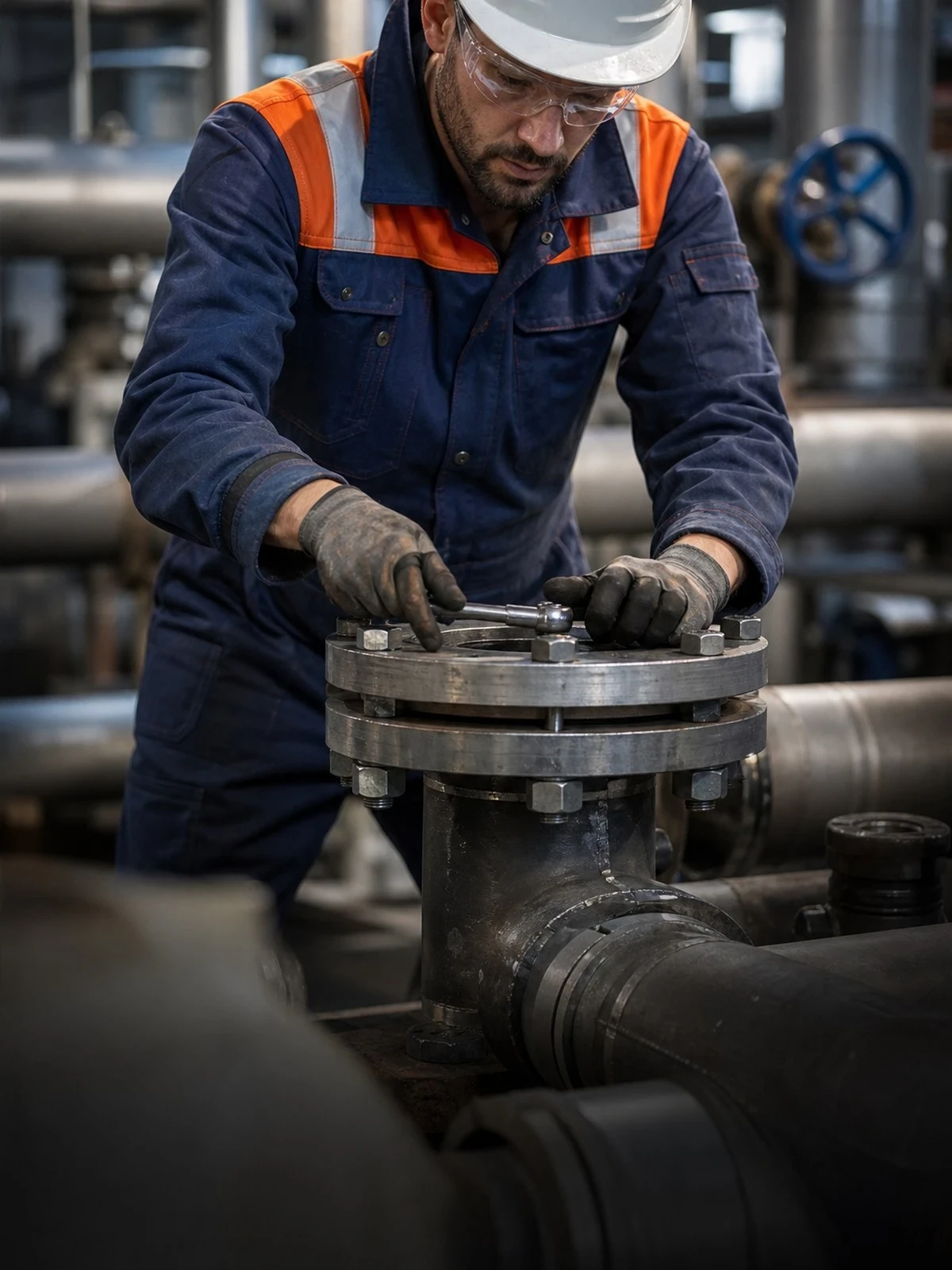
The mistakes in this trade are narrowly defined: the wrong tightening torque, a tightening sequence that was not followed, a gasket in the wrong material or a gasket forgotten during reassembly, a damaged sealing face, a spade flange left in the wrong line. The consequences are large: product release, a blow-out of a seal during start-up, injury to colleagues standing beside the line, and an installation that the client will not allow back into service until the cause has been proven. The public and employers' liability insurance is intended for exactly that injury and property damage.
Three limitations determine how much of that remains. The care, custody and control exclusion applies to the pipe, the pump or the vessel you are working on. That is property in your care. The carrying out your own assembly work again is not insured loss but your own contractual performance: new gaskets, new bolts and the hours needed to reset the joint are at your own expense. And environmental damage is covered under the AVB only if the pollution is sudden and unforeseen; soil remediation and gradually occurring pollution belong with environmental damage insurance.
On the staffing side this is heavy work under time pressure. During a turnaround you work in shifts, at height, in confined spaces and sometimes with residual products you cannot see. Article 7:658 of the Dutch Civil Code imposes a duty of care on you and you must be able to demonstrate that you met it. Under paragraph 4 that duty also applies to hired-in fitters and self-employed professionals working under your direction. Recorded toolbox talks, valid certificates and demonstrable maintenance of torque wrenches make up your file when an injury claim arrives.
This page deals with one situation. The full overview is on Compare personal liability insurance (AVP).
Independent, personal, sorted quickly
We compare your personal liability insurance (AVP) across dozens of insurers, explain where the real differences lie, and arrange the switch from start to finish — without you having to chase it yourself.
 Personal liability insurance (AVP)
 Compare
 Get covered
Why arrange it through Finass Verzekert?
We look at the terms as well as the premium, and stay your point of contact when there is a claim.
Independent
We are not tied to one insurer and compare on the basis of an objective analysis of several companies.
One fixed adviser
You call or email someone who knows your file. No menu options, no changing call centres.
Switching without hassle
We cancel your old policy and align the start date, so you are never a day without cover.
Help with claims
We report the claim and monitor how it is handled. In urgent cases you can reach us on the emergency line.
What to look out for
Four points on which a claim in this trade fails more often than on the sum insured.
The line you are working on is in your care
Everything you dismantle, align, tighten or pressure-test is in your care. If you damage the sealing face of a flange or strip a tapped hole, that is damage to property in your care, custody and control and it is excluded as standard. Limited cover for property in your care can sometimes be added, but under most policy conditions the part you are actually working on remains outside the cover.
Downtime at the client
A production line standing still costs more per hour than the whole job earns. If that downtime follows from damaged property belonging to the client, it is consequential loss and the AVB can carry it. If the downtime follows only from a leak that you find and repair without anything being damaged, it is pure financial loss and that calls for professional indemnity insurance needed.
Work permits, release and LOTO
On sites of this kind insurers tie cover to clauses: working under a valid work permit, working depressurised and released, valves locked out, and certified personnel for bolted and flanged joints. If you work without a permit or outside the release, the insurer may refuse cover or apply an increased excess. Read those clauses before you sign.
The boundary with erection insurance
The AVB covers damage to third parties, not the work you are building. For the pipework being installed, the materials on site and damage during erection there is erection all risks insurance or a Construction all risks (CAR) insurance. On project work the main contractor often arranges this; check whether you are co-insured on that policy as a subcontractor.
What does your premium depend on?
- Payroll and number of engineers: including hired-in labour and subcontracting
- Type of installations: petrochemicals and gas weigh more heavily than commercial building
- Work on pressurised systems: pressure testing and start-up increase the risk
- Sum insured: per claim and per insurance year
- Excess: often separate for property damage on third-party sites
- Working area: offshore work and work outside Europe require separate acceptance
Insurers weigh these details differently. That is where your saving is.
What is covered
| Situation | AVB | BAV |
|---|---|---|
| An employee of the client is injured when a joint blows apart during start-up | Yes | No |
| An adjacent pump is damaged beyond repair by the escaping liquid | Yes | No |
| The client misses a delivery obligation because of a coupling value you advised incorrectly | No | Yes |
| The new gaskets and the hours needed to reset the flanged joint | No | No |
| Soil remediation after the escaped product has slowly seeped into the ground | No | No |
| A claim that arrives two years after you handed over the turnaround | Provided that | Provided that |
Anyone who measures, advises and installs in the same week crosses both columns; record which role you had on each job.
Frequently asked questions
This is what people ask us most.
Is the product that escaped through my leak insured?
Product of the client that is lost is property damage and can fall under the AVB, provided it is not property that was in your own care. As soon as the release pollutes the soil, surface water or the air, the environmental clause comes into play and only sudden, unforeseen pollution is covered. Remediation and clean-up call for environmental damage insurance.
Will the insurer pay for remaking the flanged joint?
No. Repairing your own work, the replaced gaskets and bolts and the hours worked by your fitters fall outside the cover. That is the exclusion of your own performance, which appears on virtually every liability policy. What is paid is the loss others suffer as a result, such as a damaged installation or injury.
What if the client imposes a penalty or a reduction?
Contractual penalties, reductions on the contract price and periodic penalty payments are excluded. What is insured is liability in law under Article 6:162 of the Dutch Civil Code, not every obligation you take on in a contract. Have a penalty clause reviewed before you accept it. It is a risk you carry yourself.
What do I need for a quote?
The description of your activities as you want it to appear on the policy schedule, your estimated annual turnover and wage bill, the share of hired-in labour, the sectors you work in and your claims history over recent years. Also state whether you carry out work abroad. This statement falls under the duty of disclosure in Article 7:928 of the Dutch Civil Code, so complete it in full.
Every situation is different. For these situations we have a separate page.
- Compare personal liability insurance (AVP)The main page
- Liability in flange assembly: care, custody and control and consequential lossTorque, gasket, records
- Liability for flange fittersTorque, leakage, records
- Liability for pipefittersAssembly, torque, test pressure
- Liability for welders in the petrochemical industryCertification, welding procedure, consequential loss
- Quote for liability insurance for weldersSparks and fire, rejected welds, welding fumes
- Liability for flange fitters and pipefittersRecords, certification, loss along the chain
- Business liabilityAVB, BAV, employers' liability
- Liability for assembly and installation workWork at third-party sites, care, custody and control, hot work
Read more
Similar pages
Also relevant
- Liability insurance for a flange fitter as a self-employed professional (zzp’er)
- Liability insurance for a self-employed pipefitter
- Liability insurance for a flange fitter or pipefitter as a self-employed professional (zzp’er)
- Public and employers' liability insurance (AVB) for the petrochemical industry