

Third-party liability for plant and machinery
- Compulsory on public roads
- Also during work
- Cables and pipes separately
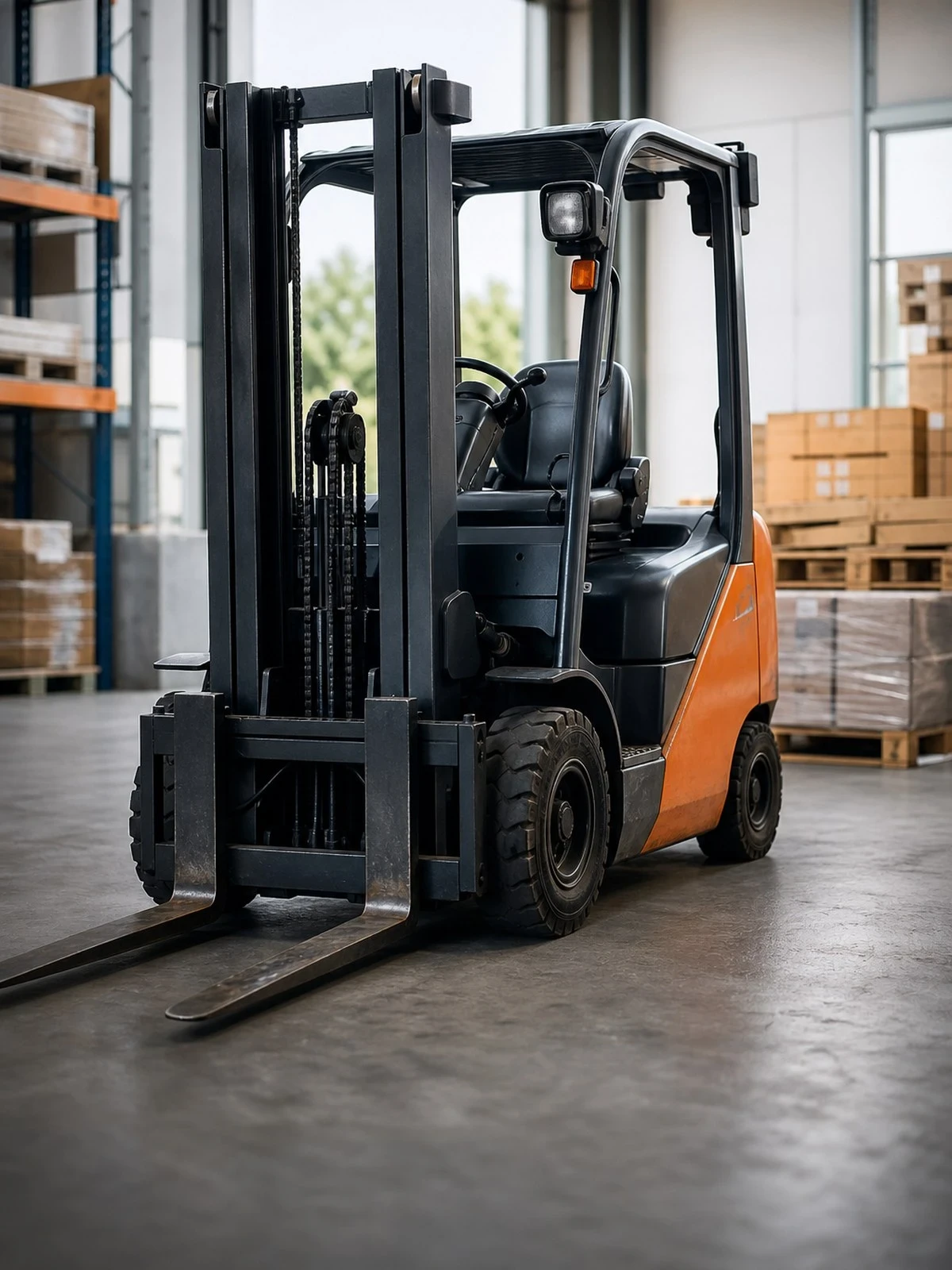
A forklift truck shares its working space with people, and that is why injury rather than dented bodywork is the claim this policy revolves around.
This page in another language: Nederlands
Work out for yourself what it would cost.
Enter your details; you will receive a proposal within one working day.
A premium indication, not personal advice. Prefer to talk it through? Call 072 - 509 24 56.
Almost all plant and machinery works at a distance from bystanders. A forklift truck does not: it drives between employees, drivers and visitors, in reverse, with a load that blocks the view. A collision with a foot or a load that slides off the forks produces injury with lasting consequences and a cost of claim that no longer bears any relation to the own-damage value of the machine.
If it is your own employee who is injured, this is not about ordinary liability but about the duty of care in Article 7:658 of the Dutch Civil Code. That places the burden of proof on you: you have to show that you provided safe working conditions, that there were driving routes, that the operator was authorised and that you exercised supervision. If a third party is hit by your employee, liability also arises under Article 6:170 of the Dutch Civil Code into view.
The third point is where the truck is used. If the forklift truck drives only on private ground, the insurance obligation under Article 2 of the Dutch Motor Insurance Liability Act (WAM) does not apply, but your liability remains full. If it crosses a public road to reach a shed, that obligation does apply. We test that point with every plant and machinery insurance for internal transport.
We compare your plant and machinery insurance across dozens of insurers, explain where the real differences lie, and arrange the switch from start to finish — without you having to chase it yourself.
 Plant and machinery insurance
 Compare
 Get covered
The structure of the cover in three parts, with an overview per situation below.
Damage you cause to others with the machine.
Damage to the machine, the body and the attachments.
What you add separately.
What is covered
| Situation | Third-party liability for plant and machinery | Own-damage cover |
|---|---|---|
| Damage to a building or a parked car next to the site | Yes | No |
| Theft of the machine from the building site | No | Provided that |
| Fire and storm damage | No | Yes |
| Inherent defect in the hydraulics or the engine | No | Provided that |
| Damage to the item you are working on with the machine | No | No |
| Wear and deferred maintenance | No | No |
Mobile plant is a motor vehicle within the meaning of the WAM and needs third-party liability insurance on public roads; non-mobile plant does not. Damage to cables and pipes is generally only covered if the excavation notification has been made and the trial trenches have been dug. The item you work on with the machine falls under the care, custody and control exclusion.
This overview is general in nature and is not personal advice. What is actually covered, including exclusions, limits and the excess, is set out in the policy conditions and the insurance card (verzekeringskaart) of the insurer; you receive both before you take out cover. Taking out cover without advice? Then read what execution only means for you.
Insurers weigh these details differently. That is where your saving is.
We look at the terms as well as the premium, and stay your point of contact when there is a claim.
We are not tied to one insurer and compare on the basis of an objective analysis of several companies.
You call or email someone who knows your file. No menu options, no changing call centres.
We cancel your old policy and align the start date, so you are never a day without cover.
We report the claim and monitor how it is handled. In urgent cases you can reach us on the emergency line.
Customers rate our service on four aspects: personal service, service delivery, availability and the outcome. The reviews are collected and published by NH1816 and come from customers who have actually taken out a policy with Finass Advies B.V. or reported a claim.
Four points that make the difference between a policy that pays out and one that does not.
If an employee is injured by a forklift truck, Article 7:658 of the Dutch Civil Code applies and you have to show that you met your duty of care. Driving routes, separated walkways, speed limiting and demonstrable supervision are the file for that. Liability for your own staff does not fall under the ordinary liability section for third parties; employer's liability cover is needed for that, which you have to arrange separately.
A forklift truck driver has to be demonstrably competent and instructed specifically for the type and the attachment. Record for each employee the certificate, the instruction and the expiry date. If an unauthorised or uninstructed worker is driving when an accident occurs, that affects both your position under the duty of care and the cover; insurers include entitlement as a policy condition and not as a recommendation.
A load carried too high, a pallet that has not been fully entered or a mast raised while driving leads to overturning or to a falling load. Damage to the goods you carry is not own-damage but falls under the care, custody and control exclusion. Match the load chart to what you actually lift and let no one ride on the forks, not even briefly.
The fire risk of a forklift truck usually lies not in the driving but in charging or refuelling. A charging point without ventilation, damaged battery cables or a leaking gas cylinder are well-known causes of fire in a warehouse. Insurers set requirements for the layout of the charging point. If you do not comply, that affects not only your machinery cover but also the fire insurance on the building and the stock.
This is what people ask us most.
The statutory insurance obligation under Article 2 WAM does not then apply, but your liability is unchanged by that. If you hit an employee or a supplier's driver, you bear the loss in full. If the truck crosses a publicly accessible road anywhere, even by a few metres, the insurance obligation does apply and that has to appear on the policy.
Not automatically. The liability section of a plant and machinery policy relates to damage to third parties. Injury to your own staff runs through the duty of care in Article 7:658 of the Dutch Civil Code and belongs on employer's liability cover. We make sure the two covers dovetail, so that an accident in your own warehouse does not fall between two policies.
It then becomes difficult on two fronts. Under the duty of care it is virtually certain that you fell short, so liability for the injury lies with you. Insurers also often include demonstrable competence as a condition, so that the cover itself comes into question. Record certificates and type instructions for each employee and keep track of expiry dates.
No, during carriage they are in your care and therefore fall under the care, custody and control exclusion. If a pallet of a customer's goods falls, that is only covered with a care, custody and control extension. If in the same manoeuvre you damage racking or a door of the building, that damage does fall under the ordinary liability cover.
Every situation is different. For these situations we have a separate page.
Request a quote without obligation. We will look at which insurer best matches your activities and your risk.
Prefer to call? 072 - 509 24 56, weekdays 09:00–17:00.
Claim on the road? Emergency line 06 - 55 20 40 72.
Finass Verzekert is a trading name of Finass Advies B.V. We advise on and arrange non-life insurance on the basis of an objective analysis of several insurers, and receive commission for this from the insurer, which is included in the premium. You pay no separate advice fee. Before you take out cover, we establish your wishes and needs.
You will find our licence, KvK and Kifid details and our complaints procedure at the foot of every page.
This page was compiled by Finass Verzekert (LinkedIn). Last updated on .
The information on this page is general in nature and is not personal advice.
Maandag- Vrijdag: 09:00- 17:00
We use cookies and similar technologies to improve your experience on our website.