

Third-party liability for plant and machinery
- Compulsory on public roads
- Also during work
- Cables and pipes separately
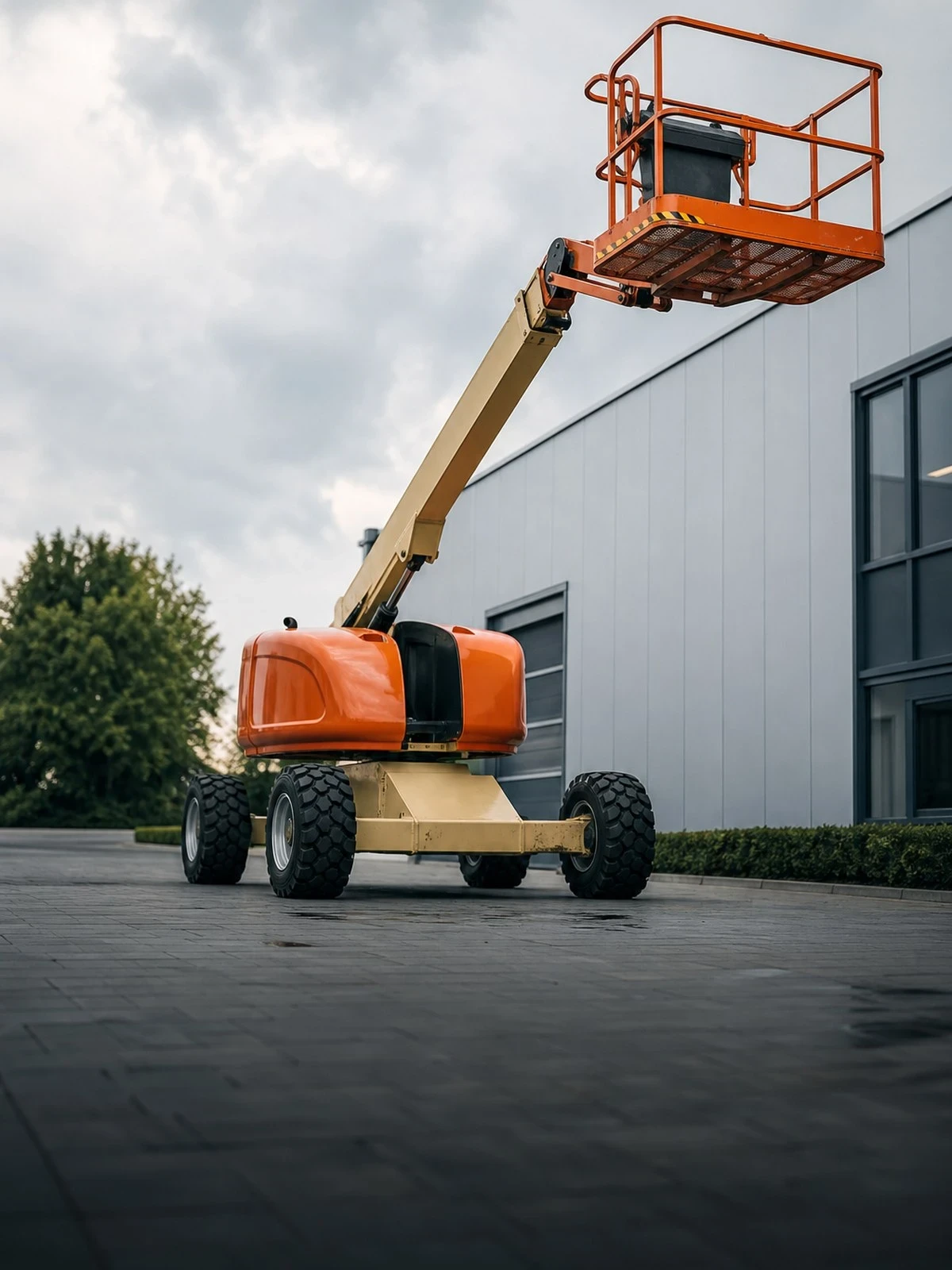
With an aerial work platform there is a person standing in the basket, and that turns every claim question from equipment damage into injury.
This page in another language: Nederlands
Work out for yourself what it would cost.
Enter your details; you will receive a proposal within one working day.
A premium indication, not personal advice. Prefer to talk it through? Call 072 - 509 24 56.
An aerial work platform does not lift a load but a human being. That makes the inspection and the authorisation of the operator more than an administrative formality: they are hard conditions of cover. Insurers state in the policy that the machine must be inspected periodically within the prescribed interval and that the operator must be demonstrably competent. If either is missing at the time of the incident, the claim can be refused.
The second feature is that the stability of a telescopic or articulated platform depends on conditions outside the machine. Wind at height, a verge that gives way under an outrigger foot after rain, a manhole beneath the asphalt: those are the causes of a machine tipping over. The manufacturer specifies a maximum wind speed and a permitted gradient; working outside those limits is no longer an accident but a choice.
Third, there is the environment above you. Working near an overhead line or a high-voltage cable is subject to a prescribed safety distance, and a basket that comes within it causes injury that is almost always permanent. If it is your own engineer who is injured, the duty of care in Article 7:658 of the Dutch Civil Codeapplies. We test that point with every plant and machinery insurance for aerial work platforms.
We compare your plant and machinery insurance across dozens of insurers, explain where the real differences lie, and arrange the switch from start to finish — without you having to chase it yourself.
 Plant and machinery insurance
 Compare
 Get covered
The structure of the cover in three parts, with an overview per situation below.
Damage you cause to others with the machine.
Damage to the machine, the body and the attachments.
What you add separately.
What is covered
| Situation | Third-party liability for plant and machinery | Own-damage cover |
|---|---|---|
| Damage to a building or a parked car next to the site | Yes | No |
| Theft of the machine from the building site | No | Provided that |
| Fire and storm damage | No | Yes |
| Inherent defect in the hydraulics or the engine | No | Provided that |
| Damage to the item you are working on with the machine | No | No |
| Wear and deferred maintenance | No | No |
Mobile plant is a motor vehicle within the meaning of the WAM and needs third-party liability insurance on public roads; non-mobile plant does not. Damage to cables and pipes is generally only covered if the excavation notification has been made and the trial trenches have been dug. The item you work on with the machine falls under the care, custody and control exclusion.
This overview is general in nature and is not personal advice. What is actually covered, including exclusions, limits and the excess, is set out in the policy conditions and the insurance card (verzekeringskaart) of the insurer; you receive both before you take out cover. Taking out cover without advice? Then read what execution only means for you.
Insurers weigh these details differently. That is where your saving is.
We look at the terms as well as the premium, and stay your point of contact when there is a claim.
We are not tied to one insurer and compare on the basis of an objective analysis of several companies.
You call or email someone who knows your file. No menu options, no changing call centres.
We cancel your old policy and align the start date, so you are never a day without cover.
We report the claim and monitor how it is handled. In urgent cases you can reach us on the emergency line.
Customers rate our service on four aspects: personal service, service delivery, availability and the outcome. The reviews are collected and published by NH1816 and come from customers who have actually taken out a policy with Finass Advies B.V. or reported a claim.
Four points that make the difference between a policy that pays out and one that does not.
The periodic inspection of an aerial work platform is included in the policy as a condition. If it has expired at the time of the incident, the insurer can refuse to pay, even where the cause appears to have nothing to do with the inspection. Put inspection dates in the same diary as your MOT, keep the inspection log with the machine and record your operators' certificates digitally.
Tipping over is the most serious loss with these machines and rarely has a technical cause. An outrigger foot sinking into a wet verge, a manhole beneath the paving or carrying on above the permitted wind speed are the usual triggers. Use outrigger pads and keep a record of wind readings, even on short jobs. Working outside the stated gradient or wind class is an exclusion and not a matter for discussion.
If someone falls out of the basket or is crushed against a structure, this is injury to an employee and the duty of care in Article 7:658 of the Dutch Civil Codeapplies. You have to show that a suitable harness with a short lanyard point was available, that it was used and that instruction was given. That liability does not fall under the liability section for third parties. It belongs on employer's liability cover.
If the basket approaches a high-voltage cable or a tram wire, a prescribed safety distance applies and sometimes an obligation to have the line switched off. If it goes wrong, there is both injury and an interruption to the network with substantial consequential loss. If you work above a road or pavement, cordoning off is compulsory; photographs of the set-up and the cordon are your most important evidence in a claim.
This is what people ask us most.
The insurer can then refuse to pay, even for a loss that has nothing to do with the inspection. A valid inspection is stated in the policy as a condition and not as advice. That applies both to damage to the machine and to third-party claims. Plan the inspection well before the expiry date and keep the inspection log with the machine, not in the office.
Only within the wind speed the manufacturer specifies for that machine. It is shown on the machine and in the manual. If you work outside it and the platform tips over, that is not an unforeseen event but a deliberate breach of a usage limit. Insurers treat it as an exclusion. Measure the wind at working height and record the reading in doubtful conditions.
Not under the liability section for third parties. If it concerns your own employee, the claim runs through the duty of care in Article 7:658 of the Dutch Civil Code and belongs on employer's liability cover. You then have to show that a harness and lanyard point were available, that instruction was given and that you supervised their actual use.
That depends on what you agree and who actually operates it. If you supply the machine with an operator, the risk largely stays with you. If you hire it out bare, responsibility for operation shifts to the hirer, but you remain responsible for a properly inspected and sound machine. Always notify hiring out in advance; not every policy covers use by third parties.
Every situation is different. For these situations we have a separate page.
Request a quote without obligation. We will look at which insurer best matches your activities and your risk.
Prefer to call? 072 - 509 24 56, weekdays 09:00–17:00.
Claim on the road? Emergency line 06 - 55 20 40 72.
Finass Verzekert is a trading name of Finass Advies B.V. We advise on and arrange non-life insurance on the basis of an objective analysis of several insurers, and receive commission for this from the insurer, which is included in the premium. You pay no separate advice fee. Before you take out cover, we establish your wishes and needs.
You will find our licence, KvK and Kifid details and our complaints procedure at the foot of every page.
This page was compiled by Finass Verzekert (LinkedIn). Last updated on .
The information on this page is general in nature and is not personal advice.
Maandag- Vrijdag: 09:00- 17:00
We use cookies and similar technologies to improve your experience on our website.