

Third-party liability for plant and machinery
- Compulsory on public roads
- Also during work
- Cables and pipes separately
Plant and machinery insurance consists of layers: liability while driving, damage to the machine itself and the risk during the work. Those three are not the same thing.
This page in another language: Nederlands
Work out for yourself what it would cost.
Enter your details; you will receive a proposal within one working day.
A premium indication, not personal advice. Prefer to talk it through? Call 072 - 509 24 56.
Plant and machinery is the collective term for machines whose primary purpose is to carry out work rather than to transport: loading shovels, excavators, telehandlers, aerial work platforms, forklift trucks, sweepers, agricultural tractors and mowers. As soon as such a machine goes onto the public road, the insurance obligation for motor vehicles under Article 2 of the Dutch Motor Insurance Liability Act (WAM) applies and liability cover is compulsory. If the machine stays exclusively on your own site, that obligation does not exist, but the risk does.
On top of third-party liability cover you can choose third-party, fire and theft or comprehensive cover. Third-party, fire and theft covers named perils such as fire, theft, storm and glass breakage. Comprehensive cover adds the damage you cause yourself: tipping over, collisions, overturning, sinking into a trench. For most machines that is the real risk, because the heaviest losses arise on the building site and not on the road.
The layer that is missing most often is the work risk. Liability for damage that arises while the machine is working (a struck pipe, a damaged facade, a fence driven into) does not automatically fall under the third-party liability cover for driving, nor always under public and employers' liability insurance. See also the covers of a car insurance policy.
We compare your plant and machinery insurance across dozens of insurers, explain where the real differences lie, and arrange the switch from start to finish — without you having to chase it yourself.
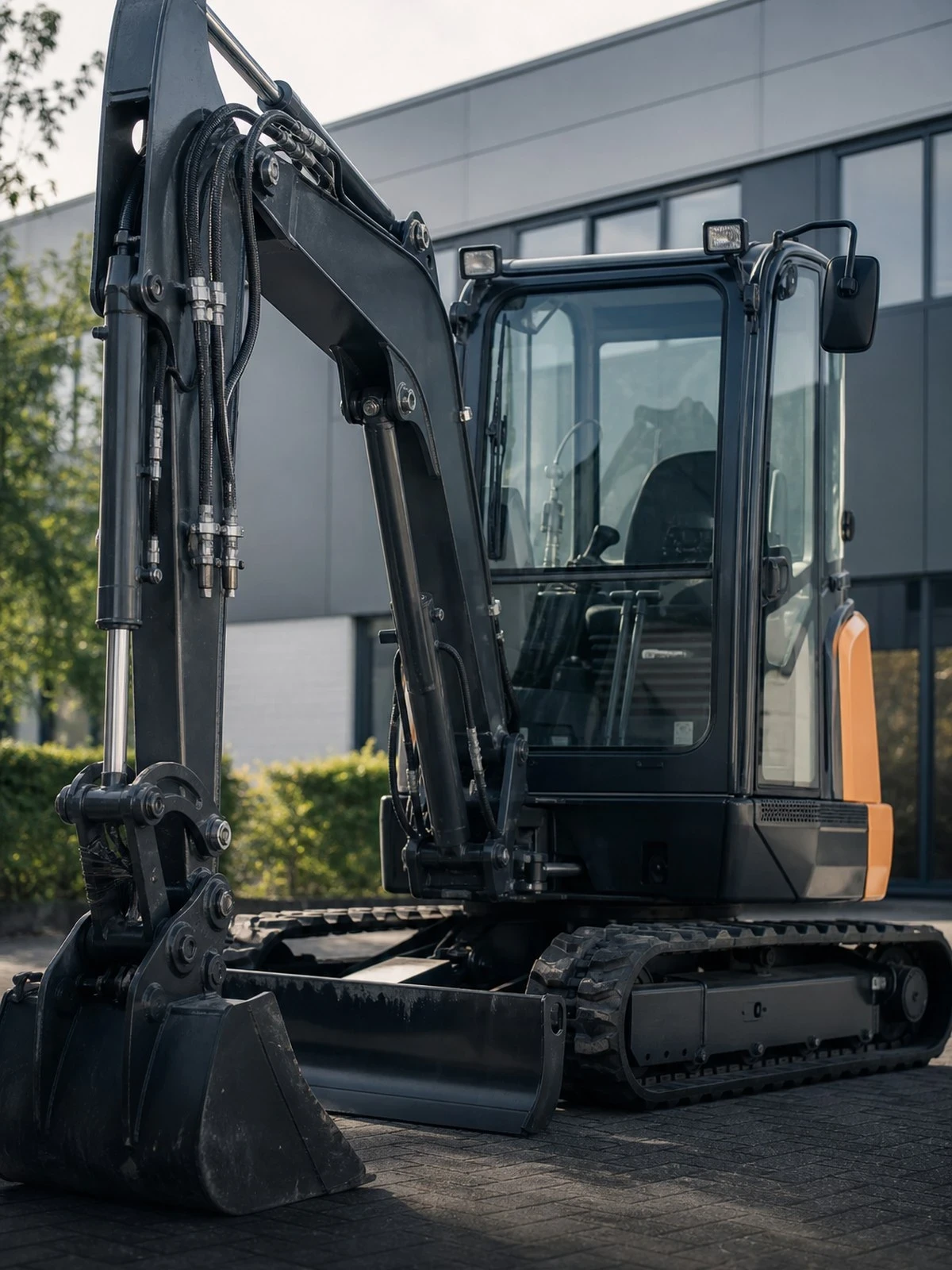 Plant and machinery insurance
 Compare
 Get covered
You build the policy up from compulsory liability to damage to the machine itself.
Damage you cause to others with the machine.
Damage to the machine, the body and the attachments.
What you add separately.
What is covered
| Situation | Third-party liability for plant and machinery | Own-damage cover |
|---|---|---|
| Damage to a building or a parked car next to the site | Yes | No |
| Theft of the machine from the building site | No | Provided that |
| Fire and storm damage | No | Yes |
| Inherent defect in the hydraulics or the engine | No | Provided that |
| Damage to the item you are working on with the machine | No | No |
| Wear and deferred maintenance | No | No |
Mobile plant is a motor vehicle within the meaning of the WAM and needs third-party liability insurance on public roads; non-mobile plant does not. Damage to cables and pipes is generally only covered if the excavation notification has been made and the trial trenches have been dug. The item you work on with the machine falls under the care, custody and control exclusion.
Exactly which perils are covered and which exclusions, limits and excesses apply is set out in the policy conditions and the insurance card (verzekeringskaart).
Insurers weigh these details differently. That is where your saving is.
We look at the terms as well as the premium, and stay your point of contact when there is a claim.
We are not tied to one insurer and compare on the basis of an objective analysis of several companies.
You call or email someone who knows your file. No menu options, no changing call centres.
We cancel your old policy and align the start date, so you are never a day without cover.
We report the claim and monitor how it is handled. In urgent cases you can reach us on the emergency line.
Customers rate our service on four aspects: personal service, service delivery, availability and the outcome. The reviews are collected and published by NH1816 and come from customers who have actually taken out a policy with Finass Advies B.V. or reported a claim.
These are the points on which most argument arises after a plant and machinery claim.
WAM cover relates to taking part in traffic. As soon as the machine stands still and works: digging, lifting, hoisting, sweeping. This is called the working risk, and that is a separate question of cover. If you strike a cable or pipe during excavation, the loss is often pure financial loss and not covered as a matter of course. Check expressly whether the working risk appears on the plant and machinery policy or on the public and employers' liability insurance, and whether the two dovetail.
Insurers ask about the type of work, the area of operation and whether the machine is hired out or lent. Anyone who insures a loading shovel for their own yard and then puts it to work with a driver on changing building sites, or hires it out without reporting this, changes the risk fundamentally. Article 7:928 of the Dutch Civil Code obliges you to provide that information and Article 7:930 of the Dutch Civil Code gives the insurer the option of reducing or refusing the settlement. Report the use of agency workers and trainees as well.
Excluded from cover are, among other things wear, mechanical and electrical failures, damage caused by deferred maintenance and construction or design faults. Damage to the load or to the object being lifted or worked on itself, business downtime without separate cover and damage caused by intent or recklessness on the part of the insured (Article 7:952 of the Dutch Civil Code) are excluded as well. Beyond that, a claim is almost always refused where the driver was not authorised or not certified, or was under the influence.
Own-damage claims are settled on market value or, with newer machines, for an agreed period on the basis of a purchase-value arrangement. In a total loss that choice determines whether or not you can buy a replacement machine. Note the declared value as well: if the machine is insured for more than its actual value, that does not lead to a higher settlement, because Article 7:960 of the Dutch Civil Code prohibits enrichment through insurance. Include accessories and attached parts expressly.
This is what people ask us most.
The insurance obligation under Article 2 WAM applies to the public road. If the forklift truck drives exclusively on closed private ground, that obligation formally does not exist. The risk remains, however: injury to an employee or damage to a customer's lorry can run high. If the truck crosses the public road even briefly, the insurance obligation does apply.
Not as a matter of course. Damage to underground cables and pipes is a classic point of dispute: many policies exclude it or make it a condition that a KLIC notification has been made and that trial trenches have been dug. In addition, the consequential loss from a failure is often pure financial loss, which calls for separate cover. Have this point assessed expressly before you take out the policy.
Third-party liability cover exists for third parties, not for the driver. Injury to your own employee runs through employer's liability and, where taking part in traffic is involved, through a WEGAM or employee injury policy. For plant and machinery that is an important point, because overturning and crushing accidents occur precisely during the work and not in traffic.
Hiring out is a change of risk that you have to report. If you hire out with an operator, you usually remain responsible for the operation yourself. If you hire out without an operator, the risk is assessed on the unknown user and insurers often set requirements for the hire agreement, for certification of the hirer and for the excess. Without notification you risk a rejection.
Only with separate cover. Own-damage cover pays the repair or the market value, but not the turnover you lose or the cost of a replacement machine. Some insurers offer a business interruption or replacement plant section. For businesses with one key machine that is a real risk you have to arrange separately.
Every situation is different. For these situations we have a separate page.
Request a quote without obligation. We set third-party liability, own-damage cover and the working risk of each insurer side by side.
Prefer to call? 072 - 509 24 56, weekdays 09:00–17:00.
Claim on the road? Emergency line 06 - 55 20 40 72.
Finass Verzekert is a trading name of Finass Advies B.V. We advise on and arrange non-life insurance on the basis of an objective analysis of several insurers, and receive commission for this from the insurer, which is included in the premium. You pay no separate advice fee. Before you take out cover, we establish your wishes and needs.
You will find our licence, KvK and Kifid details and our complaints procedure at the foot of every page.
This page was compiled by Finass Verzekert (LinkedIn). Last updated on .
The information on this page is general in nature and is not personal advice.
Maandag- Vrijdag: 09:00- 17:00
We use cookies and similar technologies to improve your experience on our website.