

Third-party liability for plant and machinery
- Compulsory on public roads
- Also during work
- Cables and pipes separately
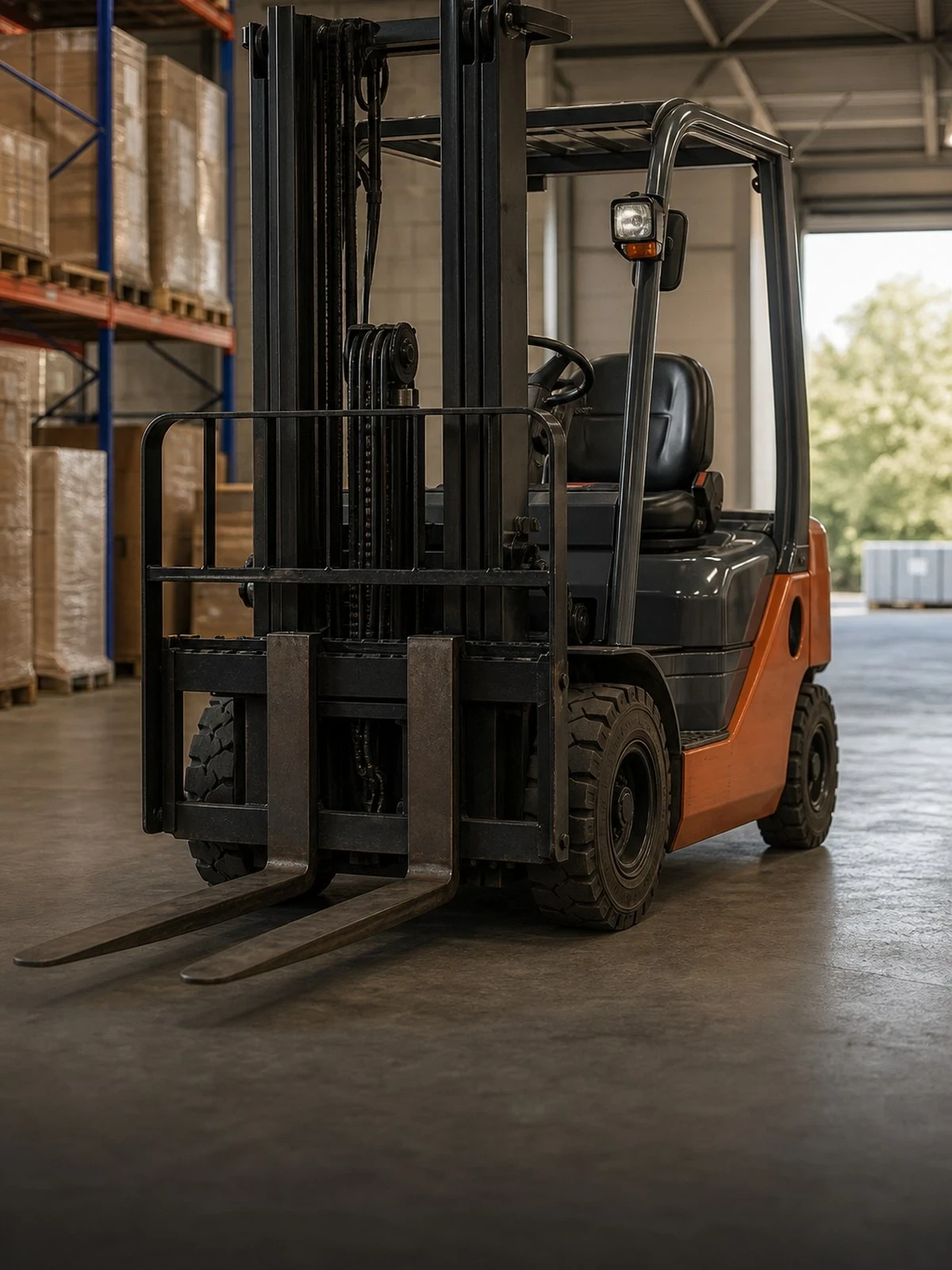
A forklift truck drives slowly, but it drives all day among people, racking and other people's goods: and it does so on ground where no insurance obligation applies.
This page in another language: Nederlands
The calculator and the quote form below are in Dutch. Prefer to do this in English? Email info@finassverzekert.nl or call 072 - 509 24 56 and we will take it from there.
Work out for yourself what it would cost.
Enter your details; you will receive a proposal within one working day.
A premium indication, not personal advice. Prefer to talk it through? Call 072 - 509 24 56.
What sets a forklift truck apart is its surroundings. Almost all of the work takes place inside a building or on a private loading and unloading yard, where the statutory insurance obligation under Article 2 of the Dutch Motor Insurance Liability Act (WAM) does not apply. That does not mean the risk is smaller. It means there is nothing forcing you to cover it, while collisions with pedestrians, racking and lorries occur most often here.
The second peculiarity is the load. What sits on the forks is in your in your care. If a pallet of a customer's equipment falls, or you drive into racking so that the stock above comes down, that is damage to property in your care and excluded as standard. Anyone who stores goods for third parties needs a separate extension for that; otherwise the stock is the only uninsured item in the building.
That leaves the staff. Injury to an employee, whether that is the driver or the person who was struck, runs not through the machinery policy but through the employers' liability of your business policy. Article 7:658 of the Dutch Civil Code places the burden of proof on you: you have to show that instruction, training and a safe layout were in order.
We compare your plant and machinery insurance across dozens of insurers, explain where the real differences lie, and arrange the switch from start to finish — without you having to chase it yourself.
 Plant and machinery insurance
 Compare
 Get covered
The structure of the cover in three parts, with an overview per situation below.
Damage you cause to others with the machine.
Damage to the machine, the body and the attachments.
What you add separately.
What is covered
| Situation | Third-party liability for plant and machinery | Own-damage cover |
|---|---|---|
| Damage to a building or a parked car next to the site | Yes | No |
| Theft of the machine from the building site | No | Provided that |
| Fire and storm damage | No | Yes |
| Inherent defect in the hydraulics or the engine | No | Provided that |
| Damage to the item you are working on with the machine | No | No |
| Wear and deferred maintenance | No | No |
Mobile plant is a motor vehicle within the meaning of the WAM and needs third-party liability insurance on public roads; non-mobile plant does not. Damage to cables and pipes is generally only covered if the excavation notification has been made and the trial trenches have been dug. The item you work on with the machine falls under the care, custody and control exclusion.
This overview is general in nature and is not personal advice. What is actually covered, including exclusions, limits and the excess, is set out in the policy conditions and the insurance card (verzekeringskaart) of the insurer; you receive both before you take out cover. Taking out cover without advice? Then read what execution only means for you.
Insurers weigh these details differently. That is where your saving is.
We look at the terms as well as the premium, and stay your point of contact when there is a claim.
We are not tied to one insurer and compare on the basis of an objective analysis of several companies.
You call or email someone who knows your file. No menu options, no changing call centres.
We cancel your old policy and align the start date, so you are never a day without cover.
We report the claim and monitor how it is handled. In urgent cases you can reach us on the emergency line.
Customers rate our service on four aspects: personal service, service delivery, availability and the outcome. The reviews are collected and published by NH1816 and come from customers who have actually taken out a policy with Finass Advies B.V. or reported a claim.
Four points that make the difference between a policy that pays out and one that does not.
Insurers ask whether drivers have demonstrably been trained and whether you have recorded the authorisation in writing. In an accident involving an agency worker who was allowed to stand in for a moment, that comes straight back. Keep the certificates for each person and record who may drive which truck. That is not only occupational health and safety but also your position under Article 7:658 of the Dutch Civil Code if injury occurs.
A racking upright that has been hit is cheap; clearing, inspecting and refitting that warehouse bay is not, and the goods that come down belong to someone else. If you drive in a rented building, damage to sprinkler pipework, dock doors and floor coating is damage to the landlord's building. Check that tenant's liability is adequately arranged for that.
Electric forklift trucks charge indoors, often overnight and unattended. Fire insurers set requirements for that: a separate charging area, distance from flammable storage, inspection of the installation. Gas cylinders have their own storage regime. If you do not comply and a fire breaks out, that affects not your machinery policy but your fire and business interruption insurance, where the sums are many times larger.
Damage to the goods on the forks is care, custody and control and therefore excluded. Tyres, forks and chains are wearing parts. Driving with an expired inspection certificate or with a safety device bypassed affects the acceptance conditions. And if you load more heavily than the load chart allows, damage from overturning becomes an argument about wilful recklessness within the meaning of Article 7:952 of the Dutch Civil Code.
If you damage the goods you are carrying, that falls under care, custody and control and is excluded as standard.
Tracks, tyres, blades, teeth and cutting edges are wear parts and are not insured anywhere; only sudden damage is covered. Deferred maintenance is also a ground for exclusion. A demonstrable maintenance regime with a logbook is therefore not only good management but also strengthens your position in a claim.
This is what people ask us most.
Only where the truck goes onto the public road; then Article 2 of the Dutch Motor Insurance Liability Act (WAM)applies. If it stays inside the fence, there is no statutory obligation, but there is full liability for whatever you drive into. Because most forklift truck claims arise precisely indoors, the absence of an obligation here is no indication that the risk is small.
No. Goods you handle with the forklift truck fall under the care, custody and control exclusion. If you store goods for third parties or move customers' goods, separate care, custody and control cover is needed, with a sum insured that matches the value of what one pallet can hold. Without that extension the loss is for your own account.
Under employer's liability, usually on your public and employers' liability insurance and not on the machinery policy. Article 7:658 of the Dutch Civil Code places the burden of proof on you: you have to show that you provided safe walkways, instruction and supervision. Recovery from the driver personally is almost always ruled out by Article 7:661 of the Dutch Civil Code.
Yes. Periodic inspection of lifting and hoisting equipment is an occupational health and safety obligation and insurers ask for the inspection certificates. After a loss, an expired inspection certificate is the first thing they look at, particularly with mast failure, chain failure or a dropped load. Keep the reports digitally for each machine, linked to the serial number.
Every situation is different. For these situations we have a separate page.
Request a quote without obligation. We will look at which insurer best matches your activities and your risk.
Prefer to call? 072 - 509 24 56, weekdays 09:00–17:00.
Claim on the road? Emergency line 06 - 55 20 40 72.
Finass Verzekert is a trading name of Finass Advies B.V. We advise on and arrange non-life insurance on the basis of an objective analysis of several insurers, and receive commission for this from the insurer, which is included in the premium. You pay no separate advice fee. Before you take out cover, we establish your wishes and needs.
You will find our licence, KvK and Kifid details and our complaints procedure at the foot of every page.
This page was compiled by Finass Verzekert. Last updated on .
The information on this page is general in nature and is not personal advice.
Maandag- Vrijdag: 09:00- 17:00
We use cookies and similar technologies to improve your experience on our website.