

Liability
- Covered while coupled
- Under the car's third-party liability cover
- Uncoupled: no longer covered
In insurance terms a caravan is two things at once: coupled up, it travels under the WAM cover of the towing car; uncoupled in storage, it stands alone.
This page in another language: Nederlands
Work out for yourself what it would cost.
Enter your details; you will receive a proposal within one working day.
A premium indication, not personal advice. Prefer to talk it through? Call 072 - 509 24 56.
As long as the caravan is behind the car, it counts as a trailer of that motor vehicle. Third-party liability then runs with the motor policy, under Article 2 of the Dutch Motor Insurance Liability Act (WAM). As soon as you uncouple and the caravan stands on a pitch or a storage site, that link stops. What happens then falls under the own-damage cover on the caravan itself, or under nothing at all.
The second point is that the caravan and the belongings inside it are two different sections. The own-damage cover covers the body, the chassis and the permanently fitted parts. The awning, canopy, bicycle carrier, crockery and bedding fall under a separate contents section with its own limit, or fall outside the policy altogether. Anyone who does not know that difference finds, after storm damage, that the most expensive part is exactly what is missing.
We set the De Goudse caravan conditions alongside those of more than thirty other insurers and look mainly at three things: which cover applies outside the travel period, how the contents section is built up and what requirements are set for storage. See also our page on touring caravan insurance if you travel mainly abroad.
We compare your caravan insurance across dozens of insurers, explain where the real differences lie, and arrange the switch from start to finish — without you having to chase it yourself.
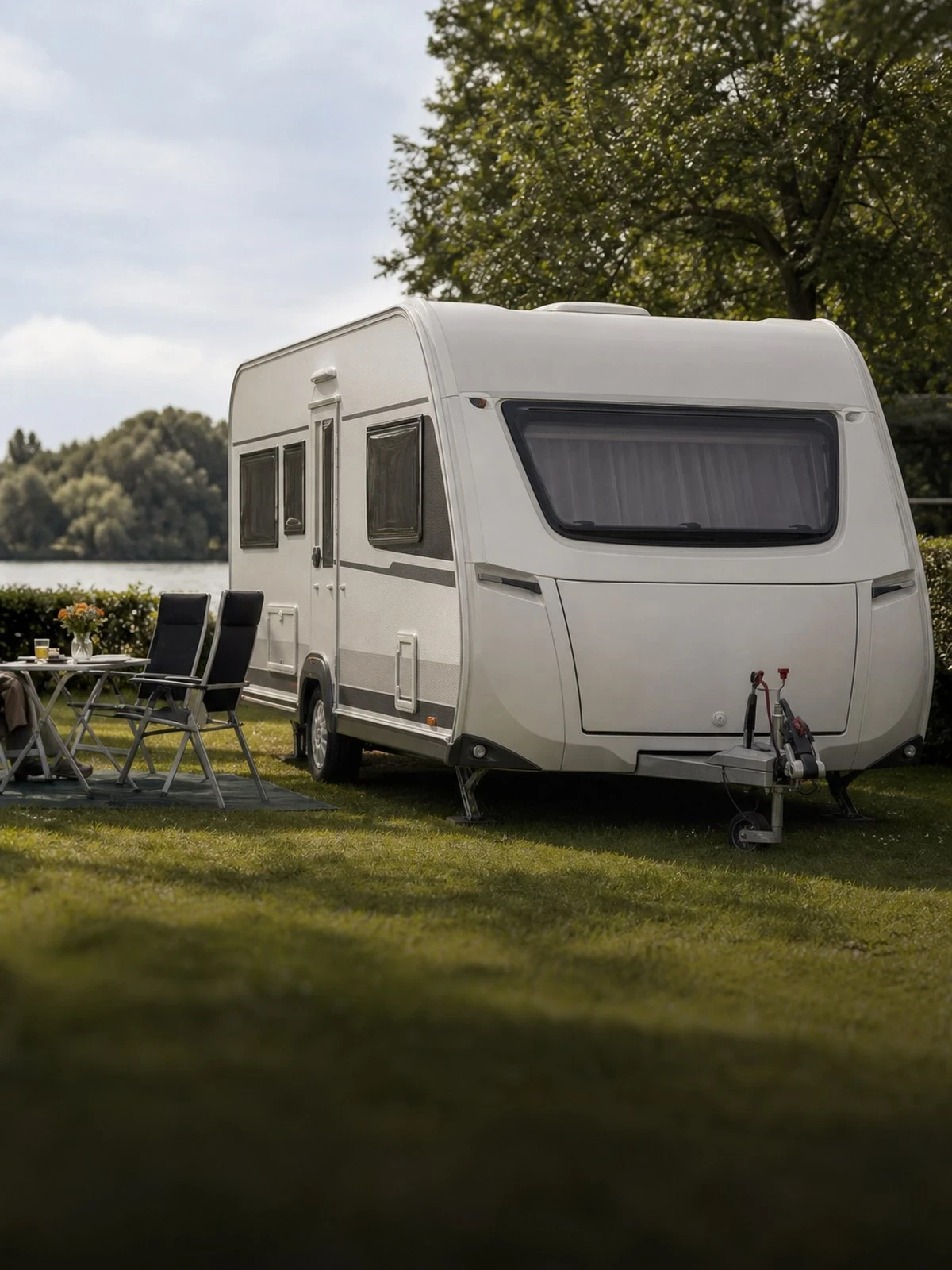 Caravan insurance
 Compare
 Get covered
The structure of the cover in three parts, with an overview per situation below.
Damage you cause to others with the trailer.
External causes beyond your control.
Including damage you cause yourself.
What is covered
| Situation | Third-party, fire and theft | Comprehensive |
|---|---|---|
| Theft after forced entry, with the prescribed lock | Yes | Yes |
| Fire and storm damage on the pitch | Yes | Yes |
| Hail damage to roof and walls | Provided that | Yes |
| Collision damage while manoeuvring | No | Yes |
| Contents in the caravan or trailer | Provided that | Provided that |
| Damp, wear and deferred maintenance | No | No |
A trailer or caravan is not an independent motor vehicle and therefore has no insurance requirement of its own. Damage you cause to others with it falls under the third-party liability cover of the towing vehicle, as long as the combination is coupled (Article 2 WAM). Once the trailer is uncoupled and has come to a standstill, that cover no longer applies.
This overview is general in nature and is not personal advice. What is actually covered, including exclusions, limits and the excess, is set out in the policy conditions and the insurance card (verzekeringskaart) of the insurer; you receive both before you take out cover. Taking out cover without advice? Then read what execution only means for you.
Insurers weigh these details differently. That is where your saving is.
We look at the terms as well as the premium, and stay your point of contact when there is a claim.
We are not tied to one insurer and compare on the basis of an objective analysis of several companies.
You call or email someone who knows your file. No menu options, no changing call centres.
We cancel your old policy and align the start date, so you are never a day without cover.
We report the claim and monitor how it is handled. In urgent cases you can reach us on the emergency line.
Customers rate our service on four aspects: personal service, service delivery, availability and the outcome. The reviews are collected and published by NH1816 and come from customers who have actually taken out a policy with Finass Advies B.V. or reported a claim.
Four points that make the difference between a policy that pays out and one that does not.
Damage you cause to someone else with the coupled caravan falls under the liability cover of the towing car. No separate third-party liability premium for the caravan is needed. But if the caravan itself is damaged while manoeuvring, that motor policy does not pay: damage to your own trailer is excluded as standard. For that you need own-damage cover on the caravan itself.
The awning is the part that most often comes to grief and is least often properly insured. In a storm, canvas tears, poles bend and the canopy blows over. Check whether the contents section is included, what limit applies to it, and whether the awning is only covered if it has been taken down as prescribed when strong winds are forecast. Valuables and cash are almost always excluded.
Most caravans are used for a few weeks and stored for the rest of the year. It is precisely in that period that damage occurs: a falling branch, a collapsing canopy roof, theft of the whole vehicle or of the drawbar. Insurers attach requirements to this, such as a hitch lock, a fenced site or storage under cover. If your storage address changes, report it; otherwise the actual situation differs from the application.
Damp penetration along seams, rotten timber parts and delaminating sandwich panels are almost always rejected as gradual deterioration or deferred maintenance. Also excluded are damage during hire to third parties, loss of value after a repair and damage caused by vermin in the body. Keep evidence of periodic damp readings. That makes the difference between a demonstrably sudden leak and a problem that has been there for years.
Replacement transport after a claim Stay mobile with replacement transport.
This is what people ask us most.
Not for driving. A coupled caravan counts as a trailer of the towing car and falls under the third-party liability of that motor policy. If the caravan stands uncoupled and then causes damage, for example by rolling away, the position is different. So check whether your policy also provides cover for the uncoupled period on the campsite.
Only if the contents or accessories section has been taken out and the awning falls within the limit. Storm damage to canvas and poles is often rejected where the awning was not taken down when strong winds were forecast, because the conditions frame that as a duty to mitigate the loss. Declare the purchase value of the awning, canopy and accessories separately on the application.
Usually yes, but subject to conditions on the storage address and the security. Theft of a caravan standing unsecured by the roadside is assessed differently from theft from a fenced site. If you move to another storage site, report it in writing. The duty of disclosure under Article 7:928 of the Dutch Civil Code also covers information that changes after the policy is taken out.
The own-damage section has a defined territorial scope stated on the policy, usually the same as that of the green card. If you travel beyond it, this has to be requested in advance. Watch the duration too: some conditions limit an unbroken stay abroad to a set period, after which the own-damage cover lapses and only third-party liability remains.
Request a quote without obligation. We will look at which insurer best matches your activities and your risk.
Prefer to call? 072 - 509 24 56, weekdays 09:00–17:00.
Claim on the road? Emergency line 06 - 55 20 40 72.
Finass Verzekert is a trading name of Finass Advies B.V. We advise on and arrange non-life insurance on the basis of an objective analysis of several insurers, and receive commission for this from the insurer, which is included in the premium. You pay no separate advice fee. Before you take out cover, we establish your wishes and needs.
You will find our licence, KvK and Kifid details and our complaints procedure at the foot of every page.
This page was compiled by Finass Verzekert (LinkedIn). Last updated on .
The information on this page is general in nature and is not personal advice.
Maandag- Vrijdag: 09:00- 17:00
We use cookies and similar technologies to improve your experience on our website.