

Trailer insurance for agricultural businesses through Avéro Achmea
Behind a tractor you rarely find an ordinary box trailer. A tipper, slurry tanker or livestock trailer takes part in the work, and it is precisely that work risk that is usually not covered by a road traffic policy.
- Several insurers compared objectively
- 9.5 customer rating for a new policy
- AFM licence 12016589
- Personal 072 - 509 24 56, weekdays 9–17
This page in another language: Nederlands
Work out for yourself what it would cost.
Enter your details; you will receive a proposal within one working day.
- We compare the offerings of several insurers
- An adviser checks whether the cover suits your activities
- We arrange the switch, including cancellation
A premium indication, not personal advice. Prefer to talk it through? Call 072 - 509 24 56.
- Independent advice
- Several insurers
- Switching arranged
- Help with claims
In brief
On the public road, liability follows the towing vehicle: the WAM treats the coupled trailer as part of that motor vehicle, and Article 2 of the Dutch Motor Insurance Liability Act (WAM) requires third-party liability cover for it. For agricultural and forestry vehicles that cover runs through the tractor insurance. That still leaves the tipper or slurry tanker itself without own-damage cover, and with agricultural equipment that is the most expensive part.
The real distinction is the one between traffic risk and work risk. On the road, it is traffic. If the trailer is unloading in the field, if it tips against a barn door, or if it catches a hydraulic line while being coupled, that is work. Many insurers cover that work risk not on the motor policy but on the public and employers' liability insurance or on the plant and machinery insurance. If there is a gap between those policies, the loss falls precisely into it.
A third subject is the road itself. Mud, manure or crop residue carried from the yard onto the road leads, if someone skids, to a liability claim under Article 6:162 of the Dutch Civil Code. Insurers then look at what you did by way of warning and cleaning. If you carry livestock, Article 6:179 of the Dutch Civil Codealso plays a part: the keeper is in principle liable for damage caused by an animal, even where nothing can be held against him.
This page deals with one situation. The full overview is on Compare trailer insurance.
Independent, personal, sorted quickly
We compare your trailer insurance across dozens of insurers, explain where the real differences lie, and arrange the switch from start to finish — without you having to chase it yourself.
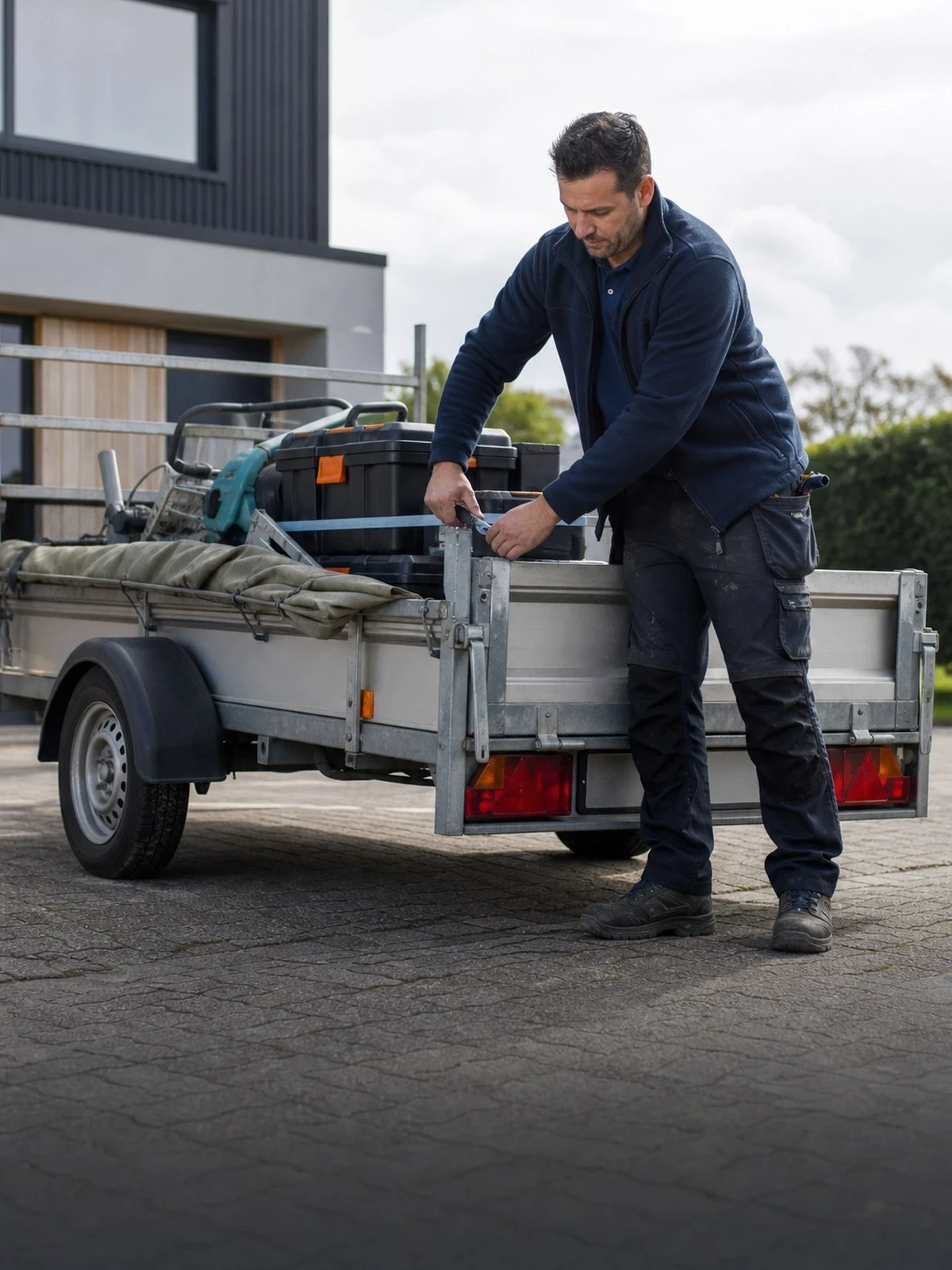 Trailer insurance
 Compare
 Get covered
Why arrange it through Finass Verzekert?
We look at the terms as well as the premium, and stay your point of contact when there is a claim.
Independent
We are not tied to one insurer and compare on the basis of an objective analysis of several companies.
One fixed adviser
You call or email someone who knows your file. No menu options, no changing call centres.
Switching without hassle
We cancel your old policy and align the start date, so you are never a day without cover.
Help with claims
We report the claim and monitor how it is handled. In urgent cases you can reach us on the emergency line.
What to look out for
Four points on which an agricultural trailer claim works out differently from an ordinary road accident.
The load is not covered
Manure, silage, potatoes or livestock are cargo and fall outside trailer insurance. If the tipper overturns and the harvest is lost, that is your own loss unless you have separate cover for carrying your own goods. Livestock killed in an accident is not covered by the motor policy either. There is separate livestock cover for that.
Work risk versus traffic risk
Damage arising while the trailer is functioning as a machine: tipping, spreading manure, loading with the front loader: is excluded under most road traffic policies. Have it put in writing which policy covers this. If you do contract work for others, another layer is added: damage to the client's land, crop or installation runs into the care, custody and control exclusion.
Driving entitlement and registration
Agricultural and forestry vehicles on the public road are subject to a registration requirement and a category T licence. If an employee or a family member working in the business drives without the required entitlement, that is an exclusion: the own-damage claim is not paid and the third-party liability insurer can recover the amount paid out. Record who is allowed to drive what.
Riding along and helping out
Anyone riding on or behind the tractor, or helping to couple and uncouple, runs a risk of injury. For staff and for hired-in workers the duty of care under Article 7:658 of the Dutch Civil Codeapplies, including subsection 4 for anyone not employed by you. Children or visitors riding along is a liability risk that you cannot pass on to the motor policy.
What does your premium depend on?
- Type and value of the trailer: tipper, slurry tanker, forage wagon or livestock trailer
- Maximum permitted mass: heavier equipment produces heavier losses
- Share of road use: a high mileage on the public road counts more heavily
- Contracting work for third parties: working on other people's land changes the liability risk
- Storage on the yard: a locked barn counts in your favour against theft
- Number and type of drivers: permanent staff, seasonal help or hired-in workers
Insurers weigh these details differently. That is where your saving is.
What is covered
| Situation | Third-party liability | Comprehensive |
|---|---|---|
| The coupled tipper swings out and hits an oncoming car on a provincial road | Yes | Yes |
| The uncoupled slurry tanker rolls off the yard into the milk lorry driver's car | Provided that | Provided that |
| Theft of the bale trailer from the yard | No | Yes |
| A blowout on the road that bends the axle of the trailer | No | Provided that |
| Rust in the floor panel after years of carrying manure | No | No |
| Subsidence of a client's yard under the weight of the loaded trailer | No | No |
Third-party liability cover runs through the towing vehicle; anything that happens to the trailer itself calls for own-damage cover.
Frequently asked questions
This is what people ask us most.
Is damage on my own yard covered?
Often not under the motor policy. WAM cover applies to taking part in traffic. On your own land, which is not public, that is usually absent. Damage to a building, a fence or a machine of your own is then not a liability matter but your own loss, which can only be paid under own-damage or buildings cover. For damage to third parties on the yard, the public and employers' liability insurance (AVB) comes into play.
Who is liable if livestock escapes from the trailer?
In principle the keeper of the animal. Article 6:179 of the Dutch Civil Code places liability for damage caused by animals on the keeper, even where there is no fault. If a cow walks onto the road and there is a collision, that is therefore your risk. That liability belongs on your public and employers' liability insurance (AVB); the trailer policy only covers damage caused by the vehicle itself in traffic.
Is mud on the road an insured loss?
Liability for it may fall under the public and employers' liability insurance (AVB). The assessment turns on Article 6:162 DCC: did you put up warning signs, and did you clean the road within a reasonable time? If you can show that, your position is stronger. Fines or penalty payments imposed by the road authority are never insured, because they are a punishment and not compensation.
Do I have to insure seasonal equipment all year round?
For own-damage cover, usually yes, because theft and fire also occur while the equipment is in storage. What you can adjust is the form of cover: some insurers offer a lower premium for the months when the equipment does not take part in traffic. Have any such arrangement confirmed in writing, because a verbal assurance will not stand up when you claim.
Every situation is different. For these situations we have a separate page.
Read more
Within Aanhangwagenverzekering
Similar pages
- Trailer insurance through Avéro Achmea
- Business trailer insurance through De Goudse
- Insuring a horse trailer and other trailers through Turien & Co
- Trailer insurance for businesses through Nationale-Nederlanden
- Trailer insurance through ASR — compare & calculate your premium
- Trailer insurance through Nationale-Nederlanden — compare & calculate your premium