

Third-party liability for plant and machinery
- Compulsory on public roads
- Also during work
- Cables and pipes separately
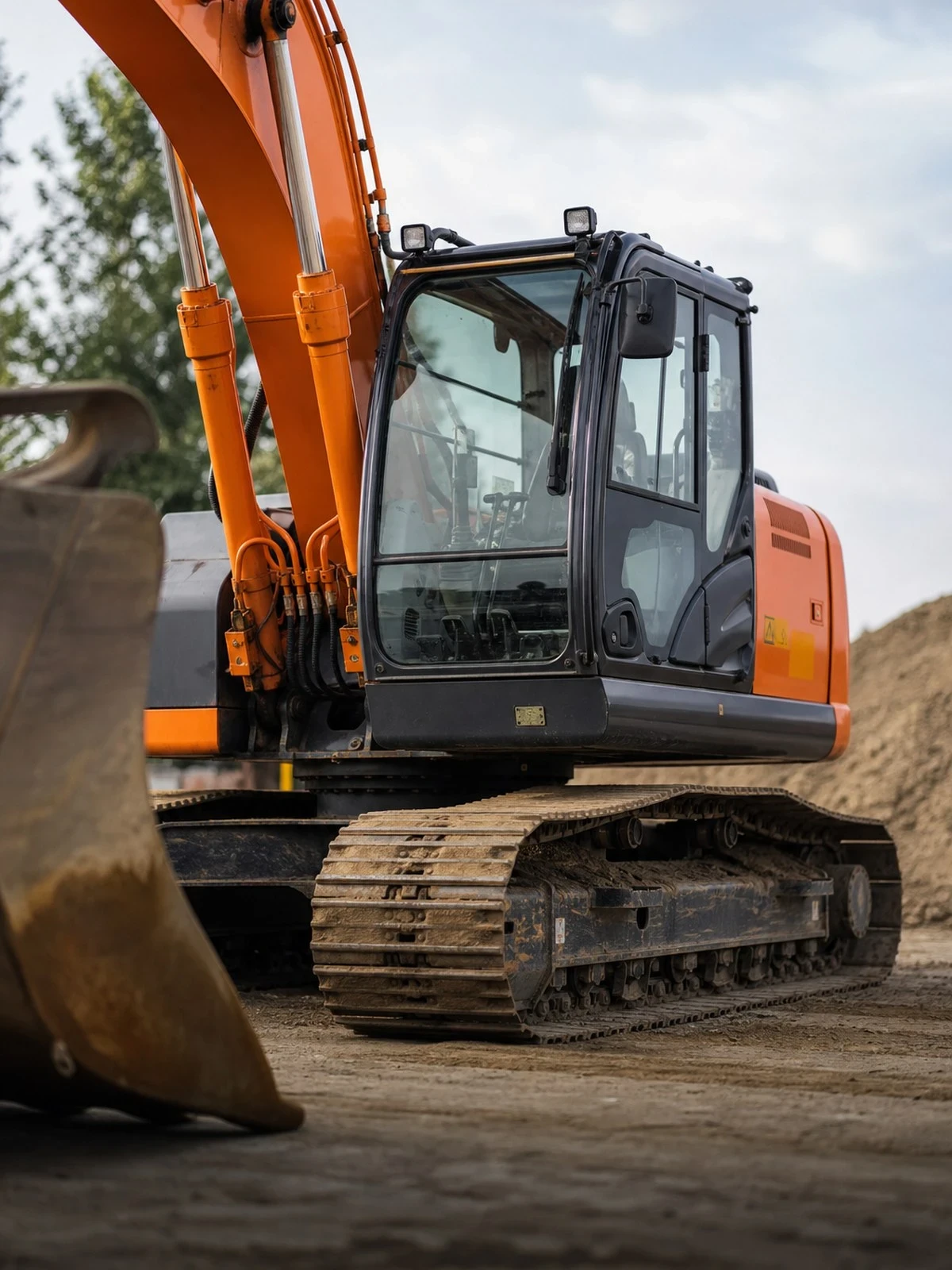
A loading shovel, telehandler or excavator moves under its own power and is therefore a motor vehicle: alongside the working risk, the traffic risk comes into play here as well.
This page in another language: Nederlands
Work out for yourself what it would cost.
Enter your details; you will receive a proposal within one working day.
A premium indication, not personal advice. Prefer to talk it through? Call 072 - 509 24 56.
Self-propelled plant — excavators, loading shovels, wheel loaders, telehandlers, dumpers and rollers: is a motor vehicle. Third-party liability cover is compulsory under Article 2 of the Dutch Motor Insurance Liability Act (WAM), and that obligation does not stop at the boundary of your own land: it applies on sites accessible to the public as well. On top of that third-party liability cover you choose third-party, fire and theft or comprehensive cover for the item itself.
Most damage, however, arises not in traffic but during the work: a boom that hits a facade, a bucket that takes a low wall with it, an excavation that undermines an adjoining foundation. That working risk has to be stated expressly in the policy, otherwise the motor insurer points to the liability insurance and the liability insurer points back.
We are not tied to Avéro Achmea and compare their conditions with those of other insurers. What differs most: the description of the working risk, the clause for damage to cables and pipes, and the requirements set for the operator. Plant without its own propulsion belongs on the non-self-propelled version.
We compare your plant and machinery insurance across dozens of insurers, explain where the real differences lie, and arrange the switch from start to finish — without you having to chase it yourself.
 Plant and machinery insurance
 Compare
 Get covered
The structure of the cover in three parts, with an overview per situation below.
Damage you cause to others with the machine.
Damage to the machine, the body and the attachments.
What you add separately.
What is covered
| Situation | Third-party liability for plant and machinery | Own-damage cover |
|---|---|---|
| Damage to a building or a parked car next to the site | Yes | No |
| Theft of the machine from the building site | No | Provided that |
| Fire and storm damage | No | Yes |
| Inherent defect in the hydraulics or the engine | No | Provided that |
| Damage to the item you are working on with the machine | No | No |
| Wear and deferred maintenance | No | No |
Mobile plant is a motor vehicle within the meaning of the WAM and needs third-party liability insurance on public roads; non-mobile plant does not. Damage to cables and pipes is generally only covered if the excavation notification has been made and the trial trenches have been dug. The item you work on with the machine falls under the care, custody and control exclusion.
This overview is general in nature and is not personal advice. What is actually covered, including exclusions, limits and the excess, is set out in the policy conditions and the insurance card (verzekeringskaart) of the insurer; you receive both before you take out cover. Taking out cover without advice? Then read what execution only means for you.
Insurers weigh these details differently. That is where your saving is.
We look at the terms as well as the premium, and stay your point of contact when there is a claim.
We are not tied to one insurer and compare on the basis of an objective analysis of several companies.
You call or email someone who knows your file. No menu options, no changing call centres.
We cancel your old policy and align the start date, so you are never a day without cover.
We report the claim and monitor how it is handled. In urgent cases you can reach us on the emergency line.
Customers rate our service on four aspects: personal service, service delivery, availability and the outcome. The reviews are collected and published by NH1816 and come from customers who have actually taken out a policy with Finass Advies B.V. or reported a claim.
Four points that make the difference between a policy that pays out and one that does not.
As soon as the machine travels on the public road, the insurance obligation under Article 2 of the Dutch Motor Insurance Liability Act (WAM)applies. That cover relates to damage caused as a motor vehicle. Damage that arises while the machine is used as a tool (digging, lifting, loading) falls under the working risk. If that is not stated separately in the policy, two insurers point at each other and you are left in between with the loss.
A struck gas pipe or fibre-optic cable often costs more in consequential loss than in repairs. Insurers link that cover to a prior excavation notification and to careful digging of trial trenches. Without a notification, or where the location data supplied is ignored, damage to underground infrastructure is not paid. Consequential loss such as business interruption suffered by third parties also carries its own, limited sub-limit.
Mistakes by an employee are for your account under Article 6:170 DCC, mistakes by a hired-in subcontractor under Article 6:171 of the Dutch Civil Code. Insurers therefore set requirements for the operator: the driving licence required for the road and demonstrable instruction or certification for lifting and hoisting work. If someone operates the machine without those papers, or under the influence, the damage is not covered.
Self-propelled plant overturns, sinks into a freshly excavated trench bed or is damaged during transport on a low-loader. Third-party, fire and theft covers fire, storm and theft; for overturning, sinking and your own fault you need the comprehensive version. Usually excluded are damage to the load being lifted or carried, damage caused by overloading the machine, and tyre or track damage on its own without further damage.
Downtime & hire Cover for losses during downtime and replacement hire.
Business & deductible The premium is usually deductible as a business expense.
This is what people ask us most.
Yes. A machine that moves under its own power is a motor vehicle and falls under the insurance obligation of Article 2 of the Dutch Motor Insurance Liability Act (WAM). That obligation applies not only on the public road but also on sites accessible to the public. If the machine also travels on the road, the registration requirements for the vehicle apply as well.
Only where you have made the prescribed excavation notification and used the location data received. If you do not, damage to underground infrastructure is rejected. Even with a correct notification there is often a separate limit for third parties' consequential loss, such as telecoms or power failure. We check that limit and the clause before you sign.
Damage that arises while the machine is used as a tool rather than as a vehicle: a boom against a facade, a load that swings against a roof edge, an excavation that causes an adjoining wall to subside. This damage falls outside ordinary motor cover. Have the working risk stated expressly, together with the work you actually carry out.
When the item does not move under its own power: generators, compressors, pumps, tower cranes and plant that is brought in on a trailer. No insurance obligation applies to those, and the policy revolves around the item and where it stands. See the non-self-propelled plant and machinery insurance through Avéro Achmea for that structure.
Every situation is different. For these situations we have a separate page.
Request a quote without obligation. We will look at which insurer best matches your activities and your risk.
Prefer to call? 072 - 509 24 56, weekdays 09:00–17:00.
Claim on the road? Emergency line 06 - 55 20 40 72.
Finass Verzekert is a trading name of Finass Advies B.V. We advise on and arrange non-life insurance on the basis of an objective analysis of several insurers, and receive commission for this from the insurer, which is included in the premium. You pay no separate advice fee. Before you take out cover, we establish your wishes and needs.
You will find our licence, KvK and Kifid details and our complaints procedure at the foot of every page.
This page was compiled by Finass Verzekert (LinkedIn). Last updated on .
The information on this page is general in nature and is not personal advice.
Maandag- Vrijdag: 09:00- 17:00
We use cookies and similar technologies to improve your experience on our website.