

Liability
- Damage to third parties
- Employers' liability
- Care, custody and control as an extension
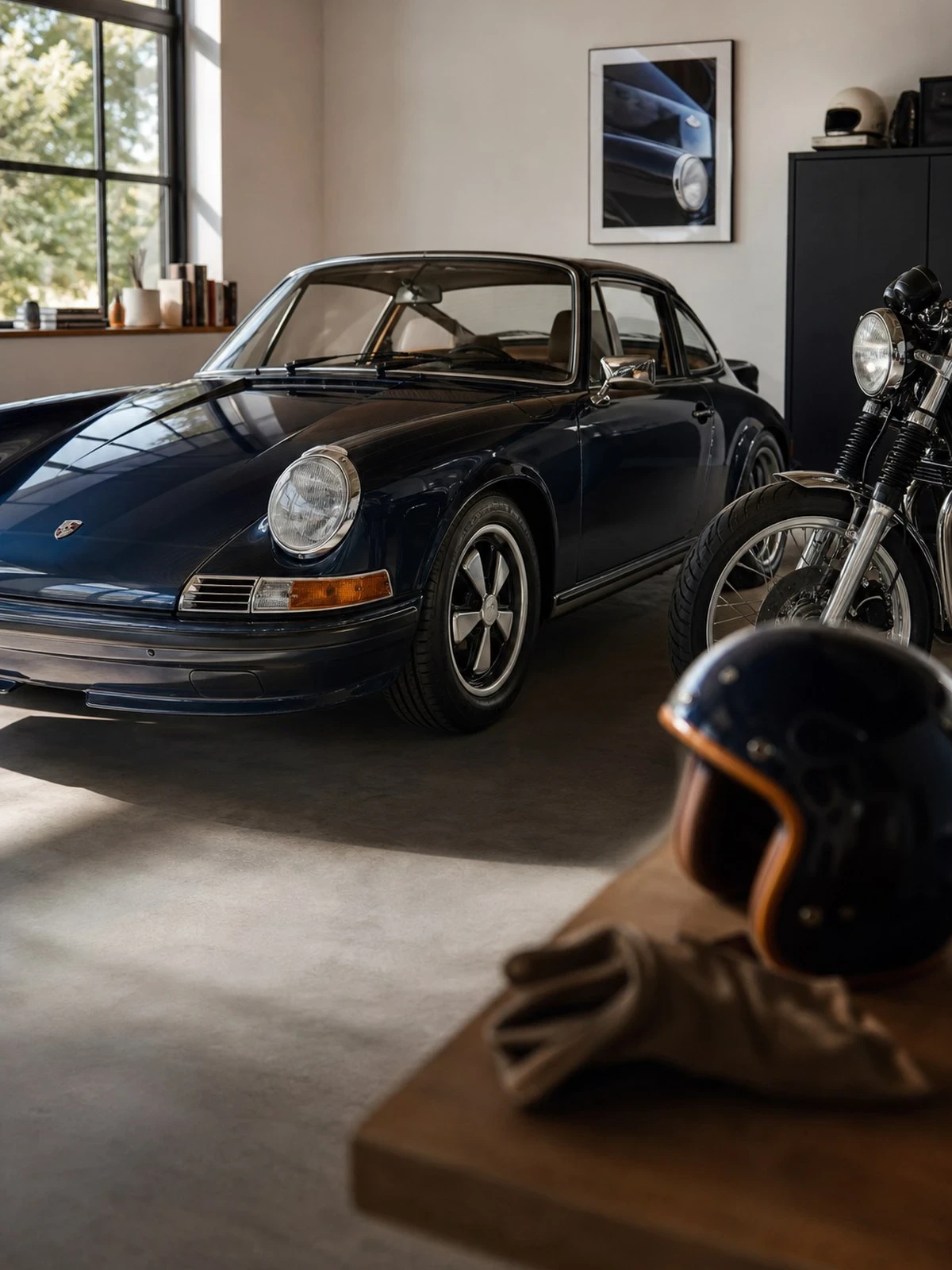
Detailing is handwork with a machine on the thinnest layer of a car, carried out on vehicles whose owners know exactly how that layer looked before the treatment.
This page in another language: Nederlands
Work out for yourself what it would cost.
Enter your details; you will receive a proposal within one working day.
A premium indication, not personal advice. Prefer to talk it through? Call 072 - 509 24 56.
What sets a detailing business apart from any other motor business is the nature of the error. You are not repairing something that is broken. You are improving something that was already good. Any deviation is therefore by definition caused by you and immediately visible: lacquer burnt through on a sharp edge, holograms in dark paint, polishing compound drawn into a rubber seal, a coating curing patchily.
On top of that, the vehicles are above-average in value. A classic with original paint, a sports car in a factory colour no longer available, a car with wrap film or PPF. Putting it right then means not spraying a panel but a paint specialist and colour matching, and sometimes a demonstrable loss in value because the originality has gone. Your care, custody and control cover must be set accordingly: not for an average car, but for the most expensive car that will come in this year.
The limit of every policy lies at your own work. Re-polishing, removing and reapplying the coating, refunding the invoice amount: those are warranty and repair obligations under your contract and they are never insured.
We compare your motor trade insurance across dozens of insurers, explain where the real differences lie, and arrange the switch from start to finish — without you having to chase it yourself.
 Motor trade insurance
 Compare
 Get covered
The structure of the cover in three parts, with an overview per situation below.
AVB for property damage and injury, BAV for professional errors.
Business contents, goods and lost turnover during downtime.
Sickness absence, accidents and the traffic risk.
What is covered
| Situation | AVB | BAV | Cyber |
|---|---|---|---|
| Injury to a visitor or customer | Yes | No | No |
| Damage to a client's property | Sometimes | No | No |
| Financial loss caused by an advisory or calculation error | No | Yes | No |
| Downtime after a ransomware attack | No | No | Yes |
| Data breach involving personal data | No | Sometimes | Yes |
| Damage to property in your care | No | No | No |
This overview is general in nature and is not personal advice. What is actually covered, including exclusions, limits and the excess, is set out in the policy conditions and the insurance card (verzekeringskaart) of the insurer; you receive both before you take out cover. Taking out cover without advice? Then read what execution only means for you.
Insurers weigh these details differently. That is where your saving is.
We look at the terms as well as the premium, and stay your point of contact when there is a claim.
We are not tied to one insurer and compare on the basis of an objective analysis of several companies.
You call or email someone who knows your file. No menu options, no changing call centres.
We cancel your old policy and align the start date, so you are never a day without cover.
We report the claim and monitor how it is handled. In urgent cases you can reach us on the emergency line.
Customers rate our service on four aspects: personal service, service delivery, availability and the outcome. The reviews are collected and published by NH1816 and come from customers who have actually taken out a policy with Finass Advies B.V. or reported a claim.
Four points that make the difference between a policy that pays out and one that does not.
On repaired or aged paintwork the lacquer is thin in places, and a rotary machine burns through before you see it. Measure each panel with a coating thickness gauge, note the readings and photograph existing damage on arrival. In a claim about burnt-through paint, that measurement is the difference between careless work and a demonstrably thin starting point that you warned the customer about in advance.
If you sell a ceramic coating with a warranty period, that promise is an obligation under your contract. If the coating does not adhere or discolours, then re-preparing and reapplying it is excluded: that is redoing your own work. A refund of the invoice amount or a credit note is not an insured loss either. Limit your warranty in writing to carrying the work out again, so that no further claim can arise.
Wheel cleaner acting on brake callipers or chrome, a tar remover attacking rubber seals, an acidic cleaner on anodised aluminium: where the deterioration arises gradual, most policies exclude it. Work to the product instructions, observe contact times and record for each treatment which product was used on which part. Without those records it cannot be established whether the damage was sudden or the result of prolonged action.
A treatment lasting several days means that vehicles which are not yours stand in your premises overnight. That is care, custody and control outside working hours, and separate security clausesapply to it: alarm class, keys kept in a certified safe, and sometimes a maximum total value that may be present at any one time. If you exceed that maximum during a busy period, the excess amount is uninsured in the event of fire or theft not covered.
This is what people ask us most.
The damage to the vehicle falls under the care, custody and control cover, provided you have taken it out and the limit is adequate. What is not covered is carrying out your own treatment again and crediting your invoice. On a car with original factory paint the customer may also claim diminution in value; discuss with your adviser in advance whether your policy includes that concept.
Not at the average, but at the maximum. If you occasionally treat a prestige car, the limit must be able to cope with that car, because that is exactly where the large claim arises. Look at the limit per event as well, where several vehicles are in your premises at once. See also insuring a prestige car for how those values are established.
Only if mobile working has been declared. Working on a customer's drive or in their garage brings extra risks: damage to the floor or to the building, and the use of third parties' water and electricity. That is a different risk description from a fixed workshop. State the proportion of mobile work in your application.
That is not damage but a dispute about the quality of your work, and it falls outside every liability cover. Insurers pay for damage, not for a disappointing result. Set out in writing beforehand what result can be expected given the condition of the paint as you found it, with photographs. That prevents most disputes before they become a claim.
Every situation is different. For these situations we have a separate page.
Request a quote without obligation. We will look at which insurer best matches your activities and your risk.
Prefer to call? 072 - 509 24 56, weekdays 09:00–17:00.
Claim on the road? Emergency line 06 - 55 20 40 72.
Finass Verzekert is a trading name of Finass Advies B.V. We advise on and arrange non-life insurance on the basis of an objective analysis of several insurers, and receive commission for this from the insurer, which is included in the premium. You pay no separate advice fee. Before you take out cover, we establish your wishes and needs.
You will find our licence, KvK and Kifid details and our complaints procedure at the foot of every page.
This page was compiled by Finass Verzekert (LinkedIn). Last updated on .
The information on this page is general in nature and is not personal advice.
Maandag- Vrijdag: 09:00- 17:00
We use cookies and similar technologies to improve your experience on our website.