

Third-party liability for plant and machinery
- Compulsory on public roads
- Also during work
- Cables and pipes separately
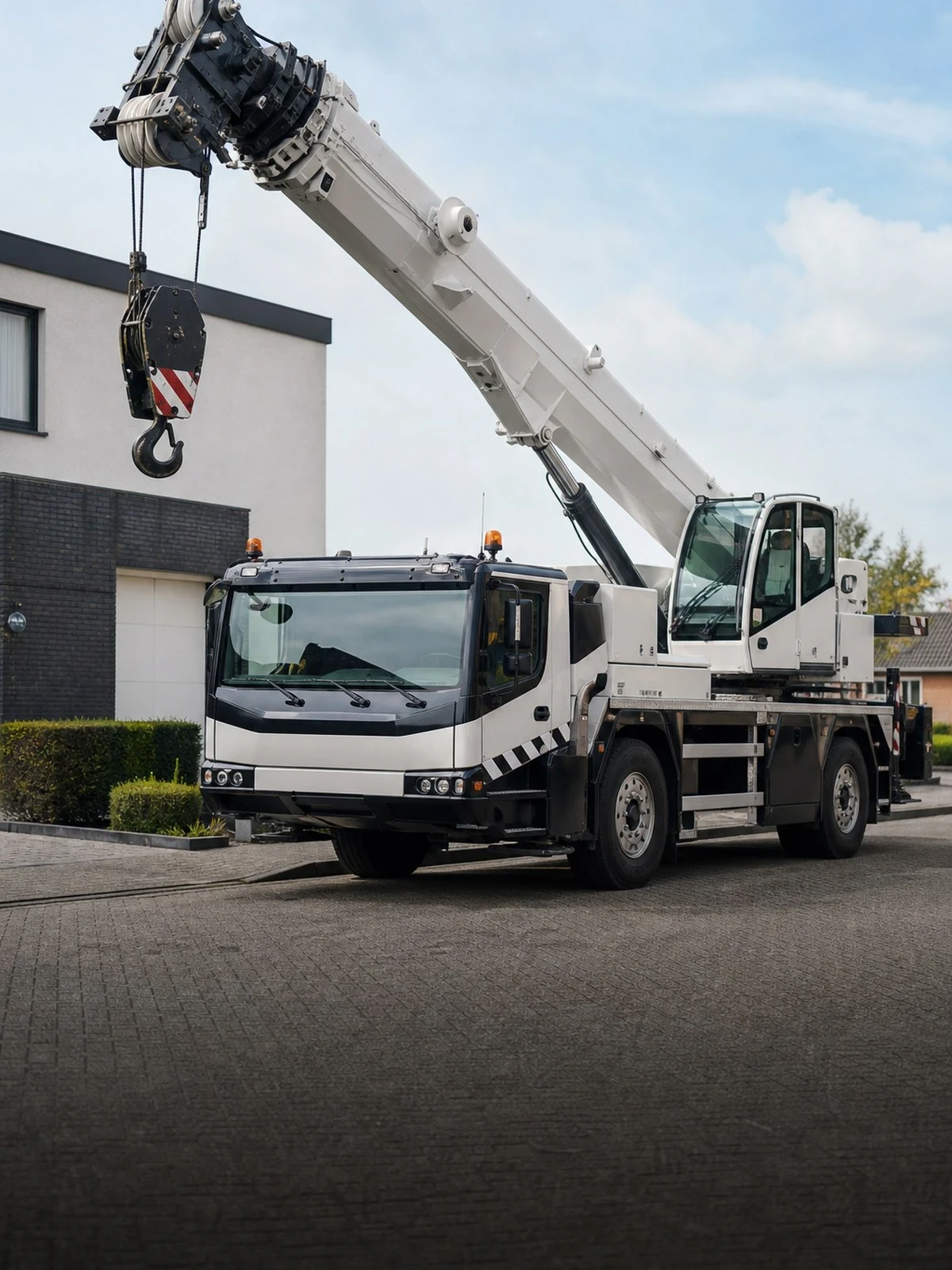
A mobile crane brings three regimes together in one machine: driving on the road, setting up on ground that has to hold, and lifting a load that is not yours.
This page in another language: Nederlands
Work out for yourself what it would cost.
Enter your details; you will receive a proposal within one working day.
A premium indication, not personal advice. Prefer to talk it through? Call 072 - 509 24 56.
In law, a mobile crane is a motor vehicle. For taking part in traffic, the compulsory insurance under Article 2 of the Dutch Motor Insurance Liability Act (WAM)applies, and that is precisely why public and employers' liability insurance excludes damage caused with or by a motor vehicle. The lifting therefore belongs on the machinery policy, in a separate working risk or lifting liability section. If that section is missing, after an incident you sit between two policies that point at each other.
The second peculiarity is the load itself. What hangs from the hook is in your in your care, and property in your care, custody and control is excluded as standard. A precast element, a transformer or part of an installation that is damaged during lifting is paid for by you, unless the care, custody and control extension is set to match the heaviest load you sling. Not the average load, because the average load rarely comes down badly.
That leaves the set-up position. If an outrigger pad sinks or a basement deck gives way under the crane, the own-damage to the crane is usually the smallest item. The lift plan records who assessed the ground and who gave the instructions. If that document is missing, liability falls back on whoever was actually directing. For plant that does not lift but hoists loads on forks, that division looks different: see insuring a telehandler.
We compare your plant and machinery insurance across dozens of insurers, explain where the real differences lie, and arrange the switch from start to finish — without you having to chase it yourself.
 Plant and machinery insurance
 Compare
 Get covered
The structure of the cover in three parts, with an overview per situation below.
Damage you cause to others with the machine.
Damage to the machine, the body and the attachments.
What you add separately.
What is covered
| Situation | Third-party liability for plant and machinery | Own-damage cover |
|---|---|---|
| Damage to a building or a parked car next to the site | Yes | No |
| Theft of the machine from the building site | No | Provided that |
| Fire and storm damage | No | Yes |
| Inherent defect in the hydraulics or the engine | No | Provided that |
| Damage to the item you are working on with the machine | No | No |
| Wear and deferred maintenance | No | No |
Mobile plant is a motor vehicle within the meaning of the WAM and needs third-party liability insurance on public roads; non-mobile plant does not. Damage to cables and pipes is generally only covered if the excavation notification has been made and the trial trenches have been dug. The item you work on with the machine falls under the care, custody and control exclusion.
This overview is general in nature and is not personal advice. What is actually covered, including exclusions, limits and the excess, is set out in the policy conditions and the insurance card (verzekeringskaart) of the insurer; you receive both before you take out cover. Taking out cover without advice? Then read what execution only means for you.
Insurers weigh these details differently. That is where your saving is.
We look at the terms as well as the premium, and stay your point of contact when there is a claim.
We are not tied to one insurer and compare on the basis of an objective analysis of several companies.
You call or email someone who knows your file. No menu options, no changing call centres.
We cancel your old policy and align the start date, so you are never a day without cover.
We report the claim and monitor how it is handled. In urgent cases you can reach us on the emergency line.
Customers rate our service on four aspects: personal service, service delivery, availability and the outcome. The reviews are collected and published by NH1816 and come from customers who have actually taken out a policy with Finass Advies B.V. or reported a claim.
Four points that make the difference between a policy that pays out and one that does not.
Own-damage cover protects the crane, third-party liability covers the traffic risk, but neither covers the load on the hook. A separate lifting liability or working risk section exists for that. When applying, ask expressly about the sum insured for it and set it against the heaviest load in your order book. If you regularly lift installation parts with long delivery times, the real figure is not the load but the downtime that follows.
An overturn rarely starts with the crane and almost always with the ground beneath it: a sewer, a crawl space, a recently backfilled trench or a parking deck that cannot take the outrigger pressure. Record who assessed the ground and which track mats or outrigger pads were used. If you damage the client's underground infrastructure, that is damage to property that was in your care as soon as you stood on it.
On the road, Article 2 of the Dutch Motor Insurance Liability Act (WAM) and the cover attached to the registration number apply. Once the crane is on its outriggers, it is no longer taking part in traffic and the working risk cover applies. Counterweights brought in separately fall into a third category again: they travel as cargo on another vehicle. Check that the escort transport, the ballast lorry and the assembly on site all three fall within your cover.
Overloading in which the load moment limiter has been bypassed is covered nowhere. That counts as wilful recklessness within the meaning of Article 7:952 of the Dutch Civil Code. Wear of the hoist rope, slings and shackles falls under normal replacement, not under own-damage cover. Lifting without a valid inspection certificate, or with an operator whose competence cannot be demonstrated, affects the acceptance conditions. And damage because the load was slung incorrectly by a third party is an argument about who was responsible, not about cover.
Without lifting liability cover you pay for the damaged load yourself, even where the fault is yours.
Tracks, tyres, blades, teeth and cutting edges are wear parts and are not insured anywhere; only sudden damage is covered. Deferred maintenance is also a ground for exclusion. A demonstrable maintenance regime with a logbook is therefore not only good management but also strengthens your position in a claim.
This is what people ask us most.
Not automatically. The load is property in your care and therefore falls under the care, custody and control exclusion. Only a lifting liability or working risk section brings that damage within the cover, with its own sum insured. Choose that amount on the basis of the heaviest load you sling, not on the basis of what you usually lift.
No. An AVB excludes damage caused with or by a motor vehicle, and a mobile crane is a motor vehicle. That is not a detail but the reason crane firms need separate working risk cover on the machinery policy. If you work with hired plant, check whether that cover is present there and whether your own actions fall within it.
Damage to the crane itself falls under own-damage cover. Damage to the site, to pipes and cables beneath the set-up position and to surrounding buildings falls under liability, with Article 6:162 of the Dutch Civil Code as the basis. If the set-up position turns out to have been chosen without proper justification, the discussion shifts to culpability and the insurer may reduce the settlement.
For complex or heavy lifts, yes, and insurers regularly impose it as an acceptance condition. The lift plan divides the tasks between operator, slinger and site supervisor. If it is missing, there is no document after an incident to show who was responsible for what, and liability ends up with whoever actually gave the instructions.
Every situation is different. For these situations we have a separate page.
Request a quote without obligation. We will look at which insurer best matches your activities and your risk.
Prefer to call? 072 - 509 24 56, weekdays 09:00–17:00.
Claim on the road? Emergency line 06 - 55 20 40 72.
Finass Verzekert is a trading name of Finass Advies B.V. We advise on and arrange non-life insurance on the basis of an objective analysis of several insurers, and receive commission for this from the insurer, which is included in the premium. You pay no separate advice fee. Before you take out cover, we establish your wishes and needs.
You will find our licence, KvK and Kifid details and our complaints procedure at the foot of every page.
This page was compiled by Finass Verzekert (LinkedIn). Last updated on .
The information on this page is general in nature and is not personal advice.
Maandag- Vrijdag: 09:00- 17:00
We use cookies and similar technologies to improve your experience on our website.