

Liability
- Damage to third parties
- Employers' liability
- Care, custody and control as an extension
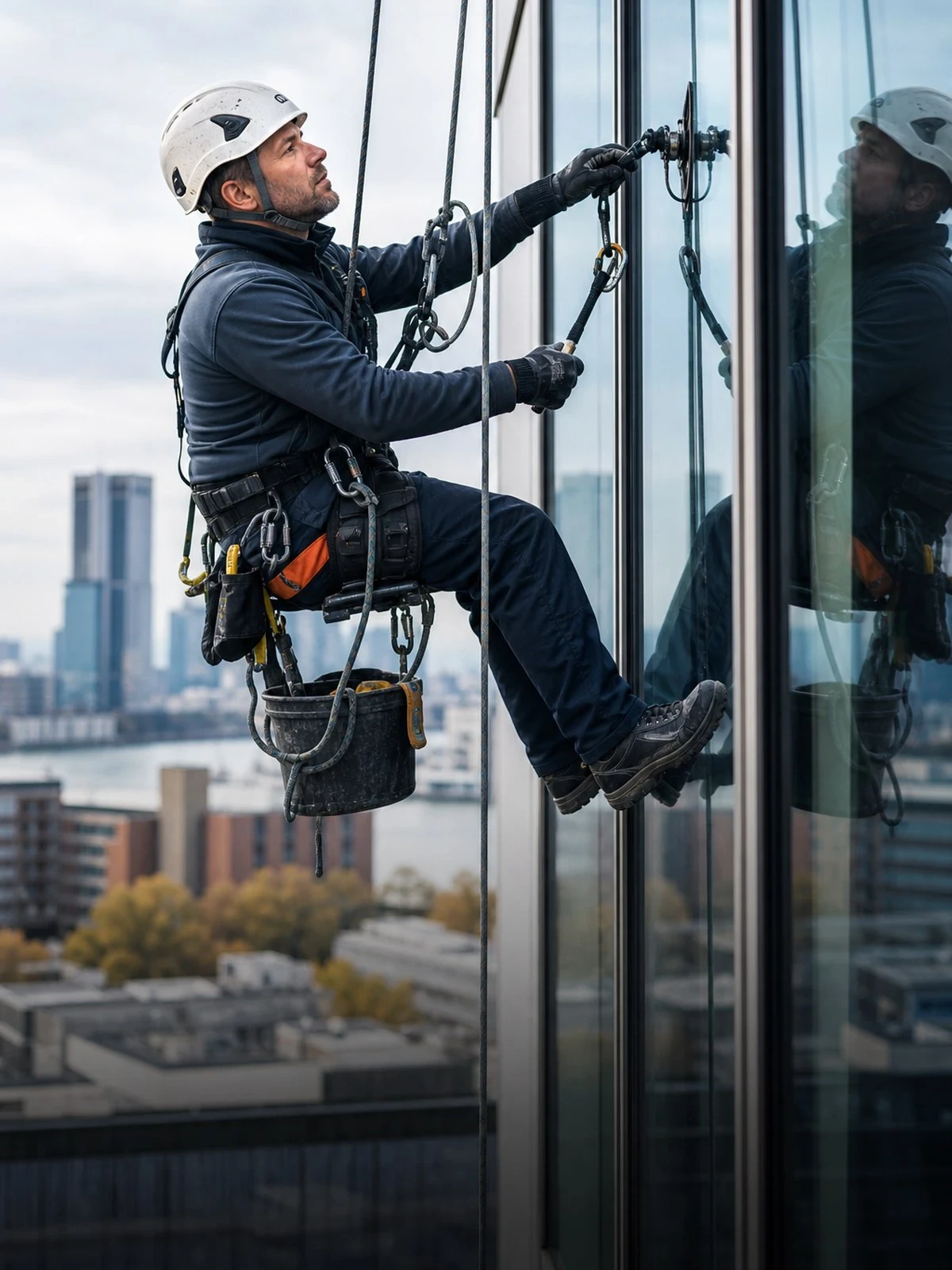
In rope access you hang from a system you built yourself, and it is precisely your own injuries that a liability policy never covers.
This page in another language: Nederlands · Deutsch
Work out for yourself what it would cost.
Enter your details; you will receive a proposal within one working day.
A premium indication, not personal advice. Prefer to talk it through? Call 072 - 509 24 56.
Working on ropes moves the centre of gravity of liability towards people rather than property. The damage you can cause to a facade is limited. The loss that arises if someone falls or if something comes down from height is not. So the relevant provision is Article 7:658 of the Dutch Civil Code on the duty of care, not the property damage section.
Rope access always works with two lines and rarely alone. As soon as you take someone with you, hire them in or let them work with you, you are held liable for that person as a principal or as a de facto employer. Article 7:658(4) of the Dutch Civil Code expressly extends that duty of care to people who are not employed by you. For self-employed professionals that is the most underestimated point.
Your own injuries fall precisely outside it. Liability insurance pays for what others suffer through you, not for your own loss of income or permanent injury. Personal accident cover and disability insurance (AOV) exist for that. We deliberately set those two alongside the liability cover when taking stock, because otherwise the picture is skewed.
We compare your personal liability insurance (AVP) across dozens of insurers, explain where the real differences lie, and arrange the switch from start to finish — without you having to chase it yourself.
 Personal liability insurance (AVP)
 Compare
 Get covered
The structure of the cover in three parts, with an overview per situation below.
AVB for property damage and injury, BAV for professional errors.
Business contents, goods and lost turnover during downtime.
Sickness absence, accidents and the traffic risk.
What is covered
| Situation | AVB | BAV | Cyber |
|---|---|---|---|
| Injury to a visitor or customer | Yes | No | No |
| Damage to a client's property | Sometimes | No | No |
| Financial loss caused by an advisory or calculation error | No | Yes | No |
| Downtime after a ransomware attack | No | No | Yes |
| Data breach involving personal data | No | Sometimes | Yes |
| Damage to property in your care | No | No | No |
This overview is general in nature and is not personal advice. What is actually covered, including exclusions, limits and the excess, is set out in the policy conditions and the insurance card (verzekeringskaart) of the insurer; you receive both before you take out cover. Taking out cover without advice? Then read what execution only means for you.
Insurers weigh these details differently. That is where your saving is.
We look at the terms as well as the premium, and stay your point of contact when there is a claim.
We are not tied to one insurer and compare on the basis of an objective analysis of several companies.
You call or email someone who knows your file. No menu options, no changing call centres.
We cancel your old policy and align the start date, so you are never a day without cover.
We report the claim and monitor how it is handled. In urgent cases you can reach us on the emergency line.
Customers rate our service on four aspects: personal service, service delivery, availability and the outcome. The reviews are collected and published by NH1816 and come from customers who have actually taken out a policy with Finass Advies B.V. or reported a claim.
Four points that make the difference between a policy that pays out and one that does not.
The duty of care of Article 7:658 of the Dutch Civil Code also applies to hired-in workers and self-employed professionals working under your direction. The burden of proof there lies largely with you: you have to show that you met that duty of care. After a fall that means demonstrable instruction, valid certificates, an inspected system and a worked-out rescue plan. Without those records a defence is virtually impossible.
If you work as a sole trader without staff, the chance that you become the casualty yourself is greater than the chance that you injure someone else. That loss falls outside every liability policy, because there is no injured third party. Arrange it separately through personal accident or disability cover. If you work under the direction of a client, Article 7:611 of the Dutch Civil Code can require that client to hold proper insurance.
You attach your system to your client's structure. If in doing so you damage the roof edge, the facade cladding or an existing anchor, that is damage to property you are working on, and that is usually excluded without care, custody and control cover. Also check that the anchor points in place have a valid inspection: if you use a condemned point, the blame shifts to you.
Above a street, a platform or an operating plant, the zone below you is the real risk. Tool tethering and a cordon that is demonstrably set up and manned determine whether injury to a passer-by is attributed to you under Article 6:162 of the Dutch Civil Code. Photograph the cordon at the start of each working day. That takes a minute and afterwards it is your only evidence.
This is what people ask us most.
Not on your liability insurance. That only pays for other people's losses. Your own injuries and loss of income belong with a personal accident policy and disability insurance (AOV). If you were working under the direction of a client, that client may be liable on the basis of their duty of care, but that means proceedings you have to bring yourself and they take time.
Yes. Article 7:658(4) of the Dutch Civil Code extends the duty of care to people who carry out work for you outside an employment relationship. For rope access that means: you are responsible for the system, the instruction and the rescue plan for your second person. So always state on your application that you work with others, even if that is only a few days a year.
Only with a care, custody and control extension. The part of the structure you work on or attach your lines to counts as property in your care and is excluded in the basic cover. Damage to other parts of the building or to third-party property is covered by the ordinary property damage cover. The distinction is a fine one but it decides the outcome of the case.
In this work certification is almost always a condition of acceptance. An expired certificate can lead to reliance on the policy conditions or, if it was stated incorrectly on the application, on Article 7:928 of the Dutch Civil Code on the duty of disclosure. So put your recertification in your diary and report any changes in your qualifications.
Every situation is different. For these situations we have a separate page.
Request a quote without obligation. We will look at which insurer best matches your activities and your risk.
Prefer to call? 072 - 509 24 56, weekdays 09:00–17:00.
Claim on the road? Emergency line 06 - 55 20 40 72.
Finass Verzekert is a trading name of Finass Advies B.V. We advise on and arrange non-life insurance on the basis of an objective analysis of several insurers, and receive commission for this from the insurer, which is included in the premium. You pay no separate advice fee. Before you take out cover, we establish your wishes and needs.
You will find our licence, KvK and Kifid details and our complaints procedure at the foot of every page.
This page was compiled by Finass Verzekert (LinkedIn). Last updated on .
The information on this page is general in nature and is not personal advice.
Maandag- Vrijdag: 09:00- 17:00
We use cookies and similar technologies to improve your experience on our website.