

Safekeeping and security
- Safe clause outside the time worn
- Requirements for an alarm and locks and fittings
- A valuation with a description of the stones
- Reporting the theft to the police
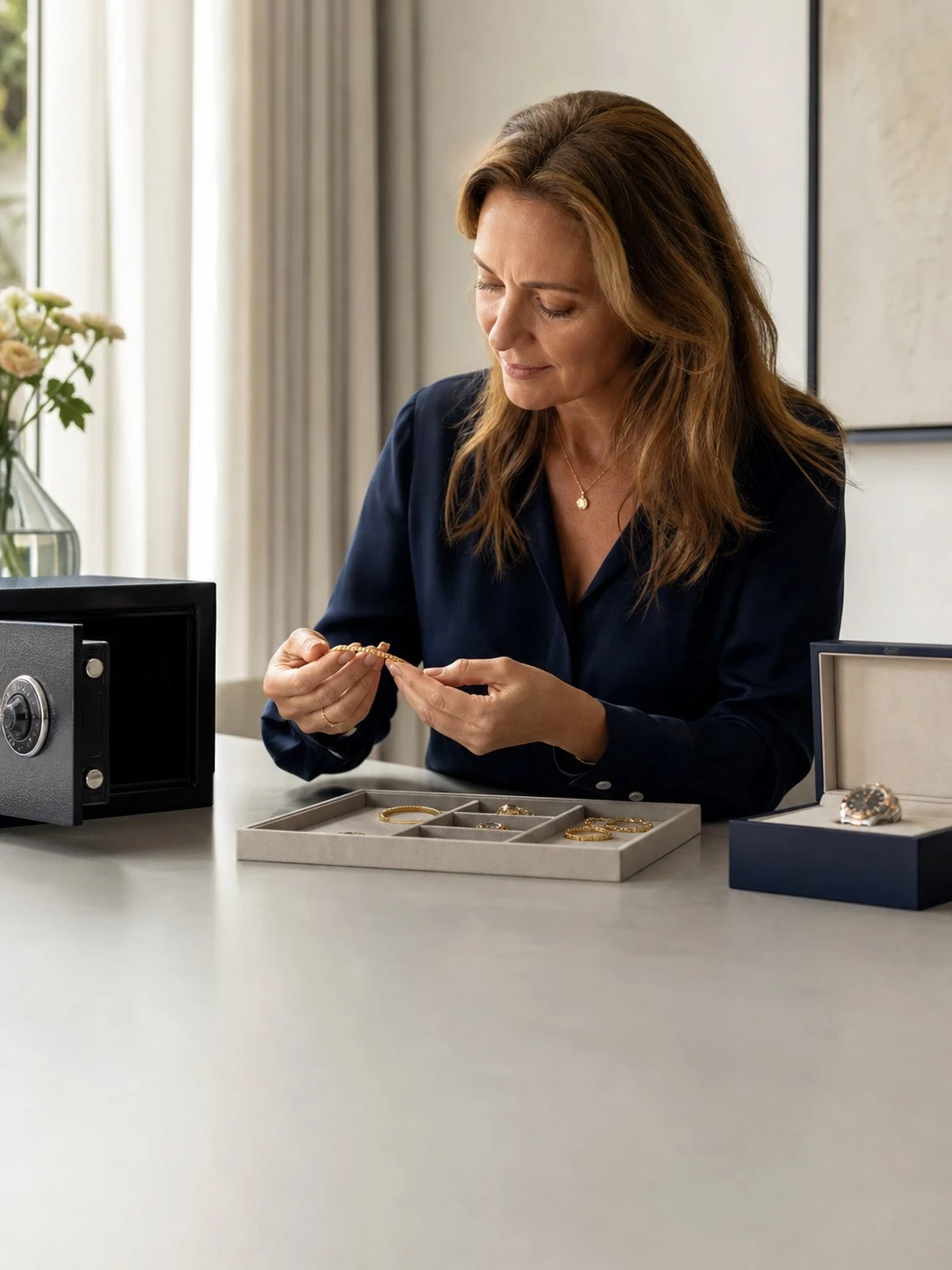
Jewellery, art and watches each call for a different approach, but they have one thing in common: home contents insurance covers them only up to a limit. Below you can read how to insure them fully.
This page in another language: Nederlands · Deutsch
Work out for yourself what it would cost.
Enter your details; you will receive a proposal within one working day.
A premium indication, not personal advice. Prefer to talk it through? Call 072 - 509 24 56.
Home contents insurance works with averages. That is why there is a payment limit for jewellery and watches in the conditions and separate sub-limits apply to art and collections. Above those amounts nothing extra is paid. The cover also applies in principle only inside the home and only for named causes, such as fire, storm and burglary with signs of forced entry. A ring you are wearing or a painting that goes to an exhibition falls outside it.
On a valuables insurance items are named individually, each with its own sum insured following from a valuation report. The cover is usually comprehensive and applies in the home, away from the home and abroad. What is then insured is not only theft and fire, but also drops, knocks and breakage. For art there are additional conditions, often referred to as fine art, with cover during transport, loans and exhibition.
The three categories make different demands. With jewellery it is about safekeeping and security, with a safe clause when the pieces are not being worn. With watches it is about the current market value and wearing them away from the home. With art it is about climate, hanging and transport. So read not only what is covered, but above all which clauses appear on your policy. See also where the home contents policy stops.
We compare your valuables insurance across dozens of insurers, explain where the real differences lie, and arrange the switch from start to finish — without you having to chase it yourself.
 Valuables insurance
 Compare
 Get covered
The type of policy is comparable, but the requirements and the exclusions differ per type of item.
The payment depends on where the jewellery was when the loss arose.
The market value differs from the purchase price, and the watch is worn away from the home.
The risk often lies not in theft but in moving works and in the conditions they are kept in.
What is covered
| Situation | Valuables | Fine art |
|---|---|---|
| Theft from the home after a break-in | Yes | Yes |
| Damage during transport to an exhibition or auction | Provided that | Yes |
| The fall in value that remains after a successful restoration | No | Provided that |
| Disappearance with no identifiable cause | Provided that | Provided that |
| Gradual effects of light, damp or temperature | No | No |
| Damage during repair, cleaning or restoration | No | No |
Which limits, clauses and excess apply to you is set out in the policy conditions and the insurance card (verzekeringskaart) that you receive before you take out cover.
Insurers weigh these details differently. That is where your saving is.
We look at the terms as well as the premium, and stay your point of contact when there is a claim.
We are not tied to one insurer and compare on the basis of an objective analysis of several companies.
You call or email someone who knows your file. No menu options, no changing call centres.
We cancel your old policy and align the start date, so you are never a day without cover.
We report the claim and monitor how it is handled. In urgent cases you can reach us on the emergency line.
Customers rate our service on four aspects: personal service, service delivery, availability and the outcome. The reviews are collected and published by NH1816 and come from customers who have actually taken out a policy with Finass Advies B.V. or reported a claim.
Four points that determine whether your jewellery, watches and art are genuinely covered.
Jewellery and watches fall under one combined maximum per event. In a single burglary in which the jewellery box disappears, you receive that amount once. For art a separate sub-limit often applies, and sometimes cover only for fire and burglary. Add up what you actually have in the house and compare it with your conditions. Only named items on a valuables policy fall outside those limits.
Above a certain value, insurers ask for a valuation report from a a recognised valuer; with art, a valuer specialising in the discipline or period concerned, with jewellery a gemmologist or certified jeweller. A valuation that meets Article 7:960 of the Dutch Civil Code binds the parties for an agreed period: within that period the insurer cannot argue that the item was worth less. If the report expires, the market value applies again when a loss occurs. So have reports renewed in good time and do not keep them with the items themselves.
Usually excluded are wear, scratches and discolouration, and with art the gradual effects of light, damp, temperature and vermin. Damage arising during repair, cleaning, polishing or restoration by a third party also falls outside, as does the the diminution in value that after a successful repair that remains; only special fine art conditions sometimes have an arrangement for that. Inherent defect is excluded, and on some policies so is disappearance without an identifiable cause, and theft from a motor vehicle almost always. Intent and recklessness are excluded under Article 7:952 of the Dutch Civil Code.
The policy sets out concrete requirements: an anchored safe of a recognised grade, a working alarm installation, or prior consent for the loan and transport of art. Those requirements are a condition of cover, not advice. If your situation changes, for example through a house move, building work or a long absence, the duty of disclosure in Article 7:928 of the Dutch Civil Code; a breach can reduce the payout or cause it to lapse (Article 7:930 of the Dutch Civil Code). You report a claim as soon as reasonably possible (Article 7:941 of the Dutch Civil Code), and after a theft with a police report.
This is what people ask us most.
Yes, that is usual. The items are entered piece by piece or by group, each with its own sum insured. Different clauses do apply per category: a safe clause for jewellery, requirements for hanging and transport for art. With a large or fragile art collection, insurers sometimes opt for separate fine art conditions alongside the valuables policy.
Not automatically. On an ordinary valuables policy transport is often limited or covered only after notification in advance. Fine art conditions usually cover the whole journey, including packing and unpacking, transport and the period with the borrower. Always report a move in advance and have it set out who bears the risk during which part of the journey.
That is called unexplained disappearance. Some policies cover it, others exclude it expressly or require an event that can be shown. This is one of the biggest differences between providers and, with small pieces of jewellery in particular, a common cause of loss. Check this point in the conditions before you sign, because afterwards there is no room left.
Insurers apply a period of validity to valuation reports. Once it passes, the binding effect falls away and the market value is established when a loss occurs. With gold, gemstones, sought-after watches and work by living artists the market value can also move quickly. Put the expiry date of each report in your diary and have a new valuation carried out before the period runs out.
Purchase invoices, certificates, valuation reports, documentation of provenance for art and photographs of each item with serial numbers and distinguishing features. Keep this file somewhere other than the items themselves, for example digitally. After a fire or theft it is usually the only proof of ownership and value, and without that proof settlement becomes an argument.
Every situation is different. For these situations we have a separate page.
Request a quote without obligation. We will check the valuations, the clauses and the territory.
Prefer to call? 072 - 509 24 56, weekdays 09:00–17:00.
Claim on the road? Emergency line 06 - 55 20 40 72.
Finass Verzekert is a trading name of Finass Advies B.V. We advise on and arrange non-life insurance on the basis of an objective analysis of several insurers, and receive commission for this from the insurer, which is included in the premium. You pay no separate advice fee. Before you take out cover, we establish your wishes and needs.
You will find our licence, KvK and Kifid details and our complaints procedure at the foot of every page.
This page was compiled by Finass Verzekert (LinkedIn). Last updated on .
The information on this page is general in nature and is not personal advice.
Maandag- Vrijdag: 09:00- 17:00
We use cookies and similar technologies to improve your experience on our website.